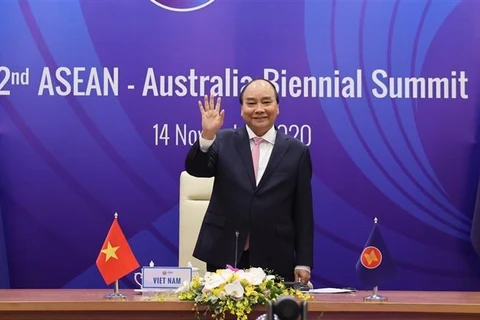
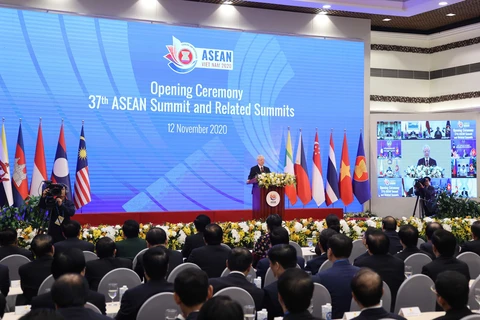
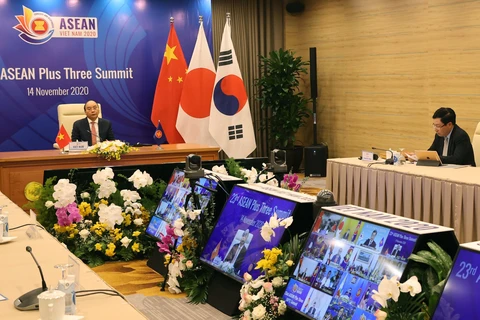
Prime Minister Nguyen Xuan Phuc, Chairman of ASEAN 2020, attends the 15th East Asia Summit (Photo: VNA)
 Hanoi, (VNA) – The 15th East Asia Summit (EAS) took place virtually on November 14, during which leaders exchanged views on regional and international issues of shared concern, including the COVID-19 pandemic and economic recovery.
Vietnam’s Prime Minister Nguyen Xuan Phuc said the EAS has been growing robustly, serving as a forum for strategic dialogue and cooperation in matters regarding peace, security and prosperity in the region.
The shared interest and need for cooperation have brought together 18 dynamic countries in the region, he said, adding that the EAS has served as a platform for the countries to work together in response to the threats to security, stability and development in the region.
Pointing to a range of challenges, PM Phuc highlighted the importance of maintaining an environment of peace and stability.
As the Chair of ASEAN and the EAS this year, Vietnam is committed to joining other EAS countries in taking stronger actions to effectively respond to emerging challenges and ensure stability and sustainability in the region, he pledged.
In his remarks, Secretary General of the United Nations António Guterres said East and Southeast Asia have set a strong example in dealing with COVID-19.
He called on the global community to tackle the present challenges with compassion and solidarity, to recover stronger and stay on track to achieve the Sustainable Development Goals.
The United Nations, led by the World Health Organisation, has been working to coordinate global efforts to develop and scale up the production of effective vaccines and therapeutics, he said.
“These must be available and affordable for everyone, everywhere,” he stressed. “Nobody is safe until we are all safe.”
It is essential to invest in people, including through social protection, universal health care and quality education, according to the UN Secretary General.
The response to the COVID-19 crisis must be aligned with the Paris Agreement and the Sustainable Development Goals, he said, suggesting the countries count on the support of the United Nations system.
“Together, we can use the response to COVID-19 to build a world with less inequality, more inclusive and more sustainable,” he affirmed.
Vietnam’s Prime Minister Nguyen Xuan Phuc said the EAS has been growing robustly, serving as a forum for strategic dialogue and cooperation in matters regarding peace, security and prosperity in the region.
The shared interest and need for cooperation have brought together 18 dynamic countries in the region, he said, adding that the EAS has served as a platform for the countries to work together in response to the threats to security, stability and development in the region.
Pointing to a range of challenges, PM Phuc highlighted the importance of maintaining an environment of peace and stability.
As the Chair of ASEAN and the EAS this year, Vietnam is committed to joining other EAS countries in taking stronger actions to effectively respond to emerging challenges and ensure stability and sustainability in the region, he pledged.
In his remarks, Secretary General of the United Nations António Guterres said East and Southeast Asia have set a strong example in dealing with COVID-19.
He called on the global community to tackle the present challenges with compassion and solidarity, to recover stronger and stay on track to achieve the Sustainable Development Goals.
The United Nations, led by the World Health Organisation, has been working to coordinate global efforts to develop and scale up the production of effective vaccines and therapeutics, he said.
“These must be available and affordable for everyone, everywhere,” he stressed. “Nobody is safe until we are all safe.”
It is essential to invest in people, including through social protection, universal health care and quality education, according to the UN Secretary General.
The response to the COVID-19 crisis must be aligned with the Paris Agreement and the Sustainable Development Goals, he said, suggesting the countries count on the support of the United Nations system.
“Together, we can use the response to COVID-19 to build a world with less inequality, more inclusive and more sustainable,” he affirmed.
World Bank Group President David Malpass said the impact of the pandemic and economic shutdown is the hardest on the poorest countries and the poorest people within each country, adding to inequality.
The pandemic remains an enormous obstacle to development, and a successful COVID-19 vaccination programme will be key to recovery.
The WB has approved an envelope of 12 billion USD for developing countries to finance the purchase and distribution of COVID-19 vaccines, tests, and treatments for their citizens.
The bank has worked hard with countries to provide technical advice on vaccine procurement and effective distribution.
According to the WB Group President, the debt burden is another major obstacle to development, and the bank is working on effective approaches for debt reduction and debt resolution.
In the current crisis, East Asia is well positioned to be the first region to recover from it. However, countries will need to prepare for a different economy post COVID by allowing capital, labour, skills and innovation to move into new businesses and sectors.
The bank is also working with countries to strengthen their domestic capital markets. For example, Indonesia and Vietnam are part of its joint capital market program (JCAP), where it supports governments in areas of pension reforms, strengthening capital market regulations and introducing new capital market products.
The World Bank Group is working hard to do as much as it can to help respond to the crisis and strengthen the recovery, he said./.
The pandemic remains an enormous obstacle to development, and a successful COVID-19 vaccination programme will be key to recovery.
The WB has approved an envelope of 12 billion USD for developing countries to finance the purchase and distribution of COVID-19 vaccines, tests, and treatments for their citizens.
The bank has worked hard with countries to provide technical advice on vaccine procurement and effective distribution.
According to the WB Group President, the debt burden is another major obstacle to development, and the bank is working on effective approaches for debt reduction and debt resolution.
In the current crisis, East Asia is well positioned to be the first region to recover from it. However, countries will need to prepare for a different economy post COVID by allowing capital, labour, skills and innovation to move into new businesses and sectors.
The bank is also working with countries to strengthen their domestic capital markets. For example, Indonesia and Vietnam are part of its joint capital market program (JCAP), where it supports governments in areas of pension reforms, strengthening capital market regulations and introducing new capital market products.
The World Bank Group is working hard to do as much as it can to help respond to the crisis and strengthen the recovery, he said./.
VNA