An Giang province’s rice output hits over 4 mln tonnes

Rice production in the Mekong Delta province of An Giang recorded over 4 million tonnes in 2014, up 17,000 tonnes from 2013 while the cultivation areas declined by 16,254 hectares to 625,086.
Rice production in the Mekong Delta province of An Giang recorded over 4million tonnes in 2014, up 17,000 tonnes from 2013 while thecultivation areas declined by 16,254 hectares to 625,086.

According to Do Vu Hung, Director of the provincial Department ofAgriculture and Rural Development, the rise stemmed from the increasedapplication of scientific and technological advances though the provinceis implementing a reform that decreased the rice cultivation acreagefor the farming of other crops.

He stressed that advanced techniques helps improve the quality of the grain which bring farmers higher profits.

The province has so far developed large-scale fields covering a totalarea of 34,200 hectares, a year-on year increase of 200 hectares.

An Giang now ranks second nationwide in paddy rice production. Itsrice has made inroads in many countries around the globe and each yearbrings the province lucrative earnings. Last year, the staple earned 203million USD.-VNA


See more

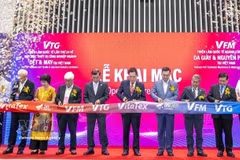
Representatives of the organising committee at the opening ceremony of the fair (Photo: VNA)

Vietnam-Cambodia trade expo promotes bilateral economic cooperation

The Vietnam-Cambodia Business Networking and Product Promotion Exposition has become a key trade promotion event, creating business and investment opportunities while strengthening mutual understanding and trust between the two countries’ armies, people and enterprises.

Vietjet Air’s Airbus A330 taxis at Vaclav Havel Airport in Prague, the Czech Republic. (Photo: VNA)

Vietnam’s airlines expand international networks

The Civil Aviation Authority of Vietnam forecasts that the country’s aviation market will handle 94 million passengers and more than 1.6 million tonnes of cargo in 2026, up 13% and 9.3%, respectively, from 2025.

A representative of Sumika Electronic Materials Vietnam (VSIP Bac Ninh Industrial Park, Tu Son Ward) briefs the delegation from Customs Sub-department Region V on the company's operations. (Photo: báo bắc ninh)

Bac Ninh customs facilitates clearance to boost exports

Pham Chi Thanh, head of Customs Sub-Department Region V, said the unit is focusing resources on developing a digital customs model and streamlining professional procedures to shorten clearance times and reduce costs for businesses while maintaining effective state management.

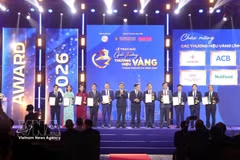
At the sixth Golden Brand Awards 2026 ceremony (Photo: VNA)

Ho Chi Minh City honours top 50 brands for 2026

The awards aim to recognise brands that can lead their industries, drive innovation and create a ripple effect across the business community, lifting the city’s standing in a new growth stage.

Luxury apartment projects in downtown Ho Chi Minh City (Photo: VNA)

Ho Chi Minh City's housing market sees price stabilisation, sharper buyer segmentation

According to Avison Young Vietnam, improved planning and infrastructure development have helped ease market uncertainty and prevented a complete freeze. More than 25,000 apartments are expected to enter the market in multiple launches between 2027 and 2030, with many projects scheduled to benefit from infrastructure improvements around 2030.

Vietnamese Deputy Minister of Industry and Trade Phan Thi Thang speaks at the forum (Photo: VNA)

Vietnam, Georgia look to more business opportunities

For Vietnamese firms, Georgia can serve as a gateway to broader regional markets, given its strategic location connecting the South Caucasus, Central Asia and China with European markets via the Black Sea.

Chairman of the Vietnamese Business Association in Laos (AVILA) Duong Dinh Bang (Photo: VNA)

PM’s visit injects fresh momentum into Vietnam-Laos special relations

At the 2026 Laos-Vietnam Investment Promotion Conference in Vientiane, the two PMs held direct dialogue with businesses and investors from both countries, affirming their determination to address bottlenecks in institutional frameworks, administrative procedures, transport infrastructure and payment connectivity. The goal of these efforts is to boost bilateral trade to 10 billion USD by 2030.