ASEAN Future Forum 2026 highlights Vietnam’s role in shaping ASEAN agenda: Chinese scholar

Professor Qu Qiang of the Minzu University of China and commentator for China Global Television Network (CGTN) said the forum underscores Vietnam’s growing role as one of the countries helping shape ASEAN’s agenda. Topics such as unity and resilience, conflict prevention and AI governance address some of the region’s most pressing challenges, while new mechanisms including political-party dialogue and greater participation by cities and youth reflect efforts to modernise regional governance.

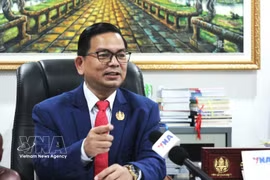
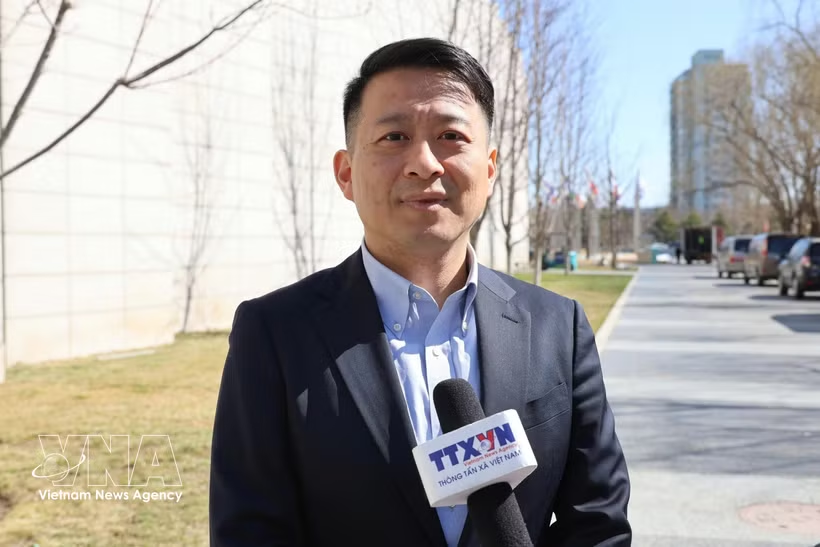
Professor Qu Qiang of the Minzu University of China and commentator for China Global Television Network (CGTN) in an interview with the Vietnam News Agency’s resident correspondent in Beijing (Photo: VNA)

Beijing (VNA) – Vietnam’s hosting of the ASEAN Future Forum (AFF) 2026 reflects its transition from an “active participant” to an increasingly influential “agenda shaper” within ASEAN, according to Professor Qu Qiang of the Minzu University of China and commentator for China Global Television Network (CGTN).

Speaking to the Vietnam News Agency’s resident correspondent in Beijing, Qu said the forum’s focus on ASEAN’s resilience and unity demonstrates Vietnam’s clear understanding of increasingly complex regional and global geopolitical challenges. More than a political slogan, the theme signals a shift towards practical cooperation aimed at strengthening ASEAN’s capacity to respond to external shocks.

The scholar highlighted the inclusion of dialogue among Southeast Asian political parties for the first time, describing it as a breakthrough that expands inter-party engagement from bilateral to multilateral cooperation. He said the initiative reflects Vietnam’s recognition that traditional intergovernmental mechanisms alone are insufficient to address non-traditional security challenges, which require the involvement of political parties, cities, youth and other stakeholders.

Regarding conflict prevention, Qu said ASEAN is moving towards a more proactive security approach centred on early risk identification, stronger warning systems and emergency communication mechanisms. Amid the prolonged Myanmar crisis, continued complexities in the East Sea and spillover effects from conflicts elsewhere, Vietnam is helping promote more effective preventive diplomacy within ASEAN, he noted.

Qu also pointed to the forum’s dedicated discussions on artificial intelligence (AI) governance and applications, saying they reflect Vietnam’s ambition to advance an “ASEAN solution” for technology governance. Such efforts could help ASEAN harness AI for socio-economic development, strengthen supply-chain resilience and play a more active role in shaping global AI standards.

Assessing Vietnam’s broader role, Qu said the ASEAN Future Forum demonstrates the country’s increasingly prominent functions as an initiator, coordinator and promoter of regional cooperation.

Since proposing the initiative at the 43rd ASEAN Summit in 2023, Vietnam has consistently invested resources in maintaining the forum as an effective supplementary dialogue channel alongside ASEAN’s formal mechanisms. This approach allows Vietnam to avoid competing with existing ASEAN platforms while creating space for new ideas and initiatives to emerge, he said.

The scholar also noted the significance of AFF 2026 taking place after Vietnam completed the consolidation of its leadership apparatus for the new term. The event provides an opportunity for the country to reaffirm its foreign policy of independence, self-reliance, peace, cooperation and development, while conveying a message of continuity and stability in both domestic and external policies.

Another noteworthy aspect, according to Qu, is the forum’s emphasis on a people-centred approach, placing it on equal footing with the goals of peace and prosperity. By encouraging participation from cities, young people, businesses and social organisations, Vietnam is helping broaden the concept of ASEAN centrality from the intergovernmental level to society as a whole, thereby strengthening the connection between regional policies and the interests of ordinary citizens.

Qu further observed that the forum underscores Vietnam’s growing role as one of the countries helping shape ASEAN’s agenda. Topics such as unity and resilience, conflict prevention and AI governance address some of the region’s most pressing challenges, while new mechanisms including political-party dialogue and greater participation by cities and youth reflect efforts to modernise regional governance.

According to the scholar, the forum’s greatest value may not lie in resolving current conflicts immediately, but in fostering a habit of strategic dialogue within ASEAN. This, he said, represents a meaningful contribution by Vietnam to maintaining ASEAN centrality and helping the bloc navigate the impact of intensifying major-power competition./.


VNA
See more

Nearly 1,000 students and lecturers from universities and colleges across Can Tho city attend the event at Can Tho University on July 15, 2026. (Photo: VNA)

Vietnam, Philippines strengthen people-to-people friendship

Shirley Nuevo, Acting Consul General of the Philippines in Ho Chi Minh City, said the past 50 years have demonstrated how the two countries and their peoples have grown together as friends, trusted partners and close neighbours within the ASEAN family.

Prime Minister Le Minh Hung addresses the working session with the Standing Board of the Tuyen Quang Party Committee in Vi Xuyen commune on July 15, 2026. (Photo: VNA)

PM urges Tuyen Quang to accelerate measures to achieve double-digit growth

The PM chaired a working session on July 15 with the Standing Board of the Tuyen Quang Party Committee on socio-economic development, the double-digit growth target, public investment disbursement, the operation of the two-tier local government model, implementation of Politburo Resolution No. 57, and measures to address local challenges.

Deputy Minister of Foreign Affairs Dang Hoang Giang (right), who is also head of the ASEAN Senior Officials' Meeting (SOM) delegation of Vietnam, and EU Ambassador to ASEAN Sujiro Seam at their meeting in Hanoi (Photo published by VNA)

Vietnam pledges continued contributions to ASEAN-EU ties: Deputy FM

Deputy FM Dang Hoang Giang, who is also head of the ASEAN Senior Officials' Meeting (SOM) delegation of Vietnam, spoke highly of the positive progress in the ASEAN-EU Strategic Partnership, noting that the EU has become one of ASEAN's most reliable partners and has provided substantial support for the ASEAN Community-building process.

Minister of Foreign Affairs Le Hoai Trung (R) receives Indian Ambassador to Vietnam Tshering Sherpa in Hanoi on July 15. (Photo: VNA)

Foreign Minister receives Indian Ambassador

Minister of Foreign Affairs Le Hoai Trung said Vietnamese authorities are expediting investigations into the cause of the recent speedboat accident and will strictly address any violations while strengthening safety regulations to prevent similar incidents.

Nguyen Van Tho (R), Permanent Vice Chairman of the Ho Chi Minh City People's Council and Chairman of the municipal Vietnam–US Friendship Association, presents flowers to Melissa A. Brown, US Consul General in Ho Chi Minh City, at the get-together marking the 250th anniversary of the US’s Independence Day in the city on July 15, 2026. (Photo: Xuan Khu/VNA)

People-to-people friendship forms key foundation of Vietnam–US ties: diplomat

Vietnam and the US have established a comprehensive strategic partnership based on mutual respect for each other's independence, sovereignty, territorial integrity and political systems. By putting the past behind, looking towards the future, building on common interests, and managing differences properly, they have advanced relations for the benefit of both peoples.

Politburo member and Permanent member of the Party Central Committee’s Secretariat Tran Cam Tu lays flowers at the graves of the 10 female youth volunteer martyrs at the national special historical relic site of Dong Loc T-junction. (Photo: VNA)

Senior Party official offers incense at Kim Lien, Dong Loc memorial sites

At the Kim Lien site, Tu and accompanying delegates offered flowers and incense in memory of President Ho Chi Minh, the beloved leader of the Vietnamese nation, a national liberation hero and a great man of culture who devoted his life to the revolutionary cause of the Party, the nation and the people, as well as to peace and social progress worldwide.

Prime Minister Le Minh Hung speaks at the working session with the Standing Board of the Lang Son provincial Party Committee. (Photo: VNA)

PM urges Lang Son to turn border advantages into new growth drivers

The Government leader instructed Lang Son province to vigorously implement its growth plan for the second half of 2026, with the goal of achieving annual GRDP growth of at least 10%. He called for clear accountability across agencies, regular updates to monthly and quarterly growth scenarios, close monitoring of key growth drivers, and periodic reporting to ensure timely policy responses.

The flight carrying the mortal remains of Indian victims departs Ho Chi Minh City on July 13. (Photo published by VNA)

Indian Embassy thanks Vietnam for support after Phu Quoc boat tragedy

The embassy said on its official X account that the flight carrying the victims' mortal remains departed Ho Chi Minh City on July 13 and arrived in Mumbai later the same day. Authorities in the Indian states of Andhra Pradesh, Kerala and Tamil Nadu coordinated the transportation of the remains to their final destinations.

Vice President of the Da Nang Union of Friendship Organisations Nguyen Ngoc Binh speaks at the ceremony marking the 55th anniversary of diplomatic relations between Vietnam and Chile (1971–2026) in Da Nang on the evening of July 14, 2026. (Photo: VNA)

Da Nang marks 55 years of Vietnam–Chile diplomatic relations

The two countries established diplomatic relations on March 25, 1971, with Chile becoming the first South American nation to establish official ties with Vietnam. Over the past 55 years, bilateral friendship and cooperation have continued to deepen across a wide range of fields, providing a solid foundation for stronger political, economic, trade, investment and people-to-people exchanges.

Vietnamese Ambassador to Laos Nguyen Minh Tam (L) meets with Secretary of the Vientiane provincial Party Committee and Chairman of the provincial People's Council Phouthanouphet Xaysombath on July 14. (Photo: VNA)

Vietnam, Laos seek deeper cooperation between localities

Tam reaffirmed that the Vietnamese Embassy in Laos would continue acting as a bridge to promote cooperation between Vientiane province and Vietnamese localities and businesses, helping improve the effectiveness of joint projects in the coming years.