ASEAN Future Forum 2026 opens in Hanoi

In his welcoming remarks, Foreign Minister Le Hoai Trung said Vietnam established the forum with the aim of creating an open, substantive and forward-looking space for dialogue among ASEAN member states and international partners.

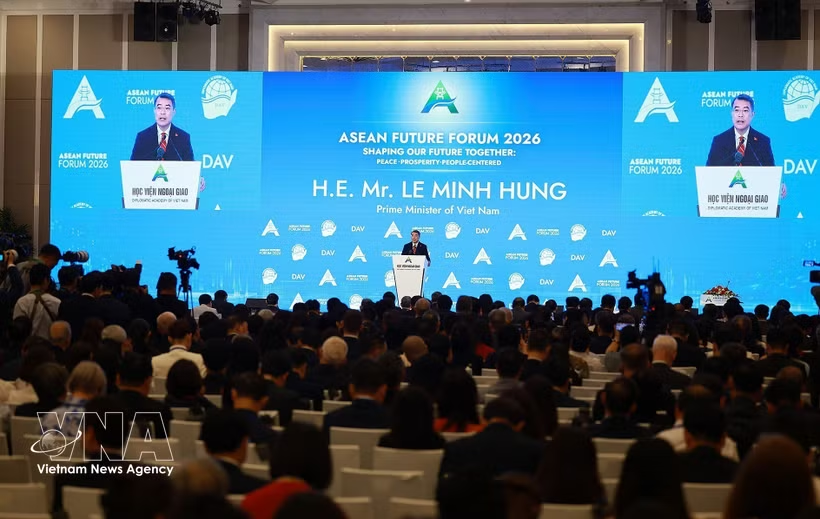
Prime Minister Le Minh Hung delivers remarks at the opening session of the third ASEAN Future Forum. (Photo: VNA)

Hanoi (VNA) – The ASEAN Future Forum (AFF) 2026 officially opened in Hanoi on June 9 under the theme “Shaping Our Future Together: Peace, Prosperity and People-Centred”.

Now in its third year, the forum has become an important platform for regional dialogue and cooperation, reaffirming Vietnam’s proactive and responsible role in advancing ASEAN’s development agenda and regional connectivity.

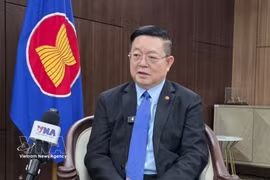
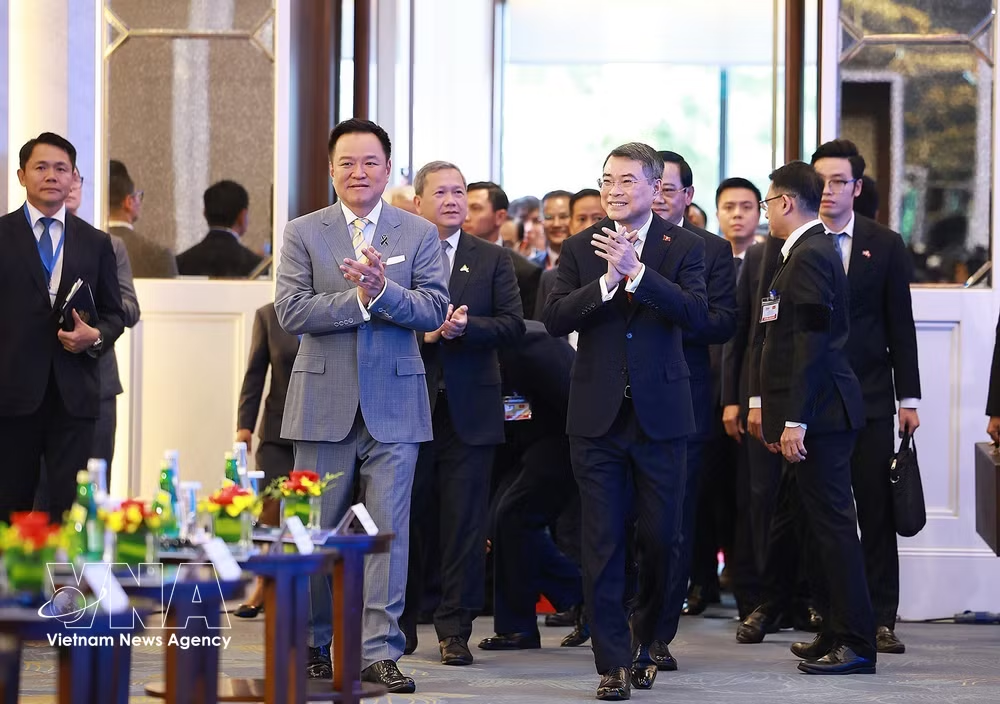
Attending the opening ceremony were Vietnam's Prime Minister Le Minh Hung, Prime Minister of Laos Sonexay Siphandone, Prime Minister of Cambodia Hun Manet, Prime Minister of Thailand Anutin Charnvirakul, Prime Minister of Timor-Leste Kay Rala Xanana Gusmao, Vietnamese Minister of Foreign Affairs Le Hoai Trung, and ASEAN Secretary-General Kao Kim Hourn.​

The ASEAN Future Forum was first introduced by Vietnam at the 43rd ASEAN Summit as a multi-stakeholder, multi-level platform designed to complement existing ASEAN mechanisms and support long-term policy thinking for the ASEAN Community.
vnanet-potal-khai-mac-dien-dan-tuong-lai-asean-lan-thu-ba-8814052.jpg
Prime Minister Le Minh Hung joins Lao Prime Minister Sonexay Siphandone, Cambodian Prime Minister Hun Manet, Thai Prime Minister Anutin Charnvirakul and Timor-Leste Prime Minister Kay Rala Xanana Gusmao at the opening session of the third ASEAN Future Forum. (Photo: VNA)

In his welcoming remarks, Foreign Minister Le Hoai Trung said Vietnam established the forum with the aim of creating an open, substantive and forward-looking space for dialogue among ASEAN member states and international partners.​

He noted that the forum serves as a venue for policymakers, academics, businesses and citizens to contribute ideas and initiatives toward building a stronger, more resilient and more dynamic ASEAN Community.​

According to the minister, the previous editions of the forum in 2024 and 2025 attracted broad participation and support from ASEAN countries and international partners, generating innovative yet practical proposals, many of which have since contributed to regional policy discussions and ASEAN’s long-term development agenda.

Against a backdrop of profound geopolitical shifts, growing strategic competition and rising security challenges, Vietnam hopes the forum will create additional opportunities for diplomacy, dialogue, mutual understanding and cooperation.

AFF should be a forum truly belonging to ASEAN and an effective complementary channel supporting the ASEAN Community-building process, Trung said.

This year’s programme focuses on some of the most pressing issues facing ASEAN today and in the decades ahead. Discussions will cover topics ranging from strengthening unity, enhancing resilience and strategic autonomy, and conflict prevention to emerging issues such as growth model transformation, energy security, artificial intelligence and financial technology.

A notable feature of AFF 2026 is its broader and more inclusive participation. In addition to exchanges among government leaders, the forum will, for the first time, host meetings involving political parties from Southeast Asian countries, local authorities from across ASEAN, and representatives from the business, economic and academic communities.

Organisers expect these discussions to generate fresh perspectives and practical solutions that will contribute to implementing the ASEAN Community Vision 2045 while helping the bloc adapt to emerging regional and global challenges.

Following the opening remarks, delegates heard keynote addresses by Vietnamese Prime Minister Le Minh Hung and other ASEAN leaders, as well as a recorded message from ASEAN foreign ministers./.
VNA

See more

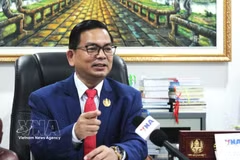
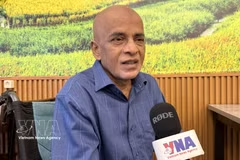
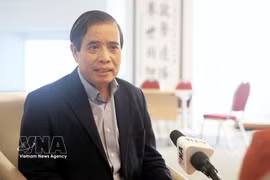
Dr. Kin Phea, Director General of the International Relations Institute of Cambodia (RAC). (Photo: VNA)

ASEAN Future Forum 2026: Important political message from Phnom Penh

Vietnam remains one of Cambodia’s most important neighbours in terms of security, economy, trade and people-to-people exchanges. Maintaining strong relations with Vietnam, therefore, serves Cambodia’s long-term national interests, said Dr. Kin Phea, Director General of the International Relations Institute of Cambodia (RAC).

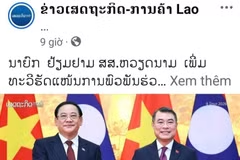
A post on the official Facebook page of the Lao Economic Daily (Photo: screenshot)

Lao media highlight deepening Vietnam–Laos cooperation

According to the reports, the Lao and Vietnamese Prime Ministers held talks on June 7, during which they briefed each other on their respective internal situations and expressed satisfaction with the socio-economic achievements recorded by the two sides. They highly valued the continued development of bilateral ties, particularly the strong political trust maintained through regular exchanges of meetings at all levels.

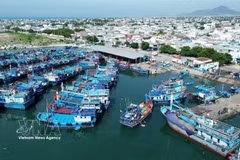
Fishing boats in Vietnam's Ninh Thuan province. (Illustrative photo: VNA)

ASEAN, Norway promote cooperation in sustainable blue economy development

The Norway–ASEAN cooperation project on blue economy development is seen as a first step toward building a regional cooperation platform to raise ASEAN member states’ awareness of the current state of aquaculture and fisheries development, identify policy gaps, and promote collaboration in the sustainable blue economy.

WB plans over 3 bln USD in financing for Philippines

WB plans over 3 bln USD in financing for Philippines

The multilateral lender is also considering structural reform initiatives as well as projects that could help the Government respond to the economic fallout from the Middle East conflict, particularly among vulnerable sectors.

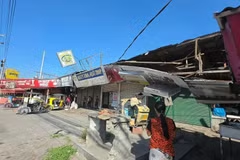
Houses are damaged after the earthquake in General Santos city, Philippines on June 8. (Photo: Xinhua/VNA)

Death toll from Philippines earthquake rises, tsunami reaches Indonesia, Japan

In the hard-hit port city of General Santos, disaster management officials confirmed seven deaths after several buildings collapsed and key infrastructure was damaged. The Philippine Institute of Volcanology and Seismology warned residents to exercise caution before returning to damaged buildings due to the risk of aftershocks.

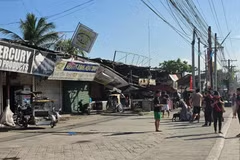
Several shops were damaged following the earthquake in General Santos City, the Philippines, on June 8, 2026. (Photo: Xinhua/VNA)

At least 12 killed, hundreds injured in Philippines earthquake

The port city of General Santos suffered the heaviest damage, with disaster management officials confirming seven fatalities and about 130 injuries after several small buildings collapsed and multiple structures, including a key bridge, sustained severe cracks. The remaining five deaths were recorded in South Cotabato, Davao Occidental and Balut Island.

Laos intensifies business environment reforms

The latest Provincial Facilitation for Investment and Trade Index report indicates that since 2018, the public sector has clearly defined timelines for document approval, reducing the time required to establish a business to just 17 days, including 10 days for the issuance of a business registration certificate, five days for seal engraving, and two days for social insurance registration.

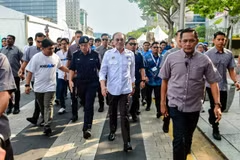
Datuk Seri Anwar Ibrahim attends the National TVET Day 2026 celebration at Dataran Putrajaya today. (Photo: Bernama)

Malaysia strengthens vocational training in technology and energy sectors

Malaysia is ramping up technical and vocational education and training (TVET) as a cornerstone of its economic transformation and talent development strategy, preparing its workforce for emerging fields such as artificial intelligence (AI), cryptocurrency technology and the global energy transition.

Indonesia eyes trade breakthrough with EAEU via FTA

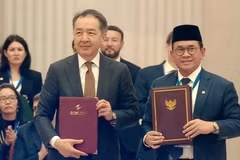
Indonesia eyes trade breakthrough with EAEU via FTA

Indonesia seeks to develop relations with all countries and sees itself as a bridge between different regions of the world. Against a backdrop of growing geopolitical and global economic uncertainty, strengthening international cooperation and building reliable supply chains have become more important than ever.

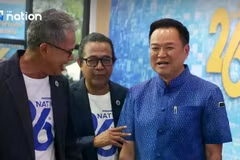
Thai Prime Minister Anutin Charnvirakul (R) at Nation TV’s 26th anniversary event on June 4, 2026. (Photo: nationthailand.com)

Thailand prioritises OECD accession

Thai Prime Minister Anutin Charnvirakul the country’s bid to join the Organisation for Economic Co-operation and Development, or OECD, is central to the government’s economic agenda.

ASEAN aims to become global digital economy hub

ASEAN aims to become global digital economy hub

Studies indicate that the ASEAN Digital Economy Framework Agreement (DEFA) could help raise ASEAN’s digital economy value to 2 trillion USD by 2030 while transforming the region into a connected, comprehensive and sustainable digital economy hub on the global stage.