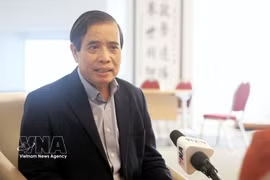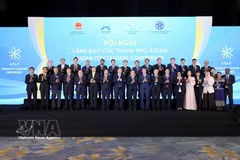
Beijing (VNA) – Vietnam’s hosting of the ASEAN Future Forum (AFF) for the third consecutive year demonstrates the country’s proactive and responsible stance as an ASEAN member, while highlighting its growing leading role in shaping regional dialogue and cooperation, according to Prof. Huang Rihan from Huaqiao University in China’s Fujian province.
Talking to the Vietnam News Agency in Beijing, Huang said the forum reflects Vietnam’s strong commitment and proactive role in advancing ASEAN integration and contributing to the bloc’s development.
He noted that Vietnam has consistently played a constructive, coordinating and balancing role within ASEAN by supporting the grouping’s centrality, strengthening unity and resilience of the bloc, and actively participating in intra-bloc cooperation across security, economic and socio-cultural fields.
The country has also promoted equal and mutually beneficial cooperation between ASEAN and its external partners while safeguarding the bloc’s common interests.
According to Huang, Vietnam’s continued hosting of the AFF has enhanced its influence within the region and provided a forward-looking forum for dialogue that helps build consensus, shape the bloc’s future direction, and enhance ASEAN’s voice on the international stage.
The Chinese scholar said that from its initial proposal to three successful editions of the forum, Vietnam has developed the AFF into a high-level dialogue mechanism focused on long-term goals, consensus-building and regional cooperation orientation. The forum’s agenda closely aligns with ASEAN’s integration process and global development trends, bringing together insights from policymakers, business leaders and academics to support ASEAN’s strategic autonomy and sustainable development.
Drawing on its geographical advantages, development potential and diplomatic capabilities, Vietnam has actively worked to coordinate positions, narrow differences, and build collective strength within ASEAN. In its external relations, Vietnam has remained committed to independence, self-reliance, and a balanced approach, playing an important role in maintaining ASEAN’s centrality and expanding the bloc’s international engagement.
According to the scholar, Vietnam’s continued hosting of the forum is not only a significant contribution to ASEAN Community-building but also reflects the country’s steady progression from a participant to a leading role in regional governance. Vietnam’s experience and commitment, he added, deserve recognition and serve as a valuable example for other countries in the region.
Commenting on the forum’s key issues debated at the event, including ASEAN unity and resilience, conflict prevention, and artificial intelligence (AI), Huang said they are closely aligned with the trends of the times, reflecting ASEAN’s current development stage as well as the challenges it is likely to face in the future. He noted that the forum’s agenda is highly relevant in practical terms and forward-looking in its vision.
He stressed that unity and resilience within ASEAN enable the bloc to operate effectively in an increasingly complex international environment. Adherence to the principles of ASEAN centrality, independent decision-making, and consensus, he said, is key to helping the bloc withstand external pressures and safeguard its own interests, thereby strengthening its influence and overall cohesion.
Regarding initiatives to prevent conflicts, Huang noted that ASEAN has a long-standing tradition of non-interference in internal affairs and the peaceful settlement of disputes. The AFF helps strengthen regional security resilience, reduce the risk of miscalculation, and preserve regional peace and stability, while also serving as an important avenue for multilateral security cooperation.
On the application of AI, Prof. Huang said ASEAN’s discussions on AI governance, digital cooperation, and technology adoption will help narrow the digital divide, promote the digital economy, strengthen regional connectivity, and create new momentum for ASEAN integration.
According to the expert, the world is undergoing a period of turbulence and transformation, marked by intensifying geopolitical competition, sluggish economic recovery, and escalating technological rivalry. As one of the world’s most dynamic regional organisations, ASEAN faces three key tasks: building internal consensus, maintaining a stable external environment, and seizing emerging opportunities.
He said the forum’s focus on unity and resilience highlights ASEAN’s commitment to independent development and a shared future. The conflict-prevention initiative reflects the common aspiration of regional countries to safeguard peace and stability, while the AI agenda aligns with the latest wave of technological innovation. By advancing digital cooperation and AI governance, ASEAN can move from being a digital adopter to a digital leader, strengthen its position in global industrial, supply, and value chains, and open up new opportunities for sustainable development in the region.
The expert said the forum also provides an opportunity to deepen cooperation between ASEAN member nations with China and the US. In particular, he noted that there remains considerable potential for further cooperation between China and Vietnam.
Frequent exchanges between Chinese and Vietnamese youth over the last two years have become a key pillar in preserving the traditional friendship between the two countries, strengthening public support for bilateral relations, and advancing the building of a China–Vietnam community with a shared future, he noted, adding that youth exchanges between the two nations will help strengthen long-term cooperation in areas such as AI and people-to-people exchanges, ease concerns, reduce misunderstandings, and build momentum for development and cooperation in the future, the scholar added./.