ASEAN must become active force in shaping new rules of era: Vietnamese PM

ASEAN should continue upholding the values that have underpinned its success - solidarity, resilience and unity in diversity, while embracing greater innovation in both thinking and action. The bloc should remain firm in its principles while becoming more agile in its responses to emerging challenges and opportunities, said PM Le Minh Hung.

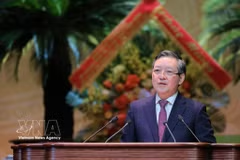
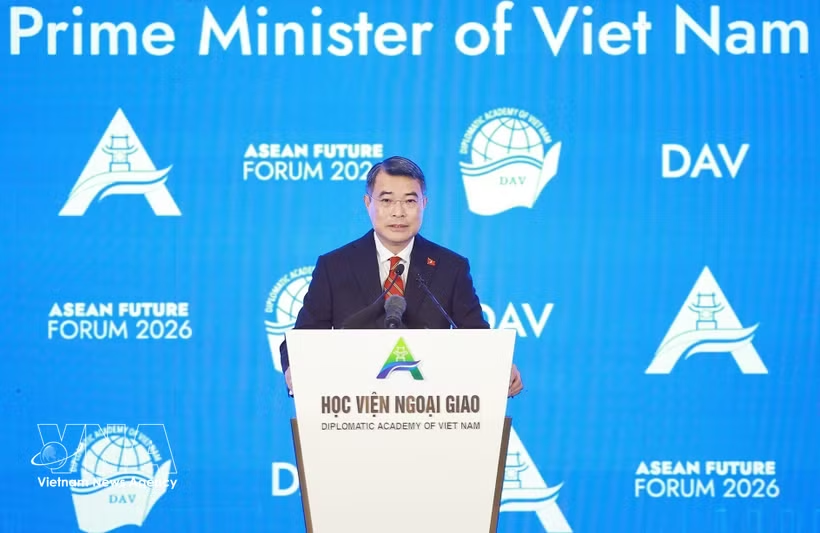
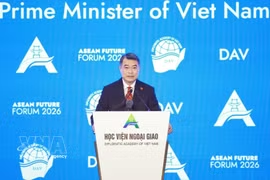
Vietnamese Prime Minister Le Minh Hung addresses the opening of the ASEAN Future Forum (AFF) 2026 in Hanoi on June 9 (Photo: VNA)

Hanoi (VNA) – ASEAN must evolve from a participant in global trends into an active force shaping the rules and standards of a rapidly changing world, Prime Minister Le Minh Hung said at the opening of the ASEAN Future Forum (AFF) 2026 in Hanoi on June 9.

Held under the theme “Shaping Our Future Together: Peace, Prosperity and People-Centred,” the forum brings together more than 600 delegates, including senior leaders, ministers, representatives of ASEAN member states and dialogue partners, international organisations, research institutes, businesses and localities.

Among those attending the opening session are Lao Prime Minister Sonexay Siphandone, Cambodian Prime Minister Hun Manet, Thai Prime Minister Anutin Charnvirakul, Timor-Leste Prime Minister Kay Rala Xanana Gusmão, and ASEAN Secretary-General Kao Kim Hourn.

Launched by Vietnam at the 2023 ASEAN Summit, the AFF has emerged as an important platform for strategic dialogue. Ideas and recommendations generated during its 2024 and 2025 editions have been reflected in ASEAN Summit documents, demonstrating the forum’s growing contribution to ASEAN’s official processes and future development agenda.

This year’s event takes place as ASEAN begins implementing the ASEAN Community Vision 2045 and marks Vietnam’s first major high-level multilateral event following the success of the 14th National Party Congress and the election of deputies to the 16th National Assembly and People’s Councils at all levels.

In his keynote address, PM Hung said ASEAN is at a pivotal moment in its development as the foundations of the global economy, technology and power structures are being reshaped.

He noted that ASEAN’s greatest achievement over nearly six decades lies not only in its population of almost 700 million people or its position as one of the world’s most dynamic growth centres, but also in its ability to overcome differences, build trust and foster cooperation to create a resilient and united community while preserving diversity.

According to the Vietnamese leader, if the past six decades were devoted to building ASEAN’s identity, the coming decades will be about shaping ASEAN’s future amid profound global transformation. Technology is redefining competitiveness, artificial intelligence is transforming productivity, data is reshaping power, and green transition is creating new development models.

In such an environment, advantages will belong not only to countries with abundant resources but also to those capable of helping establish new rules and standards of the era, he said. Vietnam believes ASEAN must become an active contributor to that process rather than simply adapting to global trends.
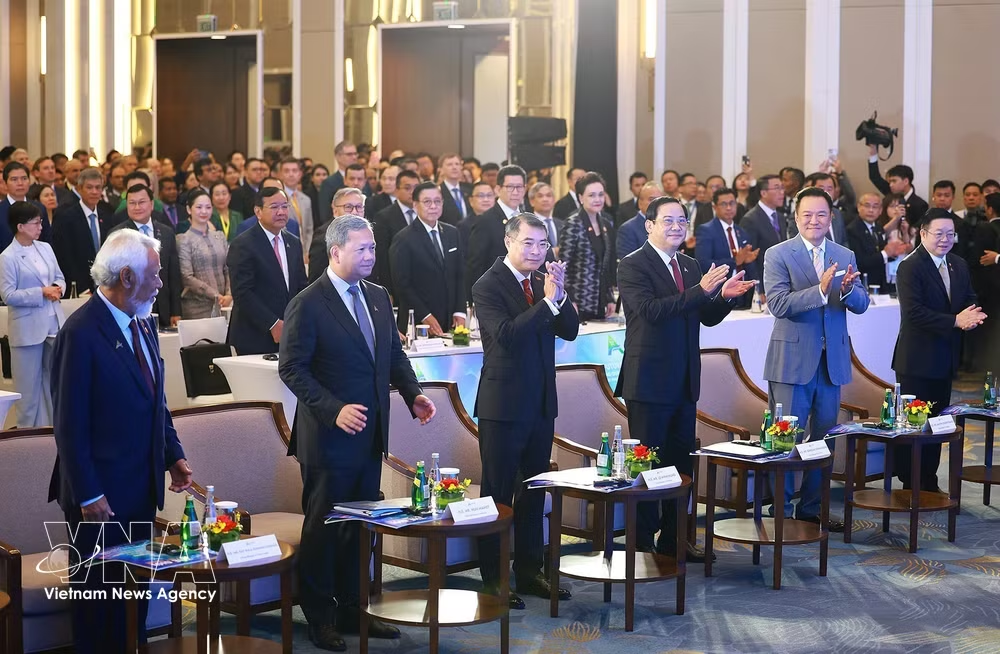
vnanet-potal-khai-mac-dien-dan-tuong-lai-asean-lan-thu-ba-8814054.jpg
Participants at the opening of the ASEAN Future Forum (AFF) 2026 in Hanoi on June 9 (Photo: VNA)

To realise this ambition, ASEAN should continue upholding the values that have underpinned its success - solidarity, resilience and unity in diversity, while embracing greater innovation in both thinking and action. The bloc should remain firm in its principles while becoming more agile in its responses to emerging challenges and opportunities.

As ASEAN implements its Community Vision 2045, PM Hung proposed three strategic directions for the bloc.

First, ASEAN should not only participate in global trends but also help shape them. In an increasingly fragmented and competitive world, the grouping needs a stronger voice in building new norms, rules and cooperative frameworks while resolving differences in accordance with international law. ASEAN should serve as a centre for dialogue, a hub for cooperation and an anchor of trust, thereby contributing to peace, stability and development in the region and beyond.

Second, ASEAN must move beyond its role as a manufacturing hub and become a centre of innovation. While its workforce and strategic location have made it a key link in global supply chains, the future belongs to economies that create, innovate and lead technological development.

ASEAN should strive to become a place where technology is developed, not merely consumed, and where value chains are created rather than simply passed through. This requires stronger investment in science and technology, innovation, digital transformation and high-quality human resources, as well as efforts to build a distinctive ASEAN digital and technology ecosystem that contributes to global standards-setting.

Third, ASEAN must become not only a community of nations but a genuine community of people. PM Hung stressed that the ultimate objective of development is improving people’s quality of life rather than achieving growth figures alone.

Innovation that widens inequality cannot be regarded as progress, while growth that is not inclusive cannot be sustainable, he said. ASEAN’s success should therefore be measured not only by GDP but also by opportunities for young people, the role of women, protection of vulnerable groups and the extent to which citizens feel they are part of the ASEAN community.

PM Hung underscored that ASEAN’s greatest contribution over the past six decades has been demonstrating that differences do not have to lead to division, unity does not diminish diversity, and integration does not erase identity.

In the decades ahead, he said, ASEAN must continue proving that a united and resilient community can play an active role in shaping peace, cooperation and development at both regional and global levels.

Reaffirming that Vietnam’s future is closely linked to ASEAN’s future, the PM pledged that Vietnam will continue working alongside fellow member states with a future-shaping aspiration, helping build a peaceful, stable and prosperous region./.
VNA

See more

Vietnamese Ambassador to Egypt Nguyen Nam Duong (L) has a working session with Egypt’s Red Sea Governor Walid Al Barqi on July 11. (Photo: VNA)

Vietnam seeks stronger economic links with Egypt's Red Sea Governorate

Beyond traditional exports, there remains considerable room to expand bilateral trade. Vietnam has potential to increase exports of tea, rice, frozen shrimp, machinery and electrical equipment, while Egypt could boost shipments of citrus fruits, grapes, fertilisers and, in particular, phosphate ore.

Chairman of the National Assembly's Committee for National Defence, Security and Foreign Affairs Le Tan Toi (R) meets with Jean-Michel Jacques, Chairman of the French National Assembly's National Defence and Armed Forces Committee. (Photo: VNA)

Vietnam, France seek to deepen Comprehensive Strategic Partnership

Both sides agreed to continue promoting regular exchanges and practical cooperation within their respective areas of responsibility, contributing to closer ties between the two legislatures and further strengthening the Vietnam-France Comprehensive Strategic Partnership.

Spokesperson of the Vietnamese Ministry of Foreign Affairs Pham Thu Hang (Photo: VNA)

Vietnam reaffirms goodwill in adhering to 1982 UNCLOS

Vietnam’s clear and consistent stance is that maritime disputes must be resolved through peaceful means, with respect for diplomatic and legal processes, without the use or threat of force, and in accordance with international law, particularly the 1982 UNCLOS

Chairman of the National Assembly's Committee for National Defence, Security and Foreign Affairs Senior Lieutenant General Le Tan Toi (right) meets with First Vice President of the Belgian Senate Andries Gryffroy. (Photo: VNA)

Vietnam, Belgium boost parliamentary cooperation, deepen bilateral relations

Toi called on the Belgian Senate to continue supporting stronger Vietnam-EU relations, including the effective implementation of the EU-Vietnam Free Trade Agreement (EVFTA), the ratification of the EU-Vietnam Investment Protection Agreement (EVIPA), and promoting the European Commission's early removal of its "yellow card" warning against Vietnamese seafood exports, in recognition of Vietnam's efforts to improve its legal framework and promote sustainable fisheries management.

Director of the General Department of Politics under the Vietnam People’s Army General Nguyen Trong Nghia inspects the ongoing search and recovery operation for martyrs’ remains at Le Thi Rieng Park in Ho Chi Minh City. (Photo: VNA)

Senior military officer inspects martyrs’ remains search at Le Thị Rieng Park

Nghia described the ongoing 500-day campaign as a sacred mission that embodies the Vietnamese tradition of remembering those who served and sacrificed for the nation. The current generation, he said, must spare no effort in carrying out the Party’s policy and fulfilling the aspirations of the people, particularly the families of the fallen.

Prime Minister Le Minh Hung (L) presents the First-Class and Second-Class Fatherland Protection Orders to the collectives for their achievements in search and rescue, humanitarian assistance and disaster relief operations in Venezuela. (Photo: VNA)

PM calls for building elite, professional international search and rescue force

During its mission from June 29 to July 7, the team worked around the clock under extremely hazardous conditions amid heavily damaged and contaminated disaster zones. Despite the challenges, rescue personnel recovered 57 victims' bodies and handed them over to local authorities and families. They also identified and reported several suspected locations where additional victims might be trapped.

People gather at Den Thuong (Upper Temple) during the Hung Kings' Commemoration Day in Phu Tho province. (Photo: VNA)

📝 OP-ED: Respect for history, gratitude a lasting cultural value of Vietnamese people

In Vietnamese cultural life, gratitude toward preceding generations has long been preserved as an integral part of the nation's identity. This tradition is reflected in ancestor worship practiced in families, the Worship of the Hung Kings, village deities, national heroes and eminent cultural figures, as well as tributes to generations who sacrificed their lives for the nation's independence and freedom.

General Phan Van Giang (R) and General Khamlieng Outhakaysone plant a tree at Thanh Thuy border gate. (Illustrative photo: VNA)

Border community twinning strengthens Vietnam–Laos friendship

Over the past decade, the twinning relationship between Thuy Phong village in Nghe An’s Kim Bang commune, and Xop Tuong village in Nam On commune, Xaychamphone district, Bolikhamxay province of Laos, has become a model for fostering a shared border of peace, friendship and cooperation.

Delegates from the two nations, along with military attachés from several countries accredited to Vietnam, lay flowers in tribute to the Cuban military experts at the memorial monument within the Vietnam Military History Museum in Hanoi on July 10. (Photo: VNA)

Vietnam, Cuba pay tribute to fallen Cuban military experts

Cuba and Vietnam on July 10 commemorated six Cuban military experts who lost their lives 60 years ago while supporting the Vietnamese people's resistance war, reaffirming the enduring solidarity and defence ties forged through the two countries' shared history.