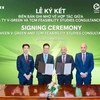
The Australian Agency for International Development (AusAID) and the World Bank have confirmed their commitment to support Vietnam's long-term socio-economic development in a recently signed strategic partnership agreement for the next five years.
Under this partnership, AusAID will provide the World Bank with 58 million Australian (61.7 million USD) for the bank's investment and advisory programme to support Vietnam.
The partnership aims to foster an enabling environment for improved economic competitiveness, increased environmental sustainability, and broadened access to economic and social opportunity.
An agreement for 97 million USD in additional funding for the third rural transport project was also signed on March 9 between the State Bank of Vietnam and the World Bank.
The project aims to increase the number of communities connected to new and improved all weather roads; improve rural road conditions through better management and maintenance; and improve institutional effectiveness to plan, implement and maintain improvements in rural transportation.
The additional financing comes from the International Development Association, the World Bank's funding resource for low income countries.
The improved transport system is expected to benefit up to five million people in all 32 participating provinces in central and northern Vietnam, including 14 mountainous provinces.
To date, the project has rehabilitated about 2,100 km of roads and completed the maintenance of approximately 13,000 km of district roads and bridges.
Also on March 9, the Asian Development Bank and the State Bank of Vietnam signed loan agreements worth 180 million USD to help the country improve irrigation and urban infrastructure.
The first agreement is to develop irrigation infrastructure and management of water resources and services in the northern Chu and southern Ma river basins in central Thanh Hoa province. The second involves improving urban infrastructure and municipal services in the northern economic centres of Viet Tri Town in Phu Tho province, Hung Yen province and Dong Dang town in Lang Son province.-VNA
Under this partnership, AusAID will provide the World Bank with 58 million Australian (61.7 million USD) for the bank's investment and advisory programme to support Vietnam.
The partnership aims to foster an enabling environment for improved economic competitiveness, increased environmental sustainability, and broadened access to economic and social opportunity.
An agreement for 97 million USD in additional funding for the third rural transport project was also signed on March 9 between the State Bank of Vietnam and the World Bank.
The project aims to increase the number of communities connected to new and improved all weather roads; improve rural road conditions through better management and maintenance; and improve institutional effectiveness to plan, implement and maintain improvements in rural transportation.
The additional financing comes from the International Development Association, the World Bank's funding resource for low income countries.
The improved transport system is expected to benefit up to five million people in all 32 participating provinces in central and northern Vietnam, including 14 mountainous provinces.
To date, the project has rehabilitated about 2,100 km of roads and completed the maintenance of approximately 13,000 km of district roads and bridges.
Also on March 9, the Asian Development Bank and the State Bank of Vietnam signed loan agreements worth 180 million USD to help the country improve irrigation and urban infrastructure.
The first agreement is to develop irrigation infrastructure and management of water resources and services in the northern Chu and southern Ma river basins in central Thanh Hoa province. The second involves improving urban infrastructure and municipal services in the northern economic centres of Viet Tri Town in Phu Tho province, Hung Yen province and Dong Dang town in Lang Son province.-VNA