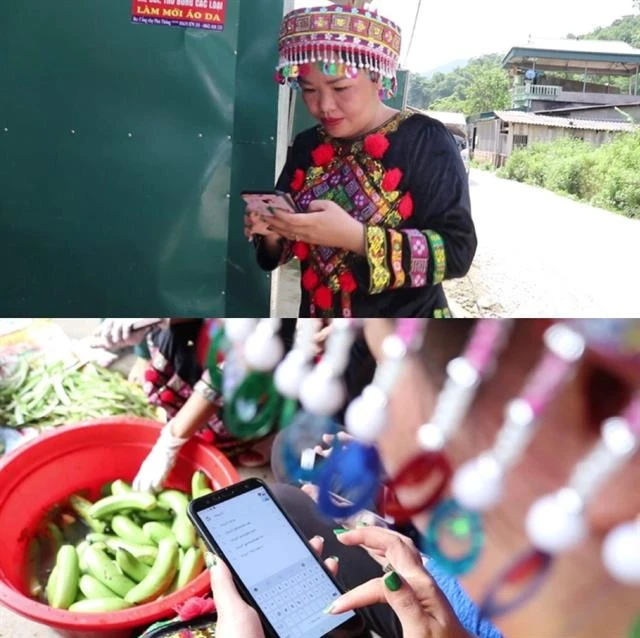
 Ly Thi Quyen uses her smartphone to interact with her customers online (Source: VNA)
 Bac Kan (VNS/VNA) - Using Facebook and other social media platforms to sell products is nothing new among urban communities.
But now ethnic women in remote mountainous areas of northern Bac Kan province are following suit.
Three months ago Ly Thi Quyen, from Dao ethnic minority group, used her Facebook and Zalo accounts to post photographs of dried banana packaging and video clips of the production.
She is the director of Thien An Cooperative in Vi Huong commune, Bach Thong district.
Quyen’s digital marketing started to pay off and she began to receive orders, not just from the local community where she lived, but also from Hanoi, HCM City, Lao Cai and Nam Dinh.
“I think using a technological application to sell is the only way to reach a very large number of customers,” she said.
“Finding stable markets for our products is our great concern because products’ output brings incomes for all 14 female workers of the cooperative. All of them are from poor households.”
Before going online, the Thien An Cooperative reached a small number of customers from the local community through traditional channels like word-of-mouth, markets and trade fairs.
Now the Thien An Cooperative sells around 200 packs of dried banana each week through both online and offline channels, earning 4 million VND (174 USD).
This has also led to a rise in salaries for the ethnic women in the cooperative.
To expand their business, the Thien An Cooperative is selling through voso.vn, a newly-launched e-commerce platform owned by Viettel Post, the delivery arm of Viettel Military Industry and Telecoms Group (Viettel).
More and more small production units and co-operatives run by ethnic women in Bac Kan will be helped go digital by United Nations Development Programme (UNDP) and Viettel Post.
The two partners signed an agreement last month as part of UNDP’s initiative called “Economic empowerment of ethnic minority women via application of I4.0”, which is expected to enable 450 ethnic minority women to expand their business.
The project equips ethnic women with the necessary skills to take photos, make videos and post them on Facebook, Zalo and e-commerce platforms like voso.vn.
Once local products are put on sale on Viettel Post’s online market will provide logistic support to deliver the items and receive money directly to their bank accounts.
Bridging the gap
Bac Kan’s agricultural products, locally made by ethnic women using natural materials, ranging from dried fruits, tea and dried vermicelli to high-valued products with multiple functions like turmeric extract and bee honey taken from forests.
However, diversified local products are not enough to make the local economy thrive. Bac Kan is still left behind other northern mountainous provinces in terms of economic development because of poor communities.
Ethnic minority people make up 95 percent of the province’s multi-dimensional poor households.
Local people’s productions and livelihoods are vulnerable to extreme weather events such as storms and flash floods, leading to low productivity.
Small-scale production and low productivity have held back local economy’s development and put ethnic women in poverty.
Pham Duy Hung, Vice Chairman of the provincial People’s Committee, said ethnic women who own or work for small-production units and co-operatives lack access to and knowledge about IT application.
He said: “Applying technology to advertise products is not popular and seeking markets for their products remains a challenge for ethnic women who are familiar and skillful with making products but not good at going out for marketing.”
20/10 Nong Ha Cooperative produces vermicelli and creates jobs for more than 20 local women. The products receive certificates of origin, food safety and have branded packages.
Nguyen Thi Hiep, the cooperative’s owner, tried to create a Facebook page to introduce vermicelli online but does not regularly update photos and information. The co-operative’s online sale, therefore, is not effective.
This is an example to show that local co-operatives, in spite of making good-quality products with food certificates, still cannot reach large markets due to lacking IT application and marketing skills.
Hung hoped that with the assistance of UNDP and Viettel Post, local ethnic women will be instructed to use technology to approach more customers.
Caitlin Wiesen, UNDP Resident Representative in Vietnam, said the new partnership with Viettel Post looks at e-commerce platform, logistics and delivery as well as e-payment system. The industry 4.0 technologies help reach gaps between local production, women in rural economy, ethnic minority women and the market outside.
“When we close that gap, that’s where the magic happens, where women and local communities are lifted out of poverty, where we have decentralised thriving economy,” she said.
“If we do it together with business from the start, then you will have much higher success and sustainability at the end.”
To ensure the sustainability of the programme, once the products reach big markets via online channels, local authorities will encourage ethnic women to continue to maintain quality and expand production with larger quantities to meet increasing demand, Hung told Vietnam News.-VNS/VNA
VNA