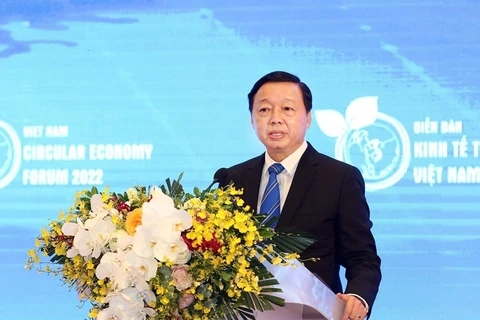
Extinguished guests discuss CE topics at the event. (Photo: VNA)
 Khalidi spoke at the event 'Harvest Day & Circular Economy Connect' hosted by the Vietnam Circular Economy Hub on December 22.
The resident representative said small- and medium-sized enterprises (SMEs), which comprise 96% of the total number of enterprises in Vietnam, have a critical role in accelerating the transition towards CE.
 Ramla Khalidi, Resident Representative of UNDP in Vietnam. (Photo: UNDP)
 "We need to ensure that businesses are provided with the technical and financial support needed to transform the production and consumption model, align with national policies on CE, and reap the benefits of the trade agreements between Vietnam and other countries," said Khalidi.
To this end, a recent UNDP-initiated capacity-building programme, in partnership with the Netherlands Embassy, has trained over 100 Vietnamese enterprises in various sectors to scale up CE models, adopt low-carbon technologies, and shift production and consumption models to greener ones.
Kees van Baar, Ambassador of the Netherlands to Vietnam, remarked that big enterprises typically have the capacity and resources to embrace CE actively. Still, it is not the case for SMEs, which account for almost 100% of the total number of enterprises in Vietnam.
He said CE transition is not only a matter of responsible business conduct but also a matter of profitability. Therefore, he believed that enterprises incorporating CE into their operation would be better off financially.
"With CE, you can profit because you reuse your water and things. You have renewable energy, so you don't have to buy gas or oil," said Baar.
Mai The Toan, vice president of the Institute of Strategy and Policy on Natural Resources and Environment, underlined CE as an inevitable path for Vietnam, given its limited natural resources, high population, and the growing pressure of environmental pollution.
He also revealed that his institute had recently outlined the National Action Plan on CE, which is slated to be submitted to Prime Minister for approval before December 31, 2023. However, for the time being, the outline was handed out to local authorities, enterprises, and research institutes to elicit their comments.
"We need to develop a set of guidelines on CE transition in Vietnam, which would instruct enterprises how to incorporate CE into their operation," Toan added.
Nguyen The Chinh, director of the Environmental Economic Policy Institute, asserted that some regulations on water treatment need revision because they are holding back the CE transition.
"Many enterprises want their treated wastewater to be reused in their production rather than discharged back to the environment. But, unfortunately, the current legal framework has not provided for the practice," said Chinh.
Without legal grounds for the reuse of treated wastewater, the enterprises have no choice but to return the effluent to the environment because closing the water loop would put them at risk of being whistle-blowed.
Nguyen Anh Duong, director of the Department for General Economic Issues and Integration Studies, Central Institute for Economic Management, underlined profits as the primary motivation for enterprises shifting their focus to CE.
"CE transition is not a matter of developing CE laws and making enterprises obey the laws, but rather raising awareness among them," Duong added.
The director was concerned that it would take more than ten years to fix all the legal issues hindering the CE transition. In the meantime, he suggested a regulatory sandbox span of at least five years, under which enterprises would be given more legal leeway to implement their CE models.
Duong Thi Phuong Anh, deputy director of the Vietnam Environment Protection Fund, claimed that her fund had launched many lending programmes to finance green projects over the past 20 years.
"We have programmes to accelerate CE transition in the country, with priority being given to wind energy, solar energy, and water treatment projects," she said.
Loans under the programmes, according to Anh, are favourable, with an average annual interest rate of roughly 3.0% and terms of between seven to 10 years. But, more importantly, the rates are fixed during the entire term of the loan.
Director Chinh said that CE transition makes profits because it allows enterprises to turn waste into pay dirt.
"Reclaimed fish head and skin can be sold at prices higher than the fish itself", said Chinh./.
To this end, a recent UNDP-initiated capacity-building programme, in partnership with the Netherlands Embassy, has trained over 100 Vietnamese enterprises in various sectors to scale up CE models, adopt low-carbon technologies, and shift production and consumption models to greener ones.
Kees van Baar, Ambassador of the Netherlands to Vietnam, remarked that big enterprises typically have the capacity and resources to embrace CE actively. Still, it is not the case for SMEs, which account for almost 100% of the total number of enterprises in Vietnam.
He said CE transition is not only a matter of responsible business conduct but also a matter of profitability. Therefore, he believed that enterprises incorporating CE into their operation would be better off financially.
"With CE, you can profit because you reuse your water and things. You have renewable energy, so you don't have to buy gas or oil," said Baar.
Mai The Toan, vice president of the Institute of Strategy and Policy on Natural Resources and Environment, underlined CE as an inevitable path for Vietnam, given its limited natural resources, high population, and the growing pressure of environmental pollution.
He also revealed that his institute had recently outlined the National Action Plan on CE, which is slated to be submitted to Prime Minister for approval before December 31, 2023. However, for the time being, the outline was handed out to local authorities, enterprises, and research institutes to elicit their comments.
"We need to develop a set of guidelines on CE transition in Vietnam, which would instruct enterprises how to incorporate CE into their operation," Toan added.
Nguyen The Chinh, director of the Environmental Economic Policy Institute, asserted that some regulations on water treatment need revision because they are holding back the CE transition.
"Many enterprises want their treated wastewater to be reused in their production rather than discharged back to the environment. But, unfortunately, the current legal framework has not provided for the practice," said Chinh.
Without legal grounds for the reuse of treated wastewater, the enterprises have no choice but to return the effluent to the environment because closing the water loop would put them at risk of being whistle-blowed.
Nguyen Anh Duong, director of the Department for General Economic Issues and Integration Studies, Central Institute for Economic Management, underlined profits as the primary motivation for enterprises shifting their focus to CE.
"CE transition is not a matter of developing CE laws and making enterprises obey the laws, but rather raising awareness among them," Duong added.
The director was concerned that it would take more than ten years to fix all the legal issues hindering the CE transition. In the meantime, he suggested a regulatory sandbox span of at least five years, under which enterprises would be given more legal leeway to implement their CE models.
Duong Thi Phuong Anh, deputy director of the Vietnam Environment Protection Fund, claimed that her fund had launched many lending programmes to finance green projects over the past 20 years.
"We have programmes to accelerate CE transition in the country, with priority being given to wind energy, solar energy, and water treatment projects," she said.
Loans under the programmes, according to Anh, are favourable, with an average annual interest rate of roughly 3.0% and terms of between seven to 10 years. But, more importantly, the rates are fixed during the entire term of the loan.
Director Chinh said that CE transition makes profits because it allows enterprises to turn waste into pay dirt.
"Reclaimed fish head and skin can be sold at prices higher than the fish itself", said Chinh./.
VNA