Da Nang launches key projects in data centre, semiconductor and AI

That includes ten racks for cloud computing services, AI applications, cyber security, with a total investment in the first phase of 800 billion VND (32 million USD).

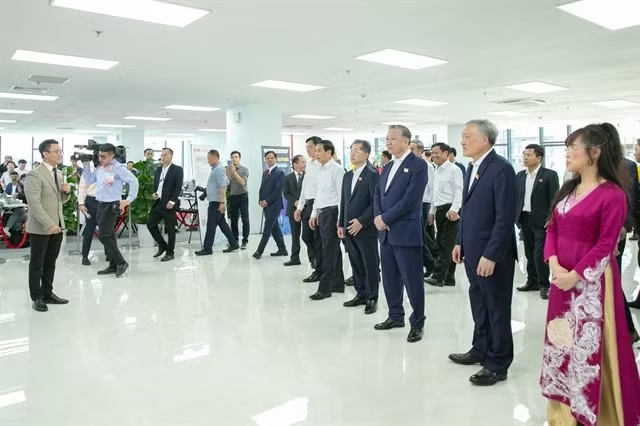
Party General Secretary To Lam visits the Da Nang Semiconductor & AI Research and Training and Centre at the Da Nang Software Park No 2 on the occasion of the 50th anniversary of the city's Reunification Day. (Photo courtesy of DSAC)

Da Nang (VNS/VNA) –The Da Nang International Data Centre JSC has officially launched the largest hub of its kind at the city’s Hi-tech Park, offering a smooth operation of a 1,000-racks system.

That includes ten racks for cloud computing services, AI applications, cyber security, with a total investment in the first phase of 800 billion VND (32 million USD).

It’s one of a series of remarkable projects in the city, and a keystone of the Da Nang’s ambitious goal of being a global semiconductor and AI manufacture centre by 2030.

The Da Nang Hi-Tech Park and Industrial Zones Authority (HPIZA) said the project, invested by by IDC Joint-Stock Company, commenced the building just three months after getting the investment certificate.

The data centre, which covers 2ha, will be designed with the globally-adopted TIA-942 Telecommunications Infrastructure Standard for Data Centres, with liquid cooling and a fanwall, as well as power usage effectiveness.

The data centre project should be operational between 2026 and 2027, IDC Joint-Stock Company said, adding that it plans to invest 1.2 trillion VND (48 million USD) in the second phase.

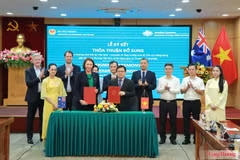
A series of Memorandums of Understanding (MoUs) on cooperations in training programmes on conductors and AI and five other investment certificates worth nearly 300 million USD, were signed by the city and partners and investors at the City Partnership Forum-Da Nang in January.

Da Nang has attracted more than a thousand projects with a total investment of 4.35 billion USD, of 3.55 billion USD contributed by six industrial parks, the Hi-Tech Park and the IT Park.

To mark the 50th anniversary of the city’s Reunification Day, the Da Nang Semiconductor & AI Research and Training and Centre (DSAC), in cooperation with partners Synopsys, Gasa Holdings, TreSemi and Intel Vietnam, opened a training course for the top 80 trainees in the sector.

DSAC also reported that more than 400 students have been enrolled for human resources training programmes in Da Nang since last year, while the other 100 final-year students have been receiving up-skilling courses to increase in manpower in the city.

The first training courses for 22 trainers in microchip design, and 17 other trainees in Assembling, Testing and Packaging (ATP) by Arizona State University have already begun in the city.

Six universities in Da Nang have inked MoUs on hi-quality human resources with DSAC, and the first global standard lab was built at DSAC with funding and assistance from Synopsys, Intel, Sovico and Tresemi.

A report from DSAC unveiled that Grovf Inc, a Datacentre Fabric Company from Armenia, has registered a research project on the development of Data Processing Unit (DPU) chip at the Da Nang Software Park No 2 (SP2).

It said the company, which has created solutions for 400/800Gbps network scale-out and scale-up for Amazon, Google, Facebook, would introduce the first chip designed by Vietnamese engineer in providing service for data centres in 2025-27.

Last month, SkyeChip, a chip design from Malaysia, was granted an investment certificate at the Da Nang SP2.

To date, 14 key businesses operating chip design and semiconductor including Synopsys, Uniquify, Renesas, Synapse (now is Quest Global), Sannei Hytechs, Mixel Vietnam, Marvell Vietnam, Sibridges Vietnam from the US, Ideas2Silion Vietnam, Korea, FPT Semiconductor, Viettel Hi-Tech và Acronics have established operation in the city.

Partners from Vietnam and Korea have also agreed five deals on cooperation and development of Artificial Intelligence (AI) technology in medical, healthcare in Da Nang.

The Republic Korea’s LG Electronics plans to introduce its R&D centre to the city, while Samsung has established a Samsung Innovation Campus (SIC) at Da Nang-Duy Tan University.

The Vietnam-Korea Information Technology and Communications University has been seeking cooperation with LG Electronics R&D Vietnam, and the University of Northhampton, in the UK, in digital human resources and application research in hi-tech industries./.

VNA
See more

The central province of Nghe An holds an investment promotion conference in Seoul on October 15. (Photo: VNA)

Nghe An seeks stronger tech, clean energy ties with RoK

A Nghe An official affirmed the province's commitment to providing a fair and favourable investment environment, preparing cleared land in the expanded Southeast Nghe An Economic Zone, streamlining administrative procedures, and ensuring clean energy infrastructure for investment projects.

Illustrative image (Photo: VNA)

Vietnam, US propel economic, trade, investment ties

Vietnam considers the US one of its leading strategic partners and wants to continue advancing the Comprehensive Strategic Partnership in a stable, substantive, and effective way for the benefit of its citizens and enterprises, said Deputy Minister of Foreign Affairs Nguyen Minh Hang.

As of the end of August 2026, bilateral trade between Vietnam and the US reached approximately 137.42 billion USD, up 23.4% year on year. (Photo: VNA)

Vietnam, US look to strengthen business, investment ties

Vietnam and the US should further promote business connections and practical cooperation in trade and investment, Deputy Foreign Minister Nguyen Minh Hang told Pamela Phan, former Deputy Assistant Secretary for Asia at the US Department of Commerce, in Hanoi on October 15.

Shoppers at Winmart (Photo: VNA)

National brand programme drives Vietnamese corporate competitiveness

Vietnam’s national brand value reached 462.28 billion USD in 2026, up 45.14% from 2020 and ranking 32nd among 193 countries, according to Brand Finance. The challenge, however, goes beyond climbing the rankings or scaling up. It is turning those gains into lasting competitiveness and getting Vietnamese firms deeper into global value chains.

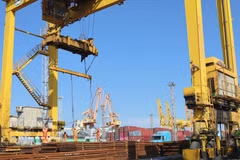
Loading and unloading steel products at Hoang Dieu–Chua Ve Port, Hai Phong city (Photo: VNA)

Hai Phong city seeks to boost inland waterway transport

According to the Hai Phong Maritime Administration, inland waterways carry coal, agricultural products, ores, stone, cement and other bulk cargoes, helping ease pressure on roads, particularly those connecting seaports and industrial parks.

Speakers at the conference (from left): AVPI Advisory Board Chair Dr Le Thu Huong, Australian Ambassador to Vietnam Gillian Bird, and Vietnamese Consul General in Sydney Nguyen Thanh Tung. (Photo: VNA)

Vietnam, Australia turn momentum into practical cooperation

Vietnam and Australia should focus on promoting two-way investment, expanding cooperation linked to APEC 2027 and making better use of people-to-people connections. Vietnam needs capital, skills, technology, infrastructure, and energy transition expertise - areas where Australia could offer valuable support.

The interface of the National E-Procurement System. (Photo: muasamcong.mpi.gov.vn)

Vietnam to move PPP bidding online from 2027

From January 1, 2027, PPP project proposals must be submitted through the National E-Procurement System. From September 1, 2027, investor selection for PPP projects tendered through open bidding will move fully online.

An automated robot-based production line at CAYI Technology Vietnam Co., Ltd. in Yen Phong II-C Industrial Park, Bac Ninh city (Photo: VNA)

EuroCham: Business Confidence Index in Vietnam remains high at 78.3 in Q3

The survey found that 64% of respondents described their current business conditions as good or very good, while 28% maintained a neutral or cautious outlook, reflecting a wait-and-see attitude as international demand remains flat and businesses look for policy momentum to translate into faster procedures and more predictable outcomes.