Deputy PM calls for integrated ASEAN fintech ecosystem

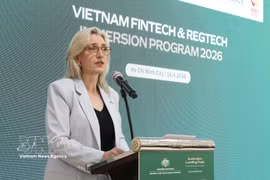
Deputy PM Nguyen Van Thang proposed a shared vision for an ASEAN fintech ecosystem that is open, secure, transparent, inclusive, and sustainable: “Open” to foster connectivity, “Secure” to enable growth, “Transparent” to build trust, “Inclusive” to ensure that no one is left behind, and “Sustainable” to strengthen resilience and support long-term progress.

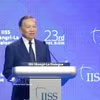
Deputy Prime Minister Nguyen Van Thang speaks at the event. (Photo: baochinhphu.vn)

Hanoi (VNA) – Deputy Prime Minister Nguyen Van Thang has called on ASEAN countries to work together to build an open, secure, transparent, inclusive and sustainable fintech ecosystem, describing financial technology as strategic infrastructure that will shape the region’s digital future.

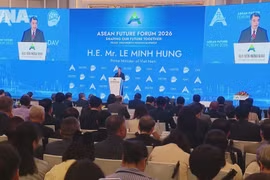
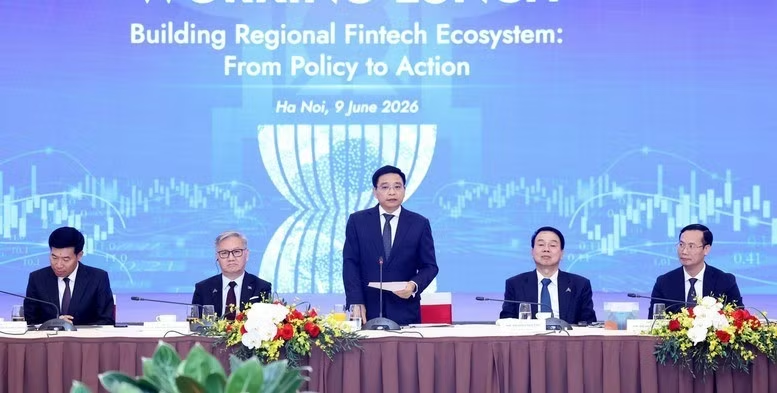
The remarks were made at a seminar on regional fintech ecosystem held in Hanoi on June 9 within the framework of the ASEAN Future Forum (AFF) 2026. The event brought together Lao Deputy Prime Minister and Minister of Foreign Affairs Thongsavan Phomvihane, representatives of Vietnamese ministries and agencies, and leading domestic and international experts and businesses.

At the discussion, Thang said exchanges at the forum had highlighted a clear reality: fintech is no longer confined to banking services or digital payments but has become a key driver of economic growth, cross-border connectivity and trust-building in ASEAN’s digital economy.

According to the Deputy PM, fintech is helping realise one of ASEAN’s most fundamental goals – bringing development opportunities closer to every citizen, business and community, including those who have not yet benefited fully from digital transformation.

To become a leading digital financial hub in the Asia-Pacific and globally, ASEAN must move beyond market integration toward connecting its fintech ecosystems, he stressed.

Thang noted that proposals discussed at the seminar, ranging from cross-border payment infrastructure and international financial centres to artificial intelligence (AI), big data, blockchain and regulatory sandboxes, all point to one essential requirement: effective coordination among governments, regulators, businesses, financial institutions, investors and end-users.

“We cannot build a strong fintech ecosystem if we remain divided by data silos, incompatible standards, or gaps in trust and governance,” he said.

The Deputy PM proposed a shared vision for an ASEAN fintech ecosystem that is open, secure, transparent, inclusive, and sustainable: “Open” to foster connectivity, “Secure” to enable growth, “Transparent” to build trust, “Inclusive” to ensure that no one is left behind, and “Sustainable” to strengthen resilience and support long-term progress.

To realise this vision, he highlighted the need to strengthen infrastructure connectivity and harmonise standards across the region. ASEAN should accelerate the development of next-generation cross-border payment systems, expanding beyond QR code payments and retail transactions to include real-time payments, embedded finance, Open API standards and regional anti-fraud coordination mechanisms.

On fostering innovation while ensuring safety, Thang called for transparent, stable and balanced legal frameworks that encourage the development of AI, blockchain and emerging technologies while safeguarding financial stability and consumer interests.

He also suggested studying the feasibility of establishing an “ASEAN Fintech Sandbox” at the regional level to enable the testing and deployment of cross-border fintech solutions in a controlled, secure and transparent environment.

The Deputy PM underscored the importance of public-private partnerships, saying governments should create enabling institutions, businesses should lead innovation, financial institutions should provide resources, and investment funds should help expand opportunities for growth.

He stressed that people must remain at the centre of digital transformation efforts and that practical outcomes should serve as the key measure of success.

Thang said ASEAN now has opportunities to emerge as a fintech centre of growing regional and global significance. He reaffirmed Vietnam’s commitment to working closely with ASEAN member states and international partners to promote a regional fintech ecosystem that is more open, connected, secure and people-centred.

The future of ASEAN will be defined not only by growth rates, but also by the quality of development; not only by technological strength, but by the ability to serve people; and not only by the degree of integration, but also by the prosperity it brings to all citizens, he said./.

VNA

See more

Cars at a public parking lot in Hai Phong city. (Photo: VNA)

Vietnam's auto sales rise 15%, hybrid, imported vehicles continue to outperform

With auto loan interest rates remaining competitive, stable vehicle supply, and an increasingly diverse product range, Vietnam's automotive market is expected to maintain its growth momentum through the remainder of 2026. SUVs, MPVs, and hybrid vehicles are likely to remain the main drivers of overall market sales.

The MoU signing ceremony between Becamex VSIP Binh Dinh and PV Gas CNG in Gia Lai province on June 26, 2026 (Photo: nhandan.vn)

Gia Lai positions itself as magnet for sustainable investment

Vice Chairman of the provincial People's Committee Nguyen Huu Que said ESG is no longer a communications message or a cost burden, but an essential requirement for accessing global capital. Gia Lai has chosen ESG as a pillar for building new competitive advantages and achieving sustainable development.

Chairman of the Tay Ninh provincial People's Committee Le Van Han delivers remarks at the inauguration ceremony. (Photo: VNA)

Suntory PepsiCo inaugurates 300-million-USD plant in southern Tay Ninh province

Built on nearly 20 hectares at Huu Thanh Industrial Park, the facility is the company's largest and most advanced plant in Vietnam and the biggest production site in Suntory PepsiCo's Asian manufacturing network. The factory has a designed annual production capacity of over 1.24 billion litres and is equipped with highly automated production, filling and warehousing systems.

Ho Chi Minh City inaugurates a UAV postal route linking Can Gio commune and Vung Tau ward on February 12, 2026. (Photo: VNA)

Ho Chi Minh City promotes UAV applications to develop low-altitude economy

With its enlarged development space, Ho Chi Minh City now combines strengths in urban development, industry and services with high-tech agriculture, the marine economy, logistics and diverse ecological areas. These conditions provide an ideal testing ground for UAV applications in urban management, land administration, environmental monitoring, disaster prevention and response, agriculture, logistics and public services.

Workers produce outdoor wooden furniture for export to Europe at the factory of Hong Ngoc Co., Ltd. in Phu Tai Industrial Park, Quy Nhon Bac ward, Gia Lai province. (Photo: VNA)

Vietnam's wood exporters race to stay on growth path

Despite headwinds from Middle East tensions that have pushed up freight and logistics costs, exports of wood and wood products were estimated at 1.53 billion USD in June, lifting first-half export turnover to 8.54 billion USD, up 4.4% from a year earlier, according to the Ministry of Agriculture and Environment (MAE).

Workers make clothes for export to the Japanese market at Hung Viet Garment Company in Hung Yen province. (Photo: VNA)

Vietnam seeks stronger export growth in H2

Despite the encouraging performance, Vietnam's exports remain heavily dependent on a limited number of major markets and product groups, while the domestic value added of many export products remains relatively low because of their reliance on imported raw materials and components.

Hiep Phuoc Industrial Park in Hiep Phuoc commune, Ho Chi Minh City. (Photo: VNA)

Ho Chi Minh City: Industrial, export processing zones attract over 2.6 bln USD in H1

Speaking at the at the city's regular socio-economic press briefing on July 9, Deputy Head of the Ho Chi Minh City Export Processing and Industrial Zones Authority (HEPZA) Tran Viet Ha said that foreign direct investment (FDI) accounted for nearly 1.6 billion USD of the total, including 65 newly licensed projects worth more than 867 million USD and 83 existing projects that added over 707 million USD in registered capital.

Ofer Fohrer, Head of the Export and Investment Promotion Division under the Foreign Trade Administration of Israel's Ministry of Economy and Industry, shares prospects for bilateral cooperation in trade, investment, and high-tech agriculture. (Photo: VNA)

Vietnam, Israel strengthen connectivity in high-tech agriculture

Israeli businesses and experts introduced a wide range of technologies and solutions for sustainable agricultural development, including smart irrigation systems, greenhouse technologies, crop varieties, microbial technologies, post-harvest solutions, aquaculture technologies, and digital transformation in agriculture.

Petrolimex Hung Yen staff serves a customer at an E10 RON95-V biofuel pump, newly put into operation to completely replace mineral gasoline. (Photo: VNA)

Fuel prices continue to fall on latest adjustment

The maximum retail price of E5RON92 was set at 19,191 VND (0.73 USD) per litre, down 539 VND from the previous ceiling and 812 VND lower than E10RON95-III. The latter was capped at 20,003 VND per litre, a decrease of 412 VND.