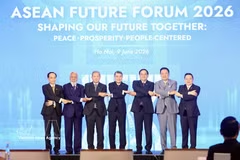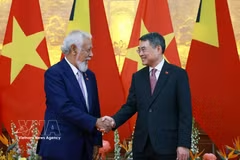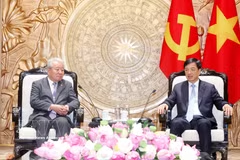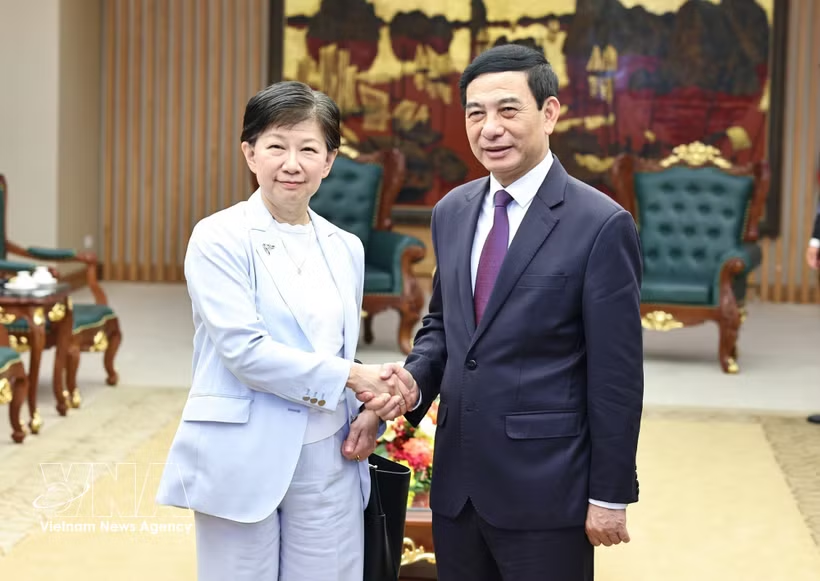
Hanoi (VNA) - Deputy Prime Minister Phan Van Giang on June 9 received Izumi Nakamitsu, United Nations Under-Secretary-General and High Representative for Disarmament Affairs, who is in Vietnam to attend the third ASEAN Future Forum (AFF) held in Hanoi from June 9–10.
Giang referred to the remarks delivered by General Secretary of the Communist Party of Vietnam Central Committee and State President To Lam at the 23rd Shangri-La Dialogue in late May, noting that the world is undergoing profound changes amid crises relating to the international order, development models and strategic trust.
Against the backdrop of increasingly complicated global political and security developments, the Deputy PM reaffirmed Vietnam’s consistent foreign policy of independence, self-reliance, peace, friendship, cooperation and development. He reiterated the country’s strong support for multilateralism, international law and the central and irreplaceable role of the UN in promoting a peaceful, stable and prosperous world.
He emphasised that Vietnam has actively and responsibly contributed to the UN’s common efforts and ongoing reform process, including support for the UN80 initiative launched by the UN Secretary-General to streamline the organisation, improve effectiveness and optimise resources. Vietnam stands ready to facilitate the establishment of additional UN offices and agencies in the country, he said.
Giang called on the UN to continue supporting Vietnam through policy advice, knowledge sharing, technology transfer and resource mobilisation. He also expressed his hope that the two sides will soon finalise the Vietnam–UN Strategic Cooperation Framework for the 2027–2031 period.
He further acknowledged the valuable support of Japan - Nakamitsu’s homeland - for Vietnam in development cooperation and post-war recovery efforts, including unexploded ordnance clearance.
On this occasion, Giang appreciated the role of Nakamitsu and the UN Secretariat in promoting dialogue, confidence-building and multilateral cooperation on disarmament. He reaffirmed Vietnam’s consistent position in support of disarmament and the complete elimination of nuclear weapons, while expressing gratitude for the UN Secretariat’s support during Vietnam’s preparation for and successful Presidency of the 11th Review Conference of the Treaty on the Non-Proliferation of Nuclear Weapons (NPT) in April and May.
The Deputy PM stressed that Vietnam is ready to share its experience in post-war recovery, mine action, victim assistance and the rehabilitation of conflict-affected areas. He also called for greater UN support in disarmament-related training, particularly in addressing emerging security and technological challenges.
For her part, Nakamitsu said she was deeply impressed by General Secretary and President Lam’s keynote address at the 23rd Shangri-La Dialogue, describing it as highly consistent with the UN's ongoing efforts to promote peace, cooperation and sustainable development.
She observed that the world is entering a period of strategic transition marked by increasing fragmentation and division across trade, security, political and military spheres. In this context, Vietnam, drawing on its historical experiences and its remarkable post-war development, is well positioned to play an important role within both the Association of Southeast Asian Nations (ASEAN) and the UN in promoting stability and reducing tensions at the regional and global levels.
Nakamitsu also commended Vietnam’s successful Presidency of the 11th NPT Review Conference, led by Ambassador Do Hung Viet, Permanent Representative of Vietnam to the UN. She noted that member states showed great respect for Vietnam’s leadership and recognised its constructive role in facilitating dialogue, building trust, encouraging substantive exchanges and amplifying the voices of small- and medium-sized countries in nuclear disarmament efforts.
Regarding Vietnam–UN cooperation, Nakamitsu affirmed that Vietnam is an exemplary partner of the UN and praised the Government’s leadership and strategic vision. She affirmed that the United Nations Country Team in Vietnam will continue supporting the country’s development objectives and international commitments.
She also expressed her readiness to support and encourage the nation’s greater participation in international disarmament training and cooperation programmes, including those related to emerging issues such as artificial intelligence governance./.
VNA