Domestic resources – key to achieve development goals: UNDP expert
Vietnam must consistently invest a larger share of national income if it is to achieve the targets set out in the ten-year development strategy of achieving upper middle-income status by 2030 and high-income status by 2045, while coping with formidable challenges of COVID-19, according to Professor Jonathan Pincus, UNDP Senior International Economist.
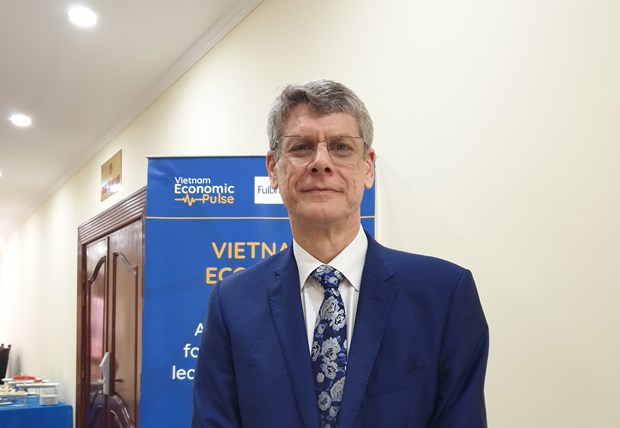 Professor Jonathan Pincus, UNDP Senior International Economist, grants an interview to the press on the sidelines of the Vietnam Economic Pulse forum virtually held on November 5. (Photo: VNA)
At the Vietnam Economic Pulse forum virtually held on November 5, Pincus laid stress on the important role of development finance for post-economic recovery in Vietnam, and said that domestic resource mobilisation is the key to increasing the supply of long-term finance for productive investment.
“Government must play a more active role mobilising resources and structuring incentives to lengthen time horizons, conserve scarce foreign exchange and encourage investment in socially desirable projects”.
Vietnam needs to maintain an investment rate between 35-40 percent of GDP to achieve the country’s economic ambitions, he said, adding the recovery relied heavily on foreign direct investment (FDI), which is expensive and generate foreign liabilities.
Therefore, rebalancing investment toward domestic sources should be a top priority of the Government for the rest of this decade.
He recommended Vietnam reform policy banks as they are a key for the country to sustain a very high rate of investment, which will be needed to recover from COVID-19 as well as other challenges such as climate change.
Talking with the press on the sidelines of the forum, Pincus said Vietnam should perform better in the public sector and financial institutions, adding it is time to have a serious look at banks for social policies to see how these institutions can be more effective.
Asked about Vietnam’s FDI attraction, he said Vietnam should look for projects that bring both new technologies and new products.
The expert said investment in productive activities, particularly in export, is good as export is vitally important to Vietnam since it helps the nation tap into global demand while the domestic market is still too small to drive investment and productivity growth.
Regarding Vietnam’s advantages for post-pandemic recovery, he said Vietnam has still been regarded as a country with tremendous export potential, saying Vietnam is a “really successful exporter of agricultural commodities.”
“There are a lot of emerging industries in Vietnam where Vietnam is still quite competitive and can develop those markets quite quickly.”
Moreover, Vietnam has “a very stable macro situation, very stable wages, very stable exchange rate,” which, Pincus said, helps to build confidence of investors.
National economy expected to grow nearly 2 percent this year
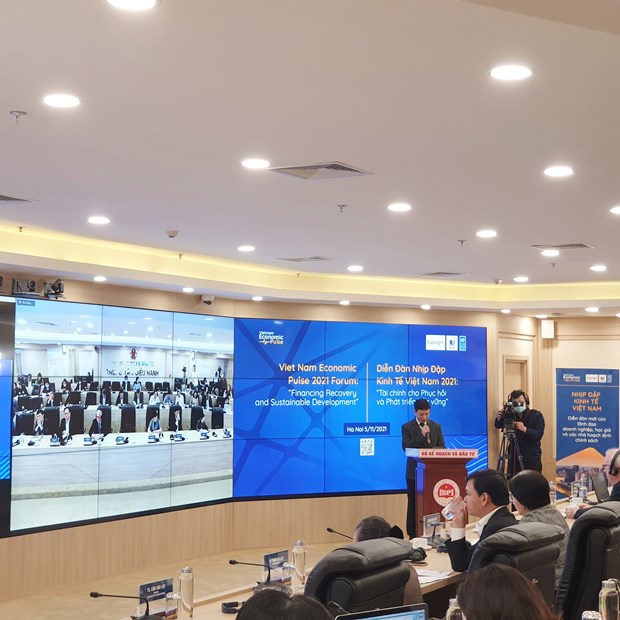 The Vietnam Economic Pulse forum was virtually held on November 5. (Photo: VNA)
In case the pandemic gets worse, the figure is projected at 0.8 percent, Thang said, adding that the country’s GDP growth rate is set at 5.8 to 6.7 percent in 2022 in the highest scenario.
According to Thang, urgent measures are needed in the remaining months of the year as well as the first months of 2022, especially those to contain the COVID-19 pandemic and remove roadblocks to the national economy.
Other experts at the forum said apart from measures to control the pandemic and increase vaccination coverage, Vietnam should work harder to support businesses and people to overcome difficulties in the short term.
However, attention should be paid to policy implementation cost and the efficiency of the policies, they noted.
Dr. Vo Tri Thanh, former deputy head of the Central Institute for Economic Management (CIEM), suggested the government continue with economic reform and restructuring programmes.
Meanwhile, businesses need to optimise opportunities presented by free trade agreements (FTAs) and step up innovation, creation and digital transformation, he added.
Pham Chi Lan, an experienced economist in Vietnam, who is also the Former General Secretary and Vice President of Vietnam Chamber of Commerce and Industry (VCCI), Member of the Prime Minister's advisory board, said that it is necessary to sketch out larger, longer and more rational support packages for local firms to recover their production since the previous ones still showed significant limitations such as complicated business procedures and impractical support.
Most importantly, businesses should receive support in improving their competitiveness and management capacity so that they can better develop in the future, she added./.



You should also see

China’s fishing ban in East Sea violates Vietnam’s sovereignty: spokesperson
Foreign Ministry spokesperson Pham Thu Hang on April 25 said Vietnam’s consistent stance on China’s fishing ban in the East Sea, which has been affirmed clearly over the past years.


See more
 Business
Labels on foods exported to Singapore must be accurate: Trade counselor
Counsellor Cao Xuan Thang, head of the Vietnam Trade Office in Singapore, has advised Vietnamese exporters to pay attention to labeling pre-packaged food products to ensure their credibility and image of businesses when exporting to the Singaporean market.
 Business
April 25 gold bullion auction cancelled
The State Bank of Vietnam (SBV) has announced that it canceled the gold bullion auction scheduled for April 25 morning as only one business submitted its bidding form.
 Business
High airfares create chance for short-distance trips for Reunification Day holiday
Due to a hike of air ticket prices for domestic flights, Vietnamese tourists are turning to short-distance trips for the upcoming National Reunification Day (April 30) and May Day (May 1) holidays.
 Business
Phu Yen, Ninh Thuan attractive to energy project developers
The south-central coastal provinces of Phu Yen and Ninh Thuan have become attractive destinations for investors operating in the energy industry thanks to great potential for renewable energy development.
 Business
Petrovietnam posts 9-billion-USD revenue in Q1
The Vietnam National Oil and Gas Group (Petrovietnam) saw total estimated revenue of 231 trillion VND (9 billion USD) from production and business activities in the first quarter of 2024, exceeding the set quarterly plan by 33% and up 19% year-on-year, head a conference held by the group recently.
