Dropping fertility rates raise alarm
Authorities are alarmed at the declining fertility rates in Ho Chi Minh City and southern provinces.
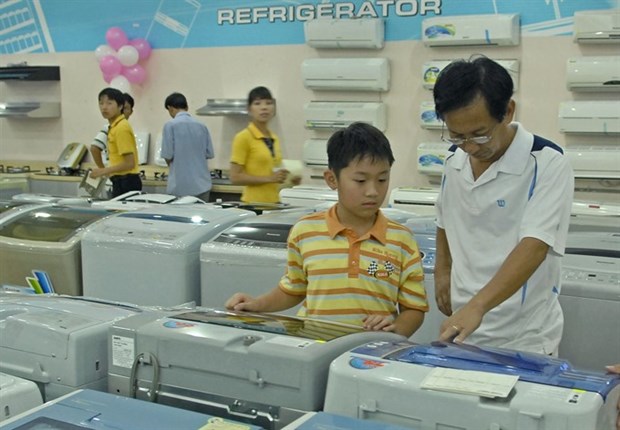 Authorities are alarmed at the declining fertility rates in Ho Chi Minh City and southern provinces. (Photo: VNA)
HCM City (VNA) - Authorities are
alarmed at the declining fertility rates in Ho Chi Minh City and southern
provinces.
The issue was brought to the forefront following comments by the Secretary of the HCM City Party Committee this week encouraging more births in the country’s largest metropolis.
Pham Thi My Le, deputy head of the HCM City Department of Population and Family Planning, said total fertility, or the number of births per woman, was 1.45 in 2015 – significantly lower than the national replacement fertility rate of 2.1 for the country. Similar rates have been observed throughout the southeastern region as well as 13 provinces of the Mekong Delta region, with fertility rates hovering at around 1.8 and 1.9, respectively – two regions with the lowest fertility rates in the country.
For a small country that occupies 14th place in the global ranking in terms population and has already posted a stable annual population increase of over 1 percent in the last decade, clamouring for more childbirths seem counter-intuitive.
However, experts are concerned because the low fertility in the south is occurring even though this region is more developed and people can afford the costs of child-rearing. On the other hand, the Red River Delta region (barring the capital city of Hanoi) does not enjoy the same level of development as HCM City, the southeastern region and Mekong Delta region, but posted a fertility rate of 2.3 and the trend is looking up. The same thing is true of mountainous areas in the north or Central Highlands, with their remote locations and high concentration of ethnic minorities, suffering economic hardship.
Low fertility rates in more developed areas, such as HCM City, the biggest economic hub of Vietnam, are attributed to high living costs as well as high demands of the population regarding education and other child-rearing aspects. In addition, the number of women waiting longer to get married and bear children due to job pressures, or those who decide not to bear children, are also on the rise as modernisation and urbanisation expands.
Two children each
This situation has made authorities in some localities change their motto to “every couple should have two children,” from the previous “a couple should bear one or two children for better rearing.”
Two children in one family will help prevent the undesired “4-2-1 pyramid structure”, where a sole child is expected to care for four grandparents (both on his/her mother’s and his/her father’s side) in addition to his/her parents, said Nguyen Viet Tien, Deputy Minister of Health.
Secretary Nguyen Thien Nhan told the media after a HCM City People’s Council meeting that Government efforts to maintain replacement fertility in the last decade are important for the "golden population" period – where for every two people of working age, there is one dependent person, and is considered by the United Nations as the once-in-a-country’s lifetime "golden opportunity" for socio-economic development.
Nhan said HCM City already has a balanced gender ratio of childbirths, but the city’s declining fertility rate might spell a negative future for the country if the fertility rate fails to counter the ageing process. An ageing population would leave the country short of labour, adversely impacting the economy and a progressively onerous burden on the country’s social security system.
However, it should be said that family planning will not be forgone in favour of increasing fertility rates, at least for the time being, since the government has not yet officially allowed HCM City to conduct “birth promotion” measures. In the meantime, local media will be tasked with “calling for the city’s citizens to be dutiful to the two-child policy.”
The national policy should be “malleable” to adapt to each locality’s situation, said health deputy minister Tien.
Childbirth is not just a familial private matter but also a “national concern that decides the existence of a country,” as Secretary Nhan once said.-VNA
The issue was brought to the forefront following comments by the Secretary of the HCM City Party Committee this week encouraging more births in the country’s largest metropolis.
Pham Thi My Le, deputy head of the HCM City Department of Population and Family Planning, said total fertility, or the number of births per woman, was 1.45 in 2015 – significantly lower than the national replacement fertility rate of 2.1 for the country. Similar rates have been observed throughout the southeastern region as well as 13 provinces of the Mekong Delta region, with fertility rates hovering at around 1.8 and 1.9, respectively – two regions with the lowest fertility rates in the country.
For a small country that occupies 14th place in the global ranking in terms population and has already posted a stable annual population increase of over 1 percent in the last decade, clamouring for more childbirths seem counter-intuitive.
However, experts are concerned because the low fertility in the south is occurring even though this region is more developed and people can afford the costs of child-rearing. On the other hand, the Red River Delta region (barring the capital city of Hanoi) does not enjoy the same level of development as HCM City, the southeastern region and Mekong Delta region, but posted a fertility rate of 2.3 and the trend is looking up. The same thing is true of mountainous areas in the north or Central Highlands, with their remote locations and high concentration of ethnic minorities, suffering economic hardship.
Low fertility rates in more developed areas, such as HCM City, the biggest economic hub of Vietnam, are attributed to high living costs as well as high demands of the population regarding education and other child-rearing aspects. In addition, the number of women waiting longer to get married and bear children due to job pressures, or those who decide not to bear children, are also on the rise as modernisation and urbanisation expands.
Two children each
This situation has made authorities in some localities change their motto to “every couple should have two children,” from the previous “a couple should bear one or two children for better rearing.”
Two children in one family will help prevent the undesired “4-2-1 pyramid structure”, where a sole child is expected to care for four grandparents (both on his/her mother’s and his/her father’s side) in addition to his/her parents, said Nguyen Viet Tien, Deputy Minister of Health.
Secretary Nguyen Thien Nhan told the media after a HCM City People’s Council meeting that Government efforts to maintain replacement fertility in the last decade are important for the "golden population" period – where for every two people of working age, there is one dependent person, and is considered by the United Nations as the once-in-a-country’s lifetime "golden opportunity" for socio-economic development.
Nhan said HCM City already has a balanced gender ratio of childbirths, but the city’s declining fertility rate might spell a negative future for the country if the fertility rate fails to counter the ageing process. An ageing population would leave the country short of labour, adversely impacting the economy and a progressively onerous burden on the country’s social security system.
However, it should be said that family planning will not be forgone in favour of increasing fertility rates, at least for the time being, since the government has not yet officially allowed HCM City to conduct “birth promotion” measures. In the meantime, local media will be tasked with “calling for the city’s citizens to be dutiful to the two-child policy.”
The national policy should be “malleable” to adapt to each locality’s situation, said health deputy minister Tien.
Childbirth is not just a familial private matter but also a “national concern that decides the existence of a country,” as Secretary Nhan once said.-VNA





You should also see

Vietnam, China promote judicial cooperation
Minister of Justice Le Thanh Long held talks with his visiting Chinese counterpart He Rong in Hanoi on April 19 to discuss measures to promote judicial cooperation between the two countries.


See more
 Health
Vietnam has first int’l trauma life support training centre
The International Trauma Life Support (ITLS) Training Centre under the Ministry of National Defence’s Military Hospital 175 officially made its debut in Ho Chi Minh City on April 15.
 Health
First southern pediatric organ transplant centre to become operational in 2025
The first pediatric organ transplant centre in Vietnam’s southern region is scheduled to be completed and put into operation on the occasion of the 50th anniversary of the Liberation of the South and National Reunification Day (April 30, 1975 - 2025).
 Health
Free surgeries offered for cleft palate children in Thua Thien-Hue
About 80 children with cleft palate in the central province of Thua Thien-Hue and surrounding localities are to receive free check-ups and surgeries from now until April 18.
 Health
Vietnam to host first int’l airway management conference
International airway experts from across the world, including the United Kingdom, United States of America, France, Italy, New Zealand, and experts from Vietnam will gather at the first South East Asian Conference of the World Alliance of Airway Management (WAAM) in Hanoi on April 13-14.
 Health
Health insurance coverage necessary for all TB patients: Deputy PM
Deputy Prime Minister Tran Hong Ha on April 8 requested the Ministry of Health to work with the Vietnam Social Security and the Ministry of Labour, Invalids and Social Affairs to provide health insurance coverage for all tuberculosis (TB) patients.
