Hanoi (VNA) – The Ministry of Finance has added environmentally-friendly cars to the list of vehicles with spareparts entitled to special preferential import tariffs under the draft decree amending and supplementing Decree No.125/2017/ND-CP on import tariff and preferential import tax table, list of goods and absolute tax, mixed tax and import tax outside the quota.
 Preferential import tax programme for auto parts is currently applied for gas-using vehicles
(Photo: VietnamPlus)
Decree No.125/2017/ND-CP, which took effect on January 1, 2018, has contributed greatly to developing the supporting industry for the automobile and many other engineering sectors, while helping increase revenue to the State budget.
According to a sales report from the Vietnam Automobile Manufacturers’ Association (VAMA), the automobile sale as of the end of December last year was estimated to rise 5.8 percent year on year.
Notably, contributions by Toyota, Hyundai Thanh Cong Vietnam Auto JSC and Truong Hai Auto Corporation to the State budget in 2018 increased some 7.3 trillion VND as compared to the previous year.
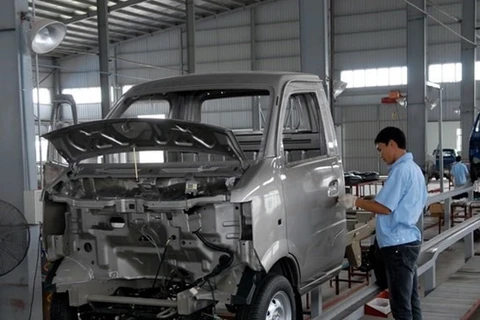
However, the decree exposed some flaws after one year of implementation. According to the existing regulations, the preferential import tax programme for auto parts is currently applied for gas vehicles, including under-nine-seater cars below 2,500cc, mini buses, buses, passenger cars, and trucks.
Eco-vehicles were not entitled to the preferential policy as there were no businesses manufacturing this kind of car at the time Decree No.125/2017/ND-CP was developed.
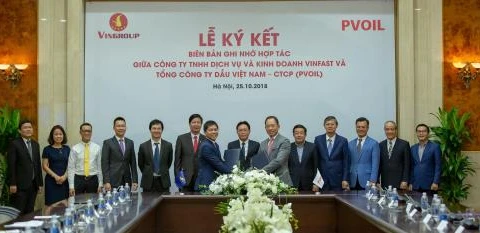
The finance ministry said that several domestic firms had plans to assemble and produce eco vehicles like electric and hybrid cars, such as VinFast, a subsidiary of Vingroup, who already sent a document to the ministry saying that it would produce some 10,000 compact cars and 500 buses in 2020, 15,000 compact cars and 1,000 buses in 2021, and 20,000 compact cars and 1,500 buses in 2022. The firm also recommended the ministry to expand tax preferential scheme to cover electric vehicles.
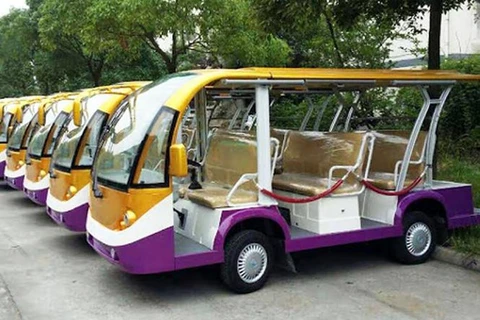
In a bid to support the development of the country’s eco vehicle production, the ministry submitted a proposal recommending the Government to develop preferential tax policies for auto parts of eco vehicles such as electric cars, hybrid cars, vehicles using on biofuels, and those using compressed natural gas (CNG).
“The definition of the kinds of automobile engines and fuels, stated in the Vietnam Register’s certifications on quality, technical safety and environment protection, will decide whether the vehicles are classified into the list of eco-friendly cars or not,” the draft decree said.
Earlier, the Ministry of Finance planned to eliminate the import tax for auto materials and parts in order to support the development of the country’s automobile industry.
The tax cut was included in the Government’s revised decree on the schedule for preferential import tariffs, flat taxes, compound tariffs and out-of-quota import tariffs.
The Ministry of Finance said it will develop preferential tax policies for raw materials and parts for automobile manufacturing and assembly from now until 2023.
This decree is expected to remove bottlenecks in the development of prioritised industries, including the automobile industry, and promote the strengths of part suppliers to increase the localisation rate (the percentage of parts produced locally).
Under the Comprehensive and Progressive Agreement for Trans-Pacific Partnership (CPTPP), which came into force on December 30, 2018, the import tax on completely built-up cars (CBUs) from CPTPP member countries will gradually fall from 70 percent to zero over the next seven to nine years.
The Europe Union - Vietnam Free Trade Agreement (EVFTA), which was signed on June 30 this year, includes a similar commitment. It stipulates that the import tax on CBUs from EU countries will gradually decrease to zero percent after nine to 10 years.
The import duty was eliminated for cars from ASEAN countries last year. By 2030, the Vietnamese automobile market will be fully open to major automobile production centres around the world including Japan, Mexico and the EU.
The ministry said Vietnam’s part suppliers are mainly small- and medium-sized enterprises with low production capacity. Among about 1,800 sparepart businesses, only about 300 are participating in the production networks of multinational corporations./.