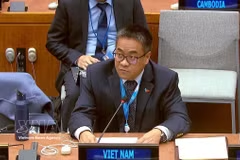
Minister Counsellor Nguyen Hai Luu, Deputy Permanent Representative of Vietnam to the UN, expressed deep concern over the dire humanitarian situation in Gaza, particularly as recent heavy rains and flooding have worsened living conditions for residents.
Reviewing the visit’s major achievements, the editorial highlighted its outcomes in various fields, including politics, economy, science, technology and innovation, human resources training, and people-to-people ties.
Although the diversification of oil import sources has helped reduce the risk of domestic oil shortage, it has not immediately reduced energy costs because import prices depend on market mechanisms, transportation costs, foreign exchange rates and the terms of oil contracts.
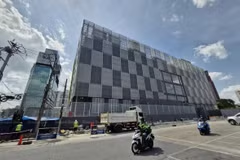
The new rules focus on controlling investment scale, electricity and water consumption, environmental impacts, and preventing investors from reserving resource quotas beyond their actual needs.
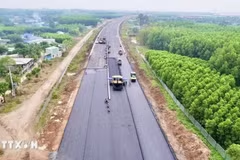
ADB estimates that the region will need an average of 476 billion USD in infrastructure investment annually during 2026–2040, equivalent to 8.7% of GDP. However, at current investment levels, government budget resources would cover only around 45% of this demand, leaving an annual financing gap of 264 billion USD.
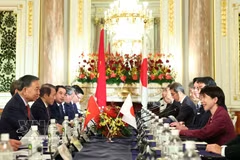
Japanese media have continued extensive coverage of General Secretary of the Communist Party of Vietnam (CPV) Central Committee and President To Lam’s activities in Japan, highlighting his meetings with representatives of leading financial institutions at the Tokyo Stock Exchange, witnessing of cooperation agreement signing and participation in cultural exchanges.
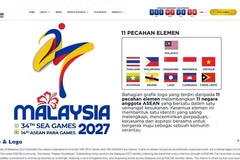
Malaysia officially launched the official website for SEA Games 2027 at www.seagamesmalaysia2027.org on November 10.
The draft agreement stipulates that ACPHEED will comprise three specialised centres based in three ASEAN member states. Vietnam will oversee the centre for prevention and preparedness; Indonesia will host the centre for detection and risk assessment; and Thailand will be responsible for the centre for response and risk communication.
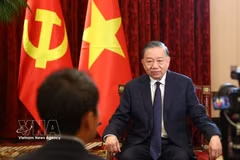
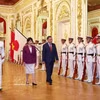
Vietnam hopes to enter a new stage of development together with Japan, in which each country's achievements create new opportunities for the other and bring practical benefits to their people, said top Vietnamese leader To Lam.
The Jakarta Globe said that Vietnam’s GDP per capita is expected to increase 8.9% to 5,259 USD in 2026, surpassing Indonesia’s projected 5,153 USD. This would place Vietnam fifth in ASEAN, after Singapore, Brunei, Malaysia and Thailand.
The Vietnamese leader said he hopes Japanese businesses will expand their investments and cooperation as there is a need for his country to develop human talent and enhance technological capability in advanced fields such as semiconductors, AI and clean energy.
A representative office in Laos could help connect business networks, create new opportunities for Lao women entrepreneurs and strengthen economic cooperation between Laos, BRICS and ASEAN.
Head of the Convention and Marine Resource Balance working team at the ministry’s Directorate of Ecosystem Conservation Ahmad Sofiullah said this week that it is a strategic effort to ensure the sustainability of Indonesia’s marine ecosystems.
Singapore aims to have sustainable aviation fuel (SAF) account for 1% of total jet fuel consumption at Changi and Seletar airports in 2027, rising to 3-5% by 2030.
Cambodia has launched the “Clean Phnom Penh 2026” campaign to raise public awareness, promote a civilised lifestyle and foster positive social behavioural standards.
At COP31, Indonesia plans to host 67 dialogue sessions at its pavilion, focusing on clean energy transition, green industry, nature-based solutions, climate finance and climate justice.
The project is being supported by the World Wildlife Fund For Nature (WWF) and the Lancang–Mekong Cooperation Special Fund.
Recent fluctuations in global energy markets highlighted the need for ASEAN member states to improve preparedness and cooperation. Stockpiling cooperation will enable ASEAN to strengthen energy security while optimising costs through resource sharing.
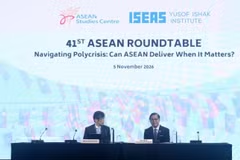
Thai Deputy Prime Minister and Minister of Foreign Affairs Sihasak Phuangketkeow noted that no single member state could tackle challenges ranging from major-power competition and economic fragmentation to climate change and energy and food security on its own. Regional cooperation is therefore a strategic imperative, enabling ASEAN not only to overcome crises but also to sustain its development momentum.
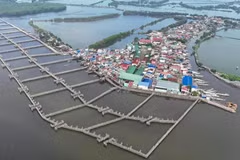
Rather than relying entirely on concrete sea walls and embankments, the project combines bamboo poles, tree branches and oyster shells to reduce wave energy, trap sediment and create favourable conditions for mangrove restoration.