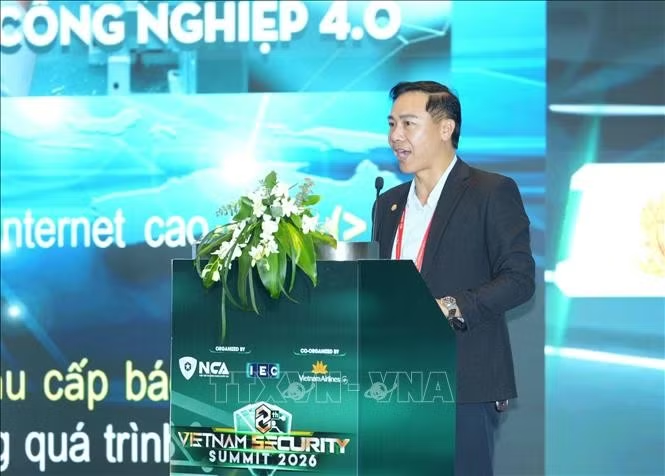
Hanoi (VNA) – Experts at the Vietnam Security Summit 2026 in Hanoi on May 22 called for stronger measures to protect personal data and enhance cybersecurity resilience amid rising cyber threats.
Speaking at a session on data security and digital identity, Senior Lieutenant Colonel Nguyen Dinh Do Thi of the Ministry of Public Security’s Department of Cybersecurity and High-Tech Crime Prevention (A05) said the world regards data as the “new oil.” For Vietnam, data is also identified as an important national resource and asset, the “lifeblood” of the digital economy and digital transformation. Ensuring data security is an urgent requirement and a continuous task that cannot be separated from the process of national digital transformation.
He said that more than 30 types of cybercrime and high-tech crimes, especially online scams, regard personal data as a “new gold mine.” Before committing crimes, offenders collect and fully acquire detailed information and data about their “targets.” Thanks to this vast database of personal information, criminals can operate on an “industrial scale” using sophisticated methods, with hundreds of scenarios linked to hot and timely issues, making it easier to deceive people.
The reality of illegal trading and appropriation of personal information and data is widespread, especially on social media platforms, underground forums, closed groups, dark web sites, and the deep web. Personal data is categorised in detail for sale, including both basic and sensitive information: full name, date of birth, address, email, phone number, national ID number, bank account details, and more.
Many companies and technology corporations use specialised software and tools to illegally collect and exploit users’ personal information and data, he noted.
According to Thi, authorities handled more than 30 cases involving the illegal sale and theft of personal data between 2023 and 2025, affecting over 160 million data records across sectors including health, education, finance, banking and telecommunications.
To protect personal data, he recommended a “five-don’t” approach, including do not share personal information online; do not connect smartphones, memory cards or USB devices to computers containing sensitive data; do not click suspicious links; do not open files from unknown sources; and do not transfer money or follow instructions from strangers via phone calls or messaging applications.
He also urged organisations and businesses to strengthen compliance with data protection regulations and adopt comprehensive security measures throughout the data-processing lifecycle.
At another session, Henry Nguyen, Business Manager of Synology Vietnam, said more than 55% of businesses in Southeast Asia have experienced ransomware issues or attempted attacks in recent years, reflecting the persistent and ongoing nature of this risk to business operations.
Data protection is no longer just about backup, but also about the ability to recover when incidents occur, he noted.
One of the solutions proposed by Synology is a data protection platform designed to help businesses build cybersecurity resilience in a more centralised, simplified, and easier-to-deploy manner, he said, adding this solution supports enterprises in strengthening their backup and data recovery capabilities, enhancing backup security through mechanisms such as immutable backups and network isolation, while also improving governance and access control across the entire data protection environment.
The Synology representative also emphasised a multi-layered approach to data protection. Accordingly, businesses not only need data copies, but must also ensure that these copies are recoverable, properly isolated, and maintain integrity when incidents occur. This also serves as a foundation for businesses to minimise disruptions, protect business operations, and maintain customer trust./.