Foreign exchange rates eat into car sales

Unfavourable foreign exchange rates in February have taken a toll on the sales of imported automobiles.
Unfavourable foreign exchange rates inFebruary have taken a toll on the sales of imported automobiles.


Total sales by members of the Vietnam Automobile ManufacturersAssociation (VAMA) reached just 7,889 units in February, a decrease of24 percent from January sales, with passenger car and SUV salesdeclining by an even more substantial 35-37 percent, according to VAMArepresentative Nguyen Anh Tuan.

January auto sales hadtotalled 10,424 units, an increase of 48 percent over the prior Januarybut still 17 percent lower than sales in December 2010.

Imports of completely-built units (CBUs) fell from 6,100 units inJanuary to just 4,500 in February, according to figures from the GeneralStatistics Office.

Meanwhile, marques such as Toyota,Ford, GM Daewoo, Mercedes-Benz, BMW and Hyundai have all increasedtheir retail prices substantially since the devaluation of theVietnamese dong against the US dollar last month.

Toyota's sticker prices have risen by 34-101 million VND (1,619-4,809 USD),while Ford has hiked prices by 37-64 million VND (1,761-3,047 USD) andHonda by 13-32 million VND (619,000-1,523 USD) per vehicle. A buyer of aHonda Accord 3.5 AT, for instance, can now expect to pay 50 million VNDmore.

Tran Kien, a car dealer on Le Van Luong Streetin Hanoi , said auto sales slowed substantially in February. Manyautomobile dealers were also ceasing imports of new cars with the aim offirst selling existing inventories, he said.

Thecontinued rise of the dollar, higher interest rates on consumer loans,and higher VAT and registration fees would add up to a sluggish carmarket this year, Kien predicted. /.
See more

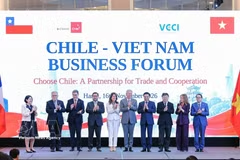
Delegates pose for a photo at the Chile-Vietnam Business Forum in Hanoi on November 16 (Photo: VNA)

Vietnam, Chile seek to expand trade ties

Chilean President José Antonio Kast pointed to potential for cooperation in agriculture and food, and called for stronger technical cooperation, better market access and closer links in innovation, technology, services and sustainable development.

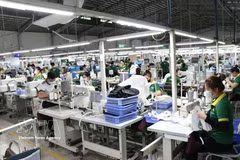
Production of footwear for export at Lefaso Tra Vinh Industrial Investment and Production Joint Stock Company, Tra Cu commune, Vinh Long province (Illustrative image. Source: VNA)

VEFTA implementation requires exporters to restructure supply chains: Experts

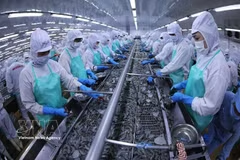
Under VEFTA, tariff reductions to zero will be meaningless for Vietnam’s key export sectors, including textiles and garments, footwear, and agricultural and aquatic products, if goods are found to contain banned chemicals, violate rules of origin or lack transparency regarding their carbon footprints.

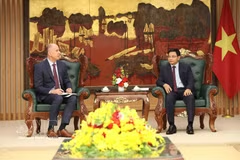
Deputy Prime Minister Nguyen Van Thang meets with Martin Sommer, head of the IMF’s Article IV consultation mission team to Vietnam, in Hanoi on November 13, 2026. (Photo: VNA)

IMF sees positive growth prospects for Vietnam, urges cautious monetary policy

Martin Sommer, head of the IMF’s Article IV consultation mission team to Vietnam, noted that inflation risks in Vietnam remain under control, but several factors could add to price pressures. He therefore called for cautious monetary policy management and readiness to respond promptly if inflationary pressures increased.

Representatives of the three first-prize-winning startups receive their awards at the event. (Photo: SGGP)

Seven green-tech startups secure 770,000 USD at Net Zero Challenge 2026

In its fourth year, the competition attracted more than 1,100 applications from 80 countries and territories, making it the most competitive edition since its launch in 2023. Nine finalists presented solutions in three categories, namely renewable energy and carbon removal; food systems and sustainable agriculture; and circular economy and waste management.

Vietnamese and Malaysian businesses connect at the event (Photo: VNA)

Vietnam, Malaysia connect businesses to boost bilateral trade cooperation

It centred on a business-to-business (B2B) matchmaking session, bringing Vietnamese and Malaysian companies together to discuss import-export needs, seek partners and explore cooperation. Vietnamese businesses aimed to connect with Malaysian importers, distributors and retailers, while expanding access for their products to Malaysia and other markets.