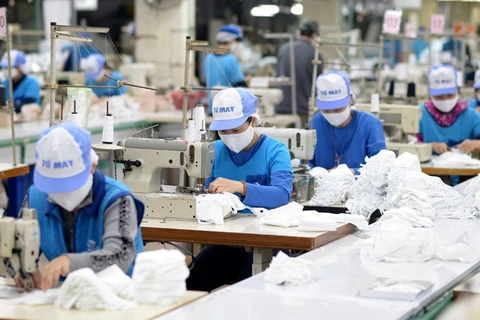
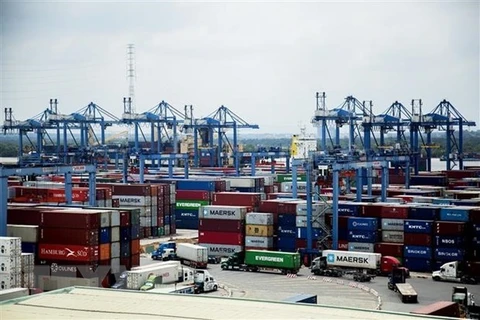
In the first 10 months of this year, total value of garment and textile exports reaches more than 33 billion USD (Photo: VNA)
 In the first 10 months of this year, total value of garment and textile exports reached more than 33 billion USD, down 12.45% year-on-year. In October, the sector saw a sign of recovery when earning 3.2 billion USD from exports, up 5.28% month-on-month, and 2.96% year-on-year.
The US is currently Vietnam’s biggest apparel importer, accounting for over 40% of the market share, followed by Japan, the EU, the Republic of Korea, and China.
According to insiders, in the gloomy picture of the market over the past 10 months, the only silver lining is high growth from countries participating in the Comprehensive and Progressive Agreement for Trans-Pacific Partnership (CPTPP) such as Japan, Canada, Australia, and New Zealand.
In addition, the country has gained access to several new markets in Africa and the Middle East, which is expected to help keep the industry's export turnover from decreasing deeply in the context of sharp reductions in global market demand.
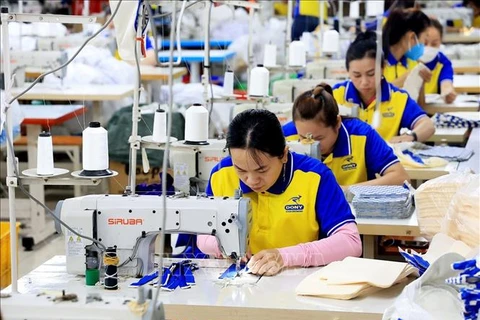
 Illustrative image (Photo: VNA)
 Regarding tasks for the last month of 2023, experts advised businesses to re-organise production to increase labour productivity, meet small orders, and arrange appropriate human resources to optimise labour costs.
Chairman of Vietnam Textile and Apparel Association (Vitas) Vu Duc Giang emphasised that businesses must quickly change themselves and adapt to market fluctuations.
He stressed the need to organise vocational skills classes and human resources training for green and digital transformation, in order to improve labour productivity and competitiveness.
In addition, it is necessary to retain customers by accepting small orders, while promoting the exploitation of new markets and reducing costs to step up production and business activities, and boost growth, added Giang./.
VNA