Gov't ignores affordable housing for low-income earners: experts
Four years ago, the State Bank of Vietnam (SBV)’s preferential loan credit package of 30 trillion VND (1.29 billion USD) helped thousands of low-income people purchase low-cost apartments in big cities.
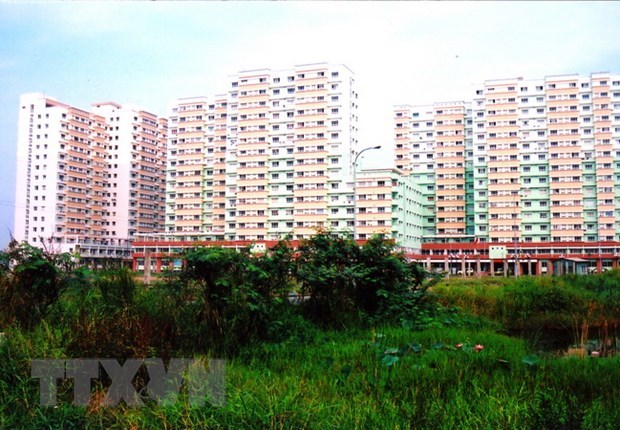 Illustrative image (Source: VNA)
HCM City (VNS/VNA) – Four years ago, the State Bank of Vietnam (SBV)’s preferential loan credit package of 30 trillion VND (1.29 billion USD) helped thousands of low-income people purchase low-cost apartments in big cities.
However, since the credit package stopped disbursing funds in mid-2016 many people have given up their dream of home ownership because of surging prices.
Hoang Thi Thuy Van, 48, in Ho Chi Minh City’s Thu Duc district, was able to buy a low-priced apartment four years ago thanks to the preferential credit package, but many people still cannot afford to buy a home.
“I feel much more fortunate than many of my colleagues who have not been able to buy an apartment,” she told Vietnam News.
Current housing prices are too high for them, no matter how much money they save, she said.
“I once thought of moving closer to the city centre in Binh Thanh or Phu Nhuan districts, but have decided to give up as the price is far beyond what I can afford,” she said.
The real estate market has experienced several so-called fever periods in recent years, pushing up property prices to a level that is unaffordable for people with low or modest incomes.
For example, a 70-sq.m one-bedroom apartment in an upscale project in Binh Thanh district which borders district 1, could cost up to 4.5 billion VND (nearly 200,000 USD), a broker in the district who has been in the industry for 10 years told Vietnam News.
A small house in a side alley without access for a car in district 4 or Phu Nhuan district could cost up to 5 billion VND (215,000 USD), he said.
For houses on large streets in central districts like districts 1, 3 and other nearby districts like Binh Thanh, Phu Nhuan and district 4, the prices were too expensive for most people, the broker said.
The real estate market is suffering a severe shortage of affordable homes despite huge demand, experts have said.
The property products in the country do not match market demand, especially in major cities like Hanoi and HCM City. The supply of high-end apartments is plentiful while there is a shortage of affordable housing.
Since mid-2017, the Grade C apartment segment (affordable apartments priced under 1,000 USD per sq metre) has seen a sharp decline in supply, according to research conducted by DKRA Vietnam, a joint-stock property company.
Grade A apartments (high-end segment priced from 1,800-3,000 USD) and Grade B apartments (mid-range segment priced from 1,100-1,800 USD) are far more plentiful than Grade C apartments.
Worse still, there are times when the affordable segment has no new supply, according to DKRA’s research.
Under the 30 trillion VND loan package administered previously by the government, homeowners could buy an affordable apartment with an area of 70 square metres or below at 15 million VND per square metre.
Le Hoang Chau, Chairman of HCM City Real Estate Association (HoREA), said the imbalance between supply and demand in the affordable segment was a sign of unsustainable development in the market.
The affordable apartment segment accounted for the smallest proportion of available housing, followed by the mid-end and high-end segments, which should instead account for the smallest percentage, he said.
“It’s very likely that affordable housing will not even exist in the near future unless the Government takes action,” he noted.
In a recent meeting between real estate businesses and HCM City leaders, Nguyen Van Duc, Deputy Director of Dat Lanh Real Estate Company, said the supply of low-cost housing had gradually plummeted in the city in recent years.
More than 10 years ago, some real estate enterprises in the city such as Khang Gia, Nam Long, Dat Lanh and Le Thanh invested in low-priced houses.
“However, not many of them are implementing such projects now,” he said.
Dat Lanh Company, for example, faced a shortage of capital to implement new low-cost projects.
The lack of investment was due to low profits from such housing, Duc said, adding that if material prices or bank interest rates increase, the company could face losses.
“Investing in low-cost housing has low profits, only about 1-2 million VND per square metre,” he said.
Le Huu Nghia, Director of Le Thanh Real Estate Company, said that real estate businesses were more interested in high-end housing because of far higher profits.
The problem had been made worse by challenges in accessing credit, complicated administrative procedures and a lack of land available for construction, he said.
Experts said that Vietnam should develop new preferential policies in land, tax, interest rates, credit and mortgages for affordable home developers, and allow the development of apartments of different sizes.
Developing affordable homes is an urgent issue as rapid urbanisation is putting pressure on city infrastructure, such as power grids, water networks and schools, they said.
Chau, Chairman of HoREA, said: “The demand for affordable housing is huge in HCM City, and regulations on low-cost housing should be issued.”
According to statistics from the Central Institute for Economic Management, on average more than 1 million people migrate from rural areas to large cities like Hanoi and HCM City each year. The figure is expected to continue to rise.
It is estimated that demand for affordable homes accounts for around 60-70 percent of total market demand, but the supply is less that 20 percent.
Apartments of less than 60 square metres with prices of less than 700 million VND (30,090 USD) account for only five percent of market supply.
According to statistics from the Ministry of Construction, by next year around 1.7 million people will be in need of homes in urban areas together with 1.7 million workers demanding stable accommodations, requiring the development of nearly 1 million apartments.-VNS/VNA





You should also see

Vietnamese Deputy PM, Venezuelan President hold talks
Vietnamese Deputy Prime Minister Tran Luu Quang held talks with President of Venezuela Nicolás Maduro Moros in Caracas on April 18, as part of his ongoing official visit to the Latin American country.



See more
 Society
Hanoi’s virtual monthly passes help commuters travel with ease
Hanoi’s virtual monthly passes for public transport have been on offer for almost one month now, making travel more convenient for the city's commuters, reported the Hanoi Public Transport Management Centre.
 Society
Overseas Vietnamese in Russia commemorate Hung Kings
Overseas Vietnamese in Russia on April 18 held a ceremony in Moscow to mark the death anniversary of Hung Kings, the legendary nation founders.
 Society
Amended Land Law - breath of fresh air blown into real estate market: lawyer
The amended Land Law, approved by the National Assembly in January 2024, is expected to exert impacts on the business activities of overseas Vietnamese (OVs), including those in Australia., said a lawyer.
 Society
Green growth – a pillar of Vietnam-Australia comprehensive strategic partnership
The Australian Government, through agencies and partners, have launched many official development assistance (ODA) projects in Vietnam, including those on climate change adaptation and clean energy infrastructure.
 Society
Vietnamese in Thailand, Israel commemorate legendary nation founders
The overseas Vietnamese (OVs) communities in Thailand and Israel have held events to commemorate Hung Kings, the legendary founders of the nation.
