Hang Bac street - birthplace of Hanoi’s silver jewellery

Hang Bac is viewed as the “most expensive” among Hanoi’s 36 old streets. In the past, people living on this street relied on three major jobs, involving silver ingot and jewellery making, and money exchange.
Hang Bac street - birthplace of Hanoi’s silver jewellery ảnh 1Foreign tourists show special interest when touring Hang Bac street which house various sophisticated silver stuff (Photo: Vietnam Pictorial)

Hanoi (VNA) - Hang Bac is viewed as the“most expensive” among Hanoi’s 36 old streets. In the past, people living onthis street relied on three major jobs, involving silver ingot and jewellerymaking, and money exchange.

Those three jobs originated from threecraft villages famous for making gold and silver jewellery in the north of ChauKhe in Hung Yen province, Dong Xam in Thai Binh province and Dinh Cong inHanoi.

In the 15th century, Minister of InteriorLuu Xuan Tin, a native of Chau Khe village of Hung Yen, was assigned by a courtof the later Le Dynasty (1428 – 1789) to set up a workshop making silver ingotsin the Thang Long imperial city, which is currently Hanoi.

At that time, silver ingots and gold barswere used as money. Tin brought artisans from Chau Khe to the capital toestablish the workshop. After a while, along with making ingots, artisans beganmaking patterns for gold and silver jewellery.

In the early years of the 19th century,under the reign of the Nguyen Dynasty (1802–1945), the workshop was relocatedto the central imperial city of Hue. Most of Chau Khe artisans remained inThang Long and set up a community at the area which is now Hang Bac street.

From then on, artisans of Dinh Cong andDong Xam craft villages came to settle down in the street. That marked thebirth of Hang Bac street which specialises in crafting gold and silver jewelleryin Hanoi.

Along with the manufacturing and trading ofsilver, shops in the street exchanged silver ingots for chips. Therefore, inthe colonial rule of France, the street’s name in French was Rue de changeurs(silver-exchange street).

Various sophisticated gold and silverjewellery works were crafted by artisans in Hang Bac street. In technicalterms, experts classify their products into two types, including those withoutpatterns such as rings and women and children’s earrings and bracelets, andthose with patterns.

Artisans in Hang Bac street usually make typicalpatterns in their gold and silver jewellery, with four mythical creatures ofdragon, kylin, turtle and phoenix being the most popular. The image of dragonis crafted with the nimble hands of the artisans under a number of themes.Different styles such as eight creatures, eight valuables and eight types offruits, among others, are also meticulously crafted in gold and silver platesand trays.

On gold and silver objects, artisans couldalso carve the images of human or plants symbolising people’s virtues in theeastern culture of truc (small bamboo), mai (ochna flower), orchid andchrysanthemum.

In all carved jewellery made of gold andsilver, there are two prominent characteristics, which are artistic form andmeticulous and lifelike patterns.
 
At present, the street stretches only about0.5 km, but there are hundreds of ateliers of all sizes established bysilversmiths and goldsmiths. Many of those shops are equipped with machines ofmodern technologies from foreign countries, yet there are still families whomaintain the traditional method of manually crafting jewellery.

Not only keeping the job which is passed downto by ancestors, residents in Hang Bac street are also able to maintain thetraditional lifestyle of the people in Hanoi’s Old Quarter. Many households aregood at doing business and become rich, but they still lead a humble life andvalue trust, and stand ready to support others in life as well as in doingbusiness./.
VNA
See more

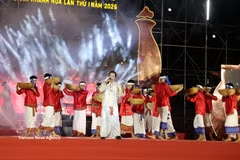
The grand Xoe dance performance with the participation of 2,026 people. (Photo: VNA)

Muong Lo Festival 2026 opens with grand Xoe dance performance

Chairman of the Lao Cai provincial People’s Committee Nguyen Tuan Anh said the province regards culture as the spiritual foundation, an endogenous resource and a driving force for sustainable development, with people at the centre of cultural creation, preservation and enjoyment.

Local residents enjoy bathing in flooded fields during the flood season in the Cong Bung Ren area, Vinh Loi hamlet, Phu Huu commune, An Giang province (Photo: VNA)

An Giang’s flood season bathing offers unique tourism experience

Although the flood season lasts only a few months, bathing in flooded fields offers more than seasonal recreation. For residents of An Giang’s border headwaters, it is a way to strengthen community bonds, preserve childhood memories and share the distinctive riverine culture of the Mekong Delta with visitors.

Delegates at the award ceremony (Photo: VNA)

VNA, Hanoi press agency named outstanding at capital press awards

A group of authors from the Hanoi Press and Radio - Television Agency won the special prize, while A prizes went to Tien Phong newspaper, Quoc Phong Thu Do (Capital Defence) newspaper and the Hanoi Press and Radio-Television Agency. VNA reporters took one B prize and three C prizes.

Vietnam’s Trade Counsellor in Algeria and Tunisia Hoang Duc Nhuan (L) introduces some Vietnamese products on the sidelines of an African trade and investment forum. (Photo: VNA)

Tunisia values Vietnam’s competitive products: Trade Counsellor

According to Vietnam Customs, bilateral trade reached 59.43 million USD in the first nine months of 2026, up 9.7% year-on-year. Vietnam’s exports totalled 45.47 million USD, an increase of 10.2%, while imports from Tunisia stood at 13.96 million USD, up 8.3%.

“Steel Land” tells a moving story of sacrifice and courage among soldiers and residents of Cu Chi during Vietnam's struggles for independence and reunification. (Photo: VNA)

Play brings Vietnamese history, culture to international audiences

Set against the life of Heoric Vietnamese Mother Nguyen Thi Ranh, who lost eight children and two grandchildren during the resistance wars against the French colonialism and US imperialism, “Steel Land” tells a moving story of sacrifice and courage among soldiers and residents of Cu Chi during the country’s struggles for independence and reunification.

A performance of Xuan Pha dance in Thanh Hoa province. The traditional dance was recognised as a national intangible cultural heritage in 2016. (Photo: VNA)

Deputy PM orders nationwide push for first Vietnamese Culture Day

November 24, 2026 marks the first Vietnamese Culture Day, meant to put the Politburo’s Resolution 80-NQ/TW on cultural development into practice. The aim is to embed culture more deeply in social life, letting every citizen create and enjoy it while helping preserve, pass on and enrich the values of Vietnamese culture, country and people.

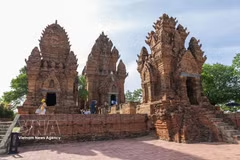
The Po Klong Garai tower complex on Trau Hill in Do Vinh ward, Khanh Hoa province, is one of the finest examples of Cham architecture preserved to this day. (Photo: VNA)

Po Klong Garai: Cham towers preserving centuries of history

The complex comprises three main structures: the Chinh (Main) Tower, Cong (Gate)Tower and Lua (Fire) Tower. The Main Tower stands about 20.5 metres tall, featuring a square base and tiered roofs that narrow towards the top. The Fire Tower, with its distinctive boat-shaped curved roof, adds a contrasting feature to the ensemble. Columns, niches, lotus motifs and decorative patterns adorn the brick walls.

Nguyen Trong Ho (right), head of Vietnam’s delegation to the Asian Para Games 2026, offers encouragement to athletes. (Photo: Vietnam Para Sports Delegation)

Vietnam targets gold at Asian Para Games 2026

Vietnam will send 36 team members, including 21 athletes competing in five sports: athletics (seven), swimming (seven), powerlifting (four), table tennis (two) and badminton (one).

A dance performance celebrates the traditional craftsmanship of the Cham people in Ninh Phuoc commune, Khanh Hoa province. (Photo: VNA)

Preserving Bau Truc pottery heritage in modern life

Bau Truc pottery is distinguished by its traditional handmade techniques. Without pottery wheels or moulds, Cham women use their hands to shape clay, water and fire into unique products that embody the community's folk knowledge, customs, memories and cultural identity.

A drum performance opens the launch of a nationwide campaign calling for all people to practice physical training in Hanoi on October 10, 2026. (Photo: VNA)

Preserving heritage and harnessing cultural strength in a new era

On the morning of October 10, a ceremony was held at Dong Kinh Nghia Thuc Square in Hanoi to launch a nationwide campaign encouraging regular physical exercise under the message “Everyone should choose at least one suitable sport to practise regularly”. The event was held in person and connected online with 33 provinces and cities nationwide.

General Secretary of the Communist Party of Vietnam Central Committee and President To Lam speaks at the ceremony marking the Hanoi Police Football Club's 70th anniversary on October 10, 2026. (Photo: VNA)

Top leader applauds Hanoi Police FC’s 70-year achievements

General Secretary and President To Lam expressed delight at the encouraging signals recorded so far, noting that with its valuable traditions, the enthusiasm of today's youth, and the attention from leaders of the Party, State, Ministry of Public Security, Hanoi Police, and local authorities, the team has every opportunity to thrive.