Hanoi targets 7.5-8 percent export growth in 2018

Hanoi has set a target of 7.5-8 percent in export growth in 2018 as compared to last year, which requires stronger efforts from both the industry-trade sector and businesses.
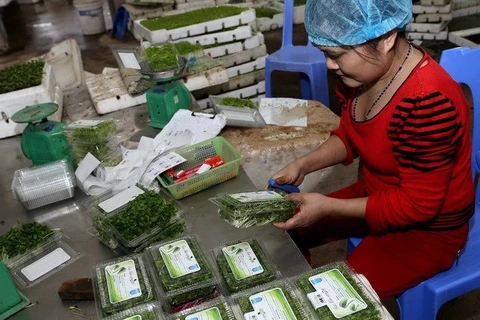
Hanoi targets 7.5-8 percent export growth in 2018 ảnh 1Illustrative image (Photo: VNA)

Hanoi (VNA) – Hanoihas set a target of 7.5-8 percent in export growth in 2018 as compared to lastyear, which requires stronger efforts from both the industry-trade sector and businesses.

The capital city raked in 1.04 billion USD fromexports in January, up 24 percent from the same period last year. 

The revenue included 139 million USD contributedby the State sector (up 9.8 percent), 352 million USD from the non-State sector(up 16.6 percent), and 556 million USD from FDI firms (up 33.6 percent),according to the municipal Department of Industry and Trade.

All key groups of commodities posted strongyear-on-year export growth in January such as agricultural products (13.6 percent),computer components and peripheral devices (68.1 percent), transport vehiclesand spare parts (12.7 percent), machinery and spare parts (21.8 percent), glassand glass products (25 percent).

However, the sale of agricultural products toChina is facing obstacles since this market is tightening plant quarantine. Ithas also encountered strict quality and food safety requirements from the US,the EU and Japan.

Meanwhile, Hanoi’s export still depends on FDIcompanies which dominate the production of processed and manufactured productswith high added value.

Nguyen Gia Phuong, Director of the HanoiInvestment, Trade and Tourism Promotion Agency, said to help businesses expandthe export market and advertise their products, the agency has continually organisedoverseas promotion campaigns, especially the countries that Vietnam has inkedfree trade agreements with.

It has also worked toreceive foreign business delegations so as to help local craft villages andcompanies to seek partners, he added.

Nguyen Thanh Hai, Deputy Director of themunicipal Department of Industry and Trade, noted the department and the HanoiPeople’s Committee will support enterprises in terms of access to loans andmarkets, increase trade promotion in such markets as Japan, China, Hong Kong(China), and Germany, help local companies to diversify export markets.

The department also plans to push ahead withadministrative reforms, abolish unnecessary business conditions, and improveonline public services, Hai said, adding that Hanoi will pay attention topromoting products’ competitiveness, investment effectiveness, and businesses’engagement in global value chains.-VNA
VNA
See more

Toy production at a Hong Kong-invested factory (Photo: VNA)

Vietnam targets deeper market penetration in Hong Kong in 2026

Vietnam-Hong Kong trade hit 62.3 billion USD in the first 11 months of 2025, soaring 73.1% annually. Vietnamese exports to Hong Kong amounted to 36.8 billion USD, a 90.6% hike, ranking fourth among Hong Kong’s import sources, while imports from Hong Kong stood at 25.5 billion USD, up 52.9% and ranking third.

Vietnam’s start-up market enters restructuring phase

Vietnam’s start-up market enters restructuring phase

In 2026, venture capital inflows into Vietnam’s start-up ecosystem are expected to recover gradually, though in a more selective manner. VinVentures forecasts that capital will focus on start-ups that have survived the rigorous screening of 2024–2025, possess clear business models, strong commercialisation capacity, and the ability to generate real cash flows.

Workers process tra (pangasius) for export (Photo: VNA)

Vietnam–Singapore trade continues to thrive

For the year as a whole, Vietnam retained its position as Singapore’s 10th largest trading partner. Bilateral trade reached a record high of nearly 40 billion SGD, up 26.2% from the previous peak of 31.67 billion SGD recorded in 2024.

Eric Van Vaerenbergh, an energy expert and lecturer at the Brussels Engineering School (ECAM) (Photo: VNA)

Belgian expert optimistic about Vietnam’s economic outlook

Vietnam should move from a growth model based mainly on expanding capital and labour to one driven by productivity improvements. He said that this requires enhancing the quality of the workforce, particularly engineers, technicians, and managers in industrial sectors.

Workers at the VSIP Hai Phong industrial and urban complex, which specialises in producing electronic components for office equipment. (Photo: VNA)

Roadmap aims to improve business climate and boost competitiveness

By the end of 2026, Vietnam aims to rank among the world’s top 50 performers in the United Nations Sustainable Development Goals, advance at least three places in the International Property Rights Index, and climb at least one position in the Global Innovation Index.

Vietnam is strengthening its position in the technology value chain, becoming a major manufacturing hub for complete consumer electronics products. (Photo: VNA)

ESG standards offer opportunities to reposition Vietnam’s electronics firms

The 2025-2027 period will be a critical turning point, as exporters to the European market will be required to strictly comply with ESG standards, including net-zero emissions roadmaps, labour standards, corporate governance and transparency requirements. As a key export sector, the electronics industry is being directly and strongly affected by this shift.

A production line for camera modules and electronic components at the factory of MCNEX VINA Co. Ltd, a Republic of Korean-invested company in Phuc Son Industrial Park, Ninh Binh province. (Photo: VNA)

Science, technology, innovation as engines of economic growth

To ensure that science and technology truly act as a powerful growth engine, experts emphasised the need for the Government to put in place supportive mechanisms and policies that encourage enterprises to invest in research and development, while strengthening cooperation among the State, research institutions and the business sector.