High-level forum advances Vietnam–US technological cooperation

The ambassador highlighted that Vietnam and the US are highly complementary. Vietnam offers a dynamic economy, a young and increasingly skilled workforce and rapidly growing innovation ecosystem, while the US offers frontier technologies, world class research institutions, capital and leading global companies.

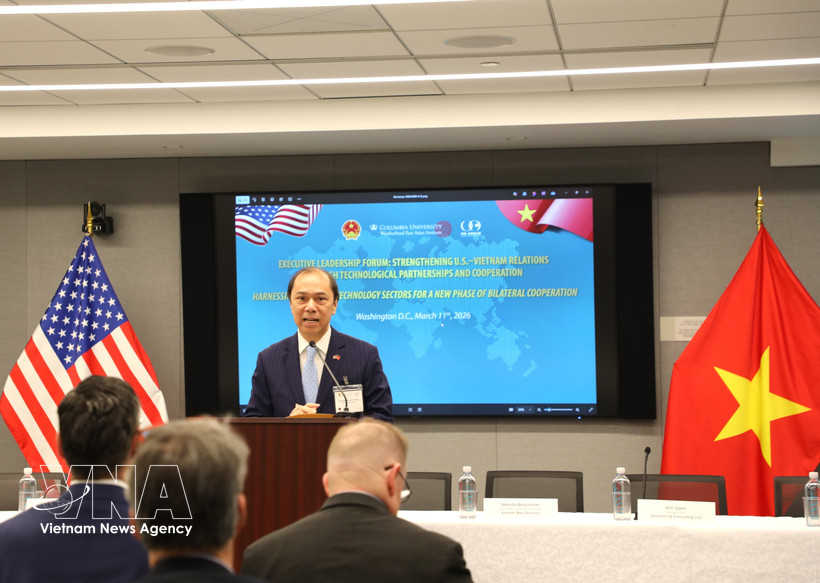
Vietnamese Ambassador to the US Nguyen Quoc Dung addresses the forum. (Photo: VNA)

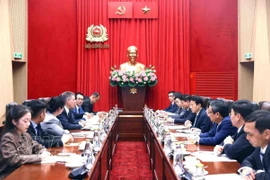
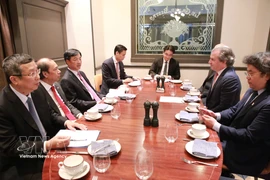
Washington D.C. (VNA) – A high-level executive leadership forum focusing on strengthening Vietnam - US relations through technology cooperation was jointly held in Washington D.C. on March 11 by the Embassy of Vietnam in the US, the Weatherhead East Asian Institute of Columbia University, and the US -ASEAN Business Council (USABC).

The event drew the attendance of more than 100 participants, including senior policymakers from the US Department of State, the US Department of Commerce, Vietnamese government agencies, as well as leaders of major technology corporations and financial institutions.

Opening the forum, Vietnamese Ambassador to the US Nguyen Quoc Dung highlighted that relations between Vietnam and the US are entering their most substantive and in-depth phase, with technology serving as an important pillar of cooperation.

The ambassador highlighted that Vietnam and the US are highly complementary. Vietnam offers a dynamic economy, a young and increasingly skilled workforce and rapidly growing innovation ecosystem, while the US offers frontier technologies, world class research institutions, capital and leading global companies.

He held that the two sides can strengthen trusted technology ecosystems, contributing to more secure and resilient supply chains and creating new opportunities for innovators in both countries.

Vietnam is committed to building an open legal framework and prioritising high value-added technology projects, positioning itself as a reliable and indispensable link in US global supply chains, the diplomat stated.

Discussions underscored the complementary strengths of the two economies as a key driver of technological collaboration. While the US leads globally in core technologies, innovation and capital, Vietnam offers dynamism, rapid adaptability and a large young STEM workforce. Vietnam is seen as a promising partner for research and development (R&D) and high-tech manufacturing by US enterprises in priority sectors such as semiconductors, artificial intelligence (AI), cybersecurity, cloud computing, robotics, aerospace and advanced manufacturing. The Vietnamese Government reaffirmed its commitment to fostering a favourable business environment to translate these advantages into concrete projects.

The forum also noted a significant shift as technology flows increasingly in both directions. Vietnamese innovations, particularly in drone technology and AI software, have begun entering the US market, demonstrating Vietnam’s growing role not only as a manufacturing base but also as a source of technological innovation and value creation within global supply chains.

Participants agreed to prioritise cooperation in digital infrastructure and energy, including the development of green data centres and energy reforms to ensure stable power supply for strategic technology industries such as semiconductors and AI.

On financing, institutions including the US International Development Finance Corporation (DFC), the Export-Import Bank of the United States (EXIM), and the US Trade and Development Agency (USTDA) pledged continued support for strategic infrastructure projects in Vietnam.

Through panel discussions, businesses and experts delivered key recommendations to Vietnam aimed at sustaining growth momentum and attracting investment, focusing on regulatory reform, private-sector promotion, workforce development, and maintaining policy flexibility and optimism.

The forum’s success reflected the shared determination of both countries to usher bilateral relations into a new phase, grounded in friendship, cooperation and joint efforts to shape the technological future of the 21st century./.

VNA
See more

Participants at the first meeting of the National Steering Committee on Semiconductor Industry Development in 2026 (Photo: VNA)

Vietnam becomes vital player in global semiconductor value chain: Deputy PM

Vietnamese companies have also gradually joined the global value chain by improving their capabilities in chip design, production and related services. Notably, a semiconductor chip manufacturing plant project developed by the Viettel Military Industry and Telecoms Group (Viettel) has already commenced.

Young voters in Ho Chi Minh City scan an QR code to participate in an online quiz about the Election Law. (Photo: VNA)

Digital technology helps enhance transparency, trust in elections

The use of technology in this election is not merely a short-term measure but reflects Ho Chi Minh City’s broader commitment to comprehensive digital transformation and smart urban governance, reinforcing public trust in the democratic process and administration.

Information about candidates for the Khanh Hoa provincial People's Council for the 2026-2031 term is published on digital information channels, making it convenient for voters to explore. (Photo: VNA)

Technology breakthrough ensures voters' access, rights

Digital platforms such as the national population database and the VNeID application have been widely applied to streamline election management and improve accuracy in voter registration, helping citizens exercise their civic rights more conveniently.

Mang But commune area in Quang Ngai province. (Photo: VNA)

3.9-magnitude earthquake recorded in Mang But, Quang Ngai

According to the Vietnam Earthquake Information and Tsunami Warning Centre under the Institute of Earth Sciences, the tremor occurred at 11:35:06 (Hanoi time) with coordinates of 14.864 degrees North latitude and 108.210 degrees East longitude, at a depth of about 8.1 km. The event was assessed as having a level-0 disaster risk.

Illustrative photo: AFP

AI Law takes effect, anchors national governance framework

Taken together, the new AI Law and its implementation roadmap not only complete Vietnam’s legal architecture for AI, but also lay a structured foundation for risk management, innovation and ecosystem development, aiming to ensure coherent and effective enforcement in the years ahead.

Viettel Networks and Ericsson sign their cooperation agreement on the sidelines of the Mobile World Congress 2026. (MWC 2026)

Viettel Networks, Ericsson partner to advance autonomous telecom networks

Under a newly signed cooperation agreement, Ericsson will provide network automation platforms and artificial intelligence (AI) technologies while working with Viettel to conduct real-world trials. The collaboration marks a new step forward, combining Viettel’s large-scale network operation expertise with Ericsson’s strengths in automation solutions and advanced technologies.

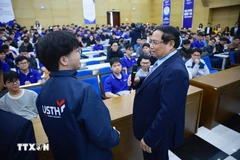
Prime Minister Pham Minh Chinh speaks with students at Hanoi University of Science and Technology (Photo: VNA)

Resolution 57: Developing high-quality sci-tech human resources key to master strategic technologies

After one year of implementing Resolution No. 57-NQ/TW of the Politburo, alongside notable achievements, the Central Steering Committee for science and technology development, innovation, and digital transformation has identified persistent shortcomings and bottlenecks requiring urgent attention - most notably a shortage of high-quality human resources in strategic technology fields.

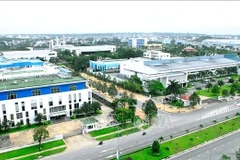
The Saigon Hi-Tech Park (Photo: VNA)

Vietnam advances toward mastering UAV technology

Products are already making their way into the US market, but this is not merely a story of applying new technology in practice, but a gradual process of mastering core details and affirming international capabilities in the UAV industry, one of Vietnam’s strategic high-tech sectors.