Hybrid model, the new rising trend in office market

A hybrid working model comprising both remote and office-based work is a trend that many companies will embrace since working methods have changed globally after the pandemic broke out, including in Vietnam, experts have predicted.
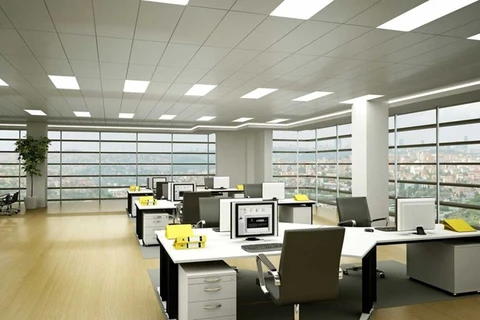
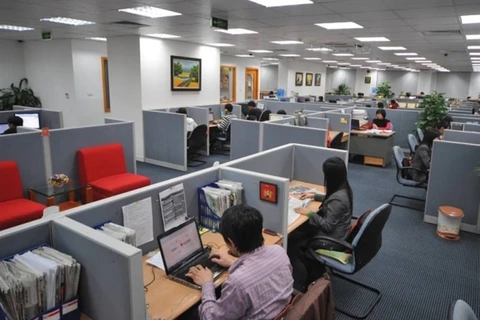
Hybrid model, the new rising trend in office market ảnh 1A working space in HCM City (Photo: VNS/VNA) 
HCM City (VNS/VNA) - A hybrid working model comprising both remoteand office-based work is a trend that many companies will embrace since workingmethods have changed globally after the pandemic broke out, including in Vietnam,experts have predicted.

In a note on trends in the property market this year, property consultancyJones Lang LaSalle (JLL) said a year of lockdowns that forced people to workfrom home showed many tasks could be done remotely, spurring companies to adoptnew, hybrid working models.

The shift was already underway at many businesses, but was accelerated byCOVID-19 like many other things, it said.

“In 2020 a work from home experiment took place globally and showed thatbusinesses can continue to operate effectively by leveraging technology” PaulFisher, country head of JLL Vietnam, said.

“But for many, the lack of face-to-face interaction has put pressure on teamsand whilst a number of our clients expect to adopt flexible working practicesin the future, for the majority this will include the office remaining thecentral point for business activities.”

But many aspects of work would not change, the note said. People would stillneed to collaborate, innovate and liaise with managers on projects and theircareers, a reason why people missed the office, and it was why for many officeswould retain a central role in corporate life.

The office still existed as the best and most convenient place for teambuilding and connecting with management.

WeWork predicted at an ongoing roundtable on office trends in the region thatbeyond economic pressures and realities that enterprises face, tapping newworkspace strategies is crucial for future-proofing themselves in a volatileclimate.

Amidst the changing face of its enterprises, Southeast Asia is seeing a shifttowards flexible workspaces bridging enterprises’ challenges and opportunities,it said.

Talking about the future of the workplace after the pandemic, Elizabeth Fuller,the company’s head of growth, SEA, said after a year of pandemic working fromhome might be an alternative option for many companies.

But this is not sustainable for businesses in the long term, she claimed.

In the workplace, innovation, creativity and organisational health hinges onsuccessful collaboration, and a loss of these would hinder sustained businessperformance, employee engagement and organisational health in the long run, shesaid.

The new work order would thus be a hybrid of flexible workplace arrangements,she said.

She cited the example of two Fortune 500 companies that have expanded theirpresence with WeWork across several buildings by establishing a headquarterpresence in one location and supporting functions and business units in theothers.

“They have leveraged our CBD presence, with locations in close proximity toeach other. This allows them to scale accordingly without having to renegotiateexisting real estate commitment, implement distributed workforce as a safetymeasure and also enjoy engagement.”

Property consultancy CBRE said the pandemic has changed the structure of officedemand.

Due to COVID-19, technology and online shopping utilisation have increasedsignificantly, which led to the expansion of e-commerce companies last year, itreported.

The pandemic has also changed the real estate strategies of occupiers.Previously employees were heavily relying on being in office, but are now morewilling to work in different spaces.

Pham Ngoc Thien Thanh, associate director, CBRE Vietnam, said: “COVID-19 hasreshaped the market’s dynamics, and unaffected sectors will drive market demandin 2021.

“Besides, tenants will start paying more attention to all factors includingsaving rental costs, ensuring employees’ wellness and maintaining businessperformance.

“To do that, occupiers tend to adopt a hybrid workplace model, designingoffices with lower density and also diversifying the workplace into differentsites such as decentralised options and co-working spaces.

“The market will be intensely competitive in the next two years with a wave ofnew supply. To stay ahead of the competition, landlords should considerapplying workplace strategy tools to evaluate current strengths anddeficiencies of their buildings to come up with an optimal solution to increasetheir assets’ values.”

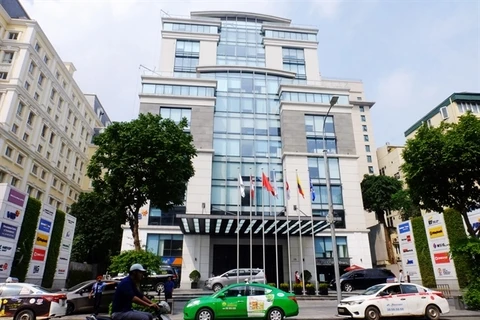
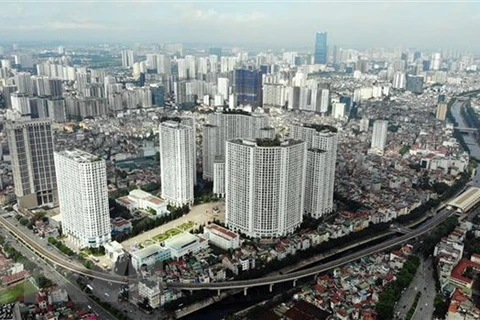
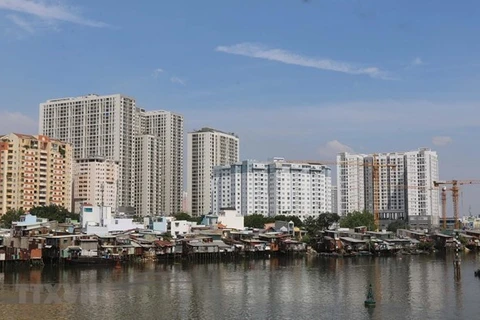
The HCM City office market remained in a deep slump last year due to COVID,which badly affected many enterprises. It witnessed negative net absorption of- 20,544sq.m of leasing area.

Three new office buildings came into the market, Friendship Tower (grade B),UOA Tower (decentralised grade A) and Opal Tower (grade B), with a combined65,372sq.m of net leasing area, but it represented a fall of 31 percent in areacompared to the previous three years./.
VNA
See more

Hoa Phat Wharf inside the Dung Quat Economic Zone (Photo: VNA)

Dung Quat EZ, Quang Ngai IPs draw nearly 19.4 bln USD

The Dung Quat Economic Zone and Quang Ngai industrial parks have so far attracted 441 projects worth around 19.4 billion USD, according to the Dung Quat Economic Zone and Quang Ngai Industrial Parks Authority (DEZA).

The Kim Long Motor Hue factory (Photo: VNA)

Hue courts capital to turn industrial zones into growth engine

The economic and industrial zones in Hue city host more than 200 active investment projects worth over 152 trillion VND (5.84 billion USD), with 139 already operational. Since the start of 2026, they have generated about 32 trillion VND, contributed 4.2 trillion VND to the state budget and brought in 730 million USD in exports, while employing more than 46,000 workers.

Processing cashew nuts for export at Nguyen Thong Co., Ltd. in Dak Lak province. (Photo: VNA)

Vietnam’s exports to New Zealand post strong growth

According to the Customs Department, two-way trade reached 844 million USD in the first half of 2026, of which Vietnam’s exports to New Zealand totaled 399.7 million USD, up 18.8% year-on-year, while imports stood at 444 million USD.

Starting from September 2026, agricultural products from the Mekong Delta are expected to be transported directly from Cai Cui Port to Guangxi, China. (Photo: VNA)

Investing in logistics to boost agricultural production and exports

Logistics is increasingly becoming a major bottleneck for exports as transport costs rise and requirements for data management, low emissions and supply chain transparency become more stringent, requiring coordinated investment in logistics infrastructure, data infrastructure and transport capacity.

Harvesting rice in the Mekong Delta (Photo: VNA)

Vietnam seen as gateway for Canadian farm produce to ASEAN

As Canada steps up trade diversification and seeks to reduce its dependence on the North American market, Vietnam could serve both as a market for Canadian goods and a base for Canadian businesses to build production capacity and expand operations in the region.

Illustrative image (Photo: VNA)

Turkish cooperatives open sourcing channel for Vietnamese businesses

The Vietnam Trade Office recommended that Vietnamese businesses in agriculture and food actively study cooperative networks in different localities in Türkiye and consider them an additional channel for accessing raw materials, processing partners, and distribution networks.

Delegates at the signing ceremony (Photo: VNA)

VPI, Beicip-Franlab Asia deepen oil, gas cooperation

Under the MoU, VPI and Beicip-Franlab Asia will undertake advanced studies in geology, geophysics, and reservoir engineering to support exploration, field development, and oil and gas resource assessment.

A visitor explores Vietnamese coffee at the expo. (Photo: VNA)

Vietnam pushes coffee, farm produce at Hong Kong food expo

After nearly 200 years, especially since the Doi Moi (renewal) began in 1986, Vietnamese coffee is now exported to more than 100 countries and territories and supports about 2.6 million jobs. Vietnam remains the world’s second largest coffee exporter, holding roughly 19-21% of the global market, and is the top producer of Robusta coffee.

Delegates at the event (Photo: VNA)

Da Nang hosts 2026 International Logistics Forum

Co-hosted by the Ministry of Industry and Trade and the Da Nang People’s Committee, the forum put modern logistics, strategic infrastructure, digital transformation, green growth and international connectivity at the centre of discussions.

Prime Minister Le Minh Hung speaks at the working session. (Photo: VNA)

Monetary policy must ensure macro stability, support growth: PM

The SBV was required to keep policy interest rates steady and add liquidity so lenders can access cheaper funding. It must manage the exchange rate in line with market developments, coordinate monetary tools, and intervene to stabilise the foreign exchange market, while maintaining close oversight of gold. Lenders must continue cutting costs, stabilising lending rates, and delivering substantive reductions.

People buy petrol at a station in Hanoi (Photo: VNA)

Petrol prices cut from 15:00 on August 13

The price of E5 RON92 petrol is capped at 21,235 VND (0.81 USD) per litre, down 493 VND, while E10 RON95-III is priced at no more than 22,119 VND per litre, down 205 VND.

Domestic and foreign businesses engage in trade networking at the event series held at Ho Chi Minh's Saigon Exhibition and Convention Centre (SECC) on August 13, 2026. (Photo: VNA)

Int'l sports exhibitions, export trade fair open in Ho Chi Minh City

A series of events opened at the Saigon Exhibition and Convention Centre (SECC) in Ho Chi Minh City on August 13, including the Vietnam Sport Show 2026, Vietnam Cycle Expo 2026 and the 14th Zhejiang Export (Vietnam) Fair 2026. They feature 520 booths operated by 400 businesses from 15 countries and territories.

Production at Bumjim Electronics Vina Co., Ltd invested by the Republic of Korea in Quang Ninh province (Photo: VNA)

Resolution No. 19-NQ/TW sets new growth drivers for Vietnam

Science and technology, innovation, digital transformation and AI must be translated into higher productivity rather than pursued as ends in themselves. At the same time, people should be placed at the centre of development, not merely viewed as a resource but as the ultimate objective of development policies.