Incentive mechanisms needed for semiconductor industry: PM

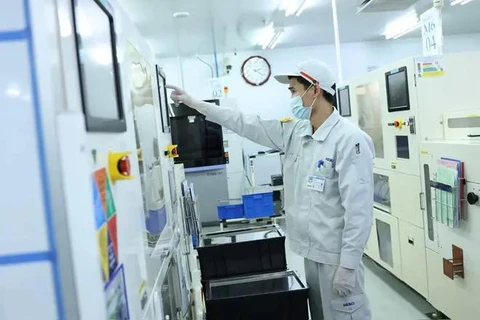
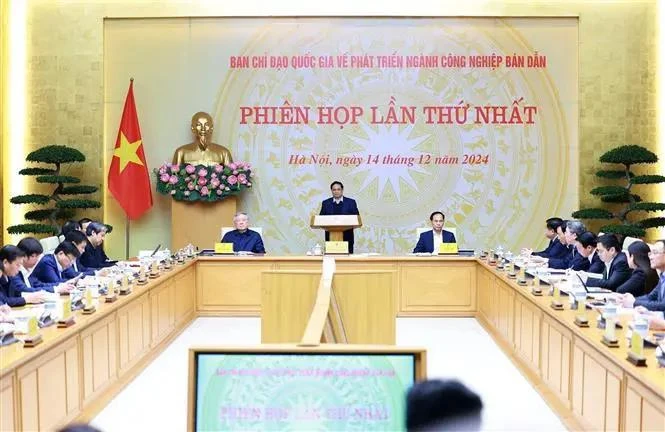
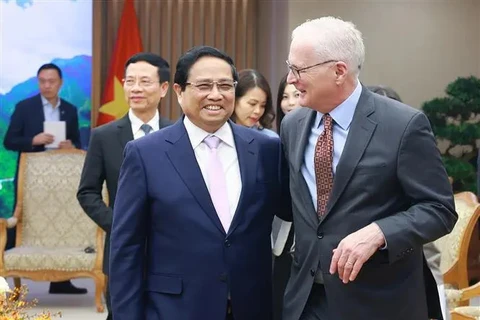
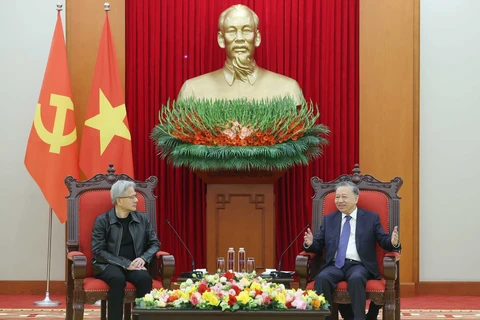
Prime Minister Pham Minh Chinh, Head of the National Steering Committee for Semiconductor Industry Development, urged the development of incentive mechanisms and policies to promote the development of the semiconductor industry, while chairing the first meeting of the committee in Hanoi on December 14 morning.

Prime Minister Pham Minh Chinh speaks at the first meeting of the National Steering Committee for Semiconductor Industry Development on December 14, 2024. (Photo: VNA)

Hanoi (VNA) - Prime Minister Pham Minh Chinh, Head of the National Steering Committee for Semiconductor Industry Development, urged the development of incentive mechanisms and policies to promote the development of the semiconductor industry, while chairing the first meeting of the committee in Hanoi on December 14 morning.

Emphasising that developing the semiconductor industry is a necessity, a strategic breakthrough, and also a key task in the coming time, the PM said that it requires the participation of the entire political system, the engagement of people, businesses, and investors, and the support of international friends.

The determination to implement the scheme must be demonstrated through specific, methodical, scientific, and drastic actions, he stressed.

The PM stated that alongside resolutions, strategies, programmes, projects, mechanisms, and policies aimed at fostering scientific and technological development, innovation, and digital transformation, Vietnam needs to make breakthroughs in policies, such as establishing an investment support fund; and proposals for policy adjustments during the formulation of legal documents like the Law on Investment and the Law on Corporate Income Tax, and preferential policies on personal income tax, fees, and charges to encourage the development of the industry.

He requested ministries, sectors, localities, education institutions, and businesses to proactively develop plans for implementing the human resource development programme serving the industry by 2030, with a vision to 2050, and the strategy for semiconductor industry development by 2030.

The Government leader said it is necessary to enhance inspections, scale up good models, promote public-private partnerships and domestic and international cooperation, and take measures to address weaknesses and limitations.

He also underlined the need to raise awareness of the role, position, potential, strength, and development requirements of the sector, to improve institutions and policies in a flexible and prioritised direction, to accelerate administrative reforms, and to devise policies for training and attracting high-quality human resources.

The PM urged establishing an investment support fund, transferring technology, and optimising Vietnam's potential, opportunities, and competitive advantages.

The Ministry of Planning and Investment (MPI) was asked to focus on implementing the tasks and solutions outlined in the human resources development programme; and completing and submitting a draft decree on an investment support fund to encourage international investors and assist domestic enterprises.

Meanwhile, the Ministry of Information and Communications will continue implementing tasks set in the national semiconductor industry development strategy to 2030, with a vision to 2050, particularly those related to the development of specialised chips and electronics.

The Ministry of Foreign Affairs was tasked with developing a project to promote international cooperation to mobilise resources for the semiconductor and electronics industry, and strengthening bilateral and multilateral cooperation in semiconductors.

It will continue to leverage the network of Vietnamese diplomatic missions abroad to promote international cooperation in this field, identifying priority areas for cooperation with each partner.

The Ministry of Industry and Trade (MoIT) will coordinate with the Ministry of Foreign Affairs to call on US agencies to promptly remove Vietnam from the D1 - D3 lists of high-tech export restrictions, thus creating more favourable conditions for Vietnam to access advanced US technologies and promote cooperation between businesses of the two countries in high-tech fields, including semiconductors.

Meanwhile, the Ministry of Education and Training was assigned to closely coordinate with the MPI to implement the personnel programme, including researching, proposing, and organising the implementation of a linkage model between the State, schools, and enterprises in workforce training.

The PM noted the need to quickly submit a project on training human resources to serve high-tech development in 2025-2035 with a vision to 2045 to prepare STEM (science, technology, engineering and mathematics) human resources with high professional and technical qualifications to serve the expansion of high-tech fields, including the semiconductor industry, especially a workforce capable of participating deeply in the research and development stage in a number of key technology fields.

He demanded the Ministry of Finance to closely work with the MPI and relevant agencies to study and propose preferential mechanisms and policies on tax, finance, management, and use of public assets to serve the training, research and development of the semiconductor industry.

The Ministry of Science and Technology was required to promote research and development, improve Vietnam's scientific and technological capacity in the semiconductor industry, especially developing core technologies and specialised chip products.

He urged ministries, sectors and localities to focus on and push ahead with the implementation of tasks and solutions in accordance with the relevant documents./.
VNA

See more

Prime Minister Pham Minh Chinh addresses the meeting meeting between the permanent Government members and leaders of Hanoi to review and provide feedback on the draft Hanoi Capital Master Plan with a 100-year vision on March 14. (Photo: baochinhphu.vn)

Hanoi’s 100-year master plan must put people at centre: PM

According to Prime Minister Pham Minh Chinh, the philosophy of the plan must place people at the centre and as the driving force of development, and Hanoi should aim to become a prosperous, civilised and modern city that preserves its cultural identity.

The National Assembly passes the law amending and supplementing several articles of the Criminal Code. (Photo: VNA_

OVs, scholars in Canada hope for further reform, int’l integration in new NA term

Overseas Vietnamese (OVs) and scholars in Canada have expressed keen interest in the upcoming election of deputies to the 16th National Assembly (NA) and People’s Councils for the 2026–2031 tenure, voicing their hopes that the legislature will further refine institutions, drive economic development, deepen international integration, and strengthen ties with OV communities.

UNDP Resident Representative in Vietnam Ramla Khalidi (Photo published by VNA)

NA, People’s Council election to shape policies sustaining Vietnam’s development momentum: UNDP official

In an interview with the Vietnam News Agency ahead of the election scheduled for March 15, UNDP Resident Representative in Vietnam Ramla Khalidi said the election marks an important milestone in Vietnam’s development trajectory as it takes place at a moment when the country is entering a new phase of policy priorities and institutional reforms that will shape its next stage of development.

Voters on Truong Sa are following information regarding the election of deputies to the 16th National Assembly and People's Councils at all levels for the 2026-2031 term (Photo: VNA)

Party leadership key to ensuring State power belongs to people in election

Ensuring that State power truly belongs to the people, with the leadership of the Communist Party of Vietnam serving as the decisive factor, remains the guiding principle for organising the election of deputies to the 16th National Assembly (NA) and People’s Councils at all levels for the 2026–2031 tenure.

Newly enlisted soldiers at the 2nd Training and Mobile Battalion in Lam Dong province eagerly participate in the early voting session. (Photo: VNA)

Ballots and civic responsibility

All these efforts converge to create the significance of the national election day. Though small, each ballot carries the weight of civic responsibility. By selecting the right representatives and placing trust wisely, voters contribute to building a National Assembly and People’s Councils capable of making important decisions for the country and localities in the new tenure.

PM Pham Minh Chinh welcomes Thai Ambassador to Vietnam Urawadee Sriphiromaya in Hanoi on March 13. (Photo: VNA)

PM Pham Minh Chinh receives Thai Ambassador to Vietnam

PM Pham Minh Chinh proposed that Thailand consider facilitating stable fuel supply for Vietnam’s civil aviation sector, thus contributing to socio-economic stability and development, as well as bilateral trade and tourism.

The special ASEAN foreign ministers’ meeting on the Middle East situation is held online on March 13. (Photo: Vietnamese Ministry of Foreign Affairs)

Vietnamese embassies in Middle East ready to assist ASEAN citizens: FM

Foreign Minister Le Hoai Trung stressed that ASEAN members should prioritise maintaining energy supplies for one another, particularly oil and gas, and make effective use of cooperation agreements with partners, including Gulf Cooperation Council (GCC) countries, to diversify energy sources.

Muong Sai commune in Son La province is decorated to celebrate the election day. (Photo: VNA)

📝OP-ED: Facts shatter distorted allegations about general election

In reality, the capacity and effectiveness of Vietnam’s legislative body have been clearly demonstrated through major policy decisions that have contributed to maintaining political stability, promoting economic growth and enhancing the country’s standing in the international arena.

Vietnamese Ambassador Nguyen Thi Van Anh (L), Permanent Representative of the State President to the Permanent Council of La Francophonie, and Administrator of the International Organisation of La Francophonie (OIF) Caroline St-Hilaire at theri meeting in Paris on March 12. (Photo published by VNA)

OIF Administrator praises Vietnam’s role, contributions

The two sides discussed cooperation in French-language education in the Southeast Asian country, ways to encourage young people to choose French, and the development of French-speaking human resources, including language training for civil servants and for Vietnamese military and police personnel participating in United Nations peacekeeping operations.

Dr Julia Roknifard, senior lecturer in international relations at Taylor’s University in Malaysia (Photo: VNA)

Legislature proves strong support to Vietnam’s development, integration: Scholar

Dr Julia Roknifard, senior lecturer in international relations at Taylor’s University in Malaysia, shared her assessment of the role of Vietnam’s highest legislative body in promoting economic development and strengthening multilateral cooperation amid a rapidly changing global landscape in in an interview with Vietnam News Agency correspondents in Kuala Lumpur.