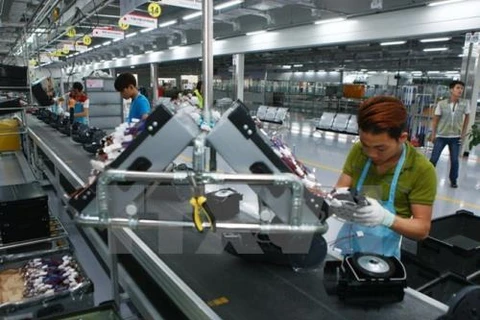
Illustrative image (Source: LG newsroom)
 Hanoi (VNA) – The Republic of Korea (RoK)’s LG Electronics plans to move its smart phone production to Vietnam to cut down losses for mobile devices business since the second quarter of 2017, Yonhap News Agency reported on April 24.
Accordingly, the firm is scheduled to shut down Pyeongtaek plant in the south of Seoul and shift its production line to the northern port city of Hai Phong.
The company currently manufactures smart phones in the RoK, Vietnam, Brazil and China while its domestic plants mostly produce premium devices.
LG Electronics has struggled in smart phone market for years amid intense competition with Samsung Electronics and Apple in hi-end segment and with Chinese manufacturers in the lower segment.
Last year, its sale of mobile devices hit 1.5 billion USD but the loss amounted to 280 million USD due to weak revenue and rising marketing cost.
Meanwhile, the LG Display Co. said on April 24 that its net loss went up to 55 million USD in the first quarter this year, higher than the 42.5 billion USD in the same period last year due to low selling prices of liquid crystal displays.-VNA
Accordingly, the firm is scheduled to shut down Pyeongtaek plant in the south of Seoul and shift its production line to the northern port city of Hai Phong.
The company currently manufactures smart phones in the RoK, Vietnam, Brazil and China while its domestic plants mostly produce premium devices.
LG Electronics has struggled in smart phone market for years amid intense competition with Samsung Electronics and Apple in hi-end segment and with Chinese manufacturers in the lower segment.
Last year, its sale of mobile devices hit 1.5 billion USD but the loss amounted to 280 million USD due to weak revenue and rising marketing cost.
Meanwhile, the LG Display Co. said on April 24 that its net loss went up to 55 million USD in the first quarter this year, higher than the 42.5 billion USD in the same period last year due to low selling prices of liquid crystal displays.-VNA
VNA