Make-in-Vietnam key to making nation a digital powerhouse
“Make in Vietnam" is an initiative/slogan launched by the Ministry of Information and Communications (MIC) in 2019, aiming to promote development of the domestic ICT industry. It calls on businesses to design, create and manufacture products in Vietnam instead of outsourcing them to help solve the nation’s problems and boost its global presence.
 A teacher in Hanoi at an online lesson. Such home-developed platforms like Azota is very convenient and effective for teachers, especially for online learning. (Photo: VNA)
The teacher with the Lang Thuong Primary School in Hanoi’s Dong Da district said it took a lot of time because she had to download, grade the work and send it back to her students.
Of late, however, her burden has been considerably eased by home-developed platforms like Azota, designed specifically for generating questions and exercises.
“This application is very convenient and effective for teachers, especially for online learning. For online exams, the system will display the student’s name, status and submission time,” Anh told Vietnam News Agency.
In addition to serving as a database for teachers and students, the platform also helps promote cohesion between teachers and students’ parents, she said, explaining that it helped parents monitor the progress of their children.
Nguyen Hai Au, a representative of the Azota Education Technology Joint Stock Company, said the idea of developing the platform came from a desire to simplify the work for teachers and shorten the time taken for administering and grading a test from several hours to a few minutes. The platform makes it easy for both teachers and students to perform their tasks, he said.
Teachers can easily upload the list of students and exam questions to the system. The test is sent to each student and the teacher can keep track of who has submitted their answers. The company says the platform has six million monthly users.
The platform has been honoured as an outstanding “Make in Vietnam” product for 2021.
“Make in Vietnam" is an initiative/slogan launched by the Ministry of Information and Communications (MIC) in 2019, aiming to promote development of the domestic ICT industry. It calls on businesses to design, create and manufacture products in Vietnam instead of outsourcing them to help solve the nation’s problems and boost its global presence.
Nguyen Manh Hung, Minister of Information and Communications (MIC), highlighted Make-in-Vietnam as a key strategy in the country’s development.
Addressing the third Forum for Digital Technology Enterprise Development on December 11, he said: “Without Make in Vietnam, our country cannot become a developed nation; cannot establish our presence in the world; cannot strengthen ourselves; and cannot become mighty and prosperous.”
 Prime Minister Pham Minh Chinh (centre) and Minister of Information and Communications Nguyen Manh Hung (first, from the right) visit a booth display technology products at the third Forum for Digital Technology Enterprise Development. (Photo: VNA)
Ha Trung Kien, deputy director general of G-Group, said the pandemic has accelerated the digital transformation process among Vietnam’s enterprises.
He cited a 2020 report of the Vietnam Chamber of Commerce and Industry that said about 75 percent of small and medium enterprises (SMEs) in the country are willing to apply digital technology in their operations and management. The gap in technology application rate between SMEs and large enterprises has decreased from over 20 percent to only 5 percent. This is significantly different from what it was before the pandemic.
Kien said the pandemic has prompted enterprises to seek ways to optimise costs and this will result in a shift from foreign to indigenously developed platforms. With many businesses seriously affected by COVID-19 in 2021, digital transformation is not a question of advancement but one of survival, he said.
Kien, who founded the Gapo social network with more than 6 million users, said that home-grown platforms have several advantages over foreign ones because the creators have a better understanding of Vietnamese culture and business needs. Moreover, Vietnamese support teams are always ready to assist enterprises and their costs are lower than that of foreign platforms.
According to him, the idea of the home-grown platform was prompted by the need of his own company.
“At the beginning, each company in our G-Group used different communication platforms. The lack of uniformity made management difficult,” he recalled.
The company then decided to adopt Workplace- a foreign technology platform for internal communication. However, it was too costly as they had to pay 8 USD per person per month, Kien said.
After three years, they ended up developing GapoWork, a set of tools that have helped employees connect with each other easily at a reasonable cost.
 GapoWork provides essential features for delivering a uniform, accurate, and rapid work flow on a single platform. (Photo courtesy of the company)
Mai Xuan Dat, the CEO of John Capital Company, which specialises in Objectives and key results (OKRs) training and startup investment, said online communication became essential to his company during pandemic times.
His company also had to stop using Workplace to optimise costs. For a long time, they couldn't find any platform as good as Facebook Workplace. It took him a while before signing up for GapoWork.
“Actually, I opposed it at the beginning, thinking it would be difficult for a Vietnamese company to make a digital product of the same quality as that of US giants. But to my surprise, everything was smooth and in just ten minutes, I felt good about using it.
“The excitement returned to the company in just one day of using GapoWork,” he said.
GapoWork was recognised as an outstanding solution at the Vietnam Digital Awards 2021.
These two products are evidence that tech products made in Vietnam can solve the nation’s problems and realise the ministry’s ambitious targets.
It is expected that the information, electronics and telecommunications industry will master or develop technologies to produce cover more than 45 percent of relevant content by 2025.
The country is expected to have 100,000 digital technology enterprises by then, with at least 10 internationally competitive unicorns playing a major role.
Progress in difficult times
Despite all the pandemic difficulties, the number of indigenous businesses in the industry increased remarkably in 2021, said Nguyen Thanh Tuyen, Deputy Director of the Information Technology Department under the MIC.
Vietnam is home to 64,000 digital technology firms, an increase of 5,600 over 2020; and these have created 1,000 indigenous ICT products and services.
In 2021, Vietnam ranked 44th out of 132 countries and economies in the Global Innovation Index (GII) and 59th out of 100 countries in startup ecosystem. The country also came third in the list of the most active startup ecosystem in Southeast Asia after Indonesia and Singapore.
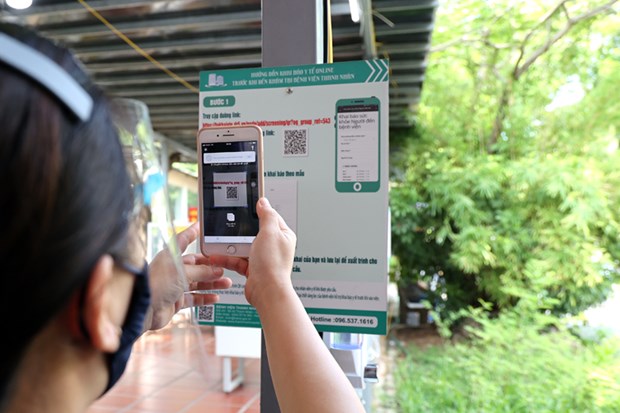 A girl scans QR code on PC-COVID, a Make in Vietnam app, which cover many functions such as online health declarations, contact tracing, and users’ information on vaccinations. (Photo: VNA)
Under the ministry’s leadership, Vietnamese businesses have researched new technologies including 5G, Artificial Intelligence (AI) and Big Data, Tuyen said, adding that the development is unprecedented.
The total revenue of the ICT industry was 3.46 quadrillion VND (152.2 billion USD) in 2021, a year on year growth of 9 percent.
The products of digital firms have been used and proved effective, Tuyen said, citing the digital transformation of public services and document management systems in several localities as examples. The smart city management centres in 38 localities have been built by Vietnamese digital tech enterprises, he noted.
Despite the impressive achievements, the ICT industry still faces numerous challenges.
Up to 90 percent of digital technology firms in Vietnam are small and medium enterprises (SMEs), so their R&D budgets remain modest.
According to the report entitled “Technological change in Vietnam: the contribution of technology to economic growth” which was developed by CSIRO, Australia’s national science agency, and the Ministry of Science and Technology, Vietnam's R&D investment level is still quite low compared to the regional and world average. In 2019, the budget for R&D in Vietnam was just 0.53 percent of the country’s GDP.
The R&D resource limitations are reflected in the number of researchers engaged in R&D per million in Vietnam, which is reported at 896 in 2018, just 7.6 percent of the Republic of Korea, 29.8 percent of Malaysia and 58 percent of Thailand.
The lack of skilled workforce can also hamper its development, industry insiders have cautioned.
Incentive policies
Le Dang Dung, acting Chairman and General Director of the Military Industry and Telecoms Group (Viettel), said telecommunication infrastructure plays an important role in the country's digital transformation process.
However, it will be difficult to master technology and ensure information safety if Vietnam continues to buy products from abroad, he stressed.
Therefore, Viettel was determined to implement the “Make-in-Vietnam” strategy in both researching and manufacturing telecommunication and digital infrastructure equipment, he told the Dau Tu (Investment) newspaper.
The acting Chairman of Viettel also suggested that special policies are issued to promote indigenous tech products in the domestic market.
"We really want to sell products in the domestic market, but it is not easy for Vietnamese businesses to buy Viettel's high-tech products (without policy support)," Dung said.
 Illustrative image. Vietnamese digital technology firms have not only processed and assembled produtcs for foreign countries but also manufactured and mastered products and platforms for the country’s digital transformation. (Photo: Vietnam Plus)
 Minister Hung said that digital tech enterprises should take responsibility for the development of platforms for national digital transformation, considering it a national mission.
He said: “These platforms will help Vietnam develop into a digital nation and create momentum for sustainable growth, thus enabling it to become a developed nation with high income by 2045”./.
Related stories: Digital transformation goes mainstream in Vietnam
Cashless society gets closer as Vietnam digital banking gathers pace
E-commerce - important pillar of Vietnam’s digital economic development





You should also see

ASEAN Future Forum 2024 wraps up in Hanoi
The ASEAN Future Forum 2024 (AFF 2024) wrapped up in Hanoi on April 23 after a day of productive discussions.



See more
 Business
3,400 taels of SJC-branded gold bars successfully auctioned
The State Bank of Vietnam auctioned 16,800 taels of SJC-branded gold bars in Hanoi on April 23. This is the first auction of this kind in 11 years.
 Business
HCM City seeks to draw remittances in infrastructure
A seminar aimed at channeling overseas remittances into infrastructure took place in Ho Chi Minh City on April 23, given that remittances to the city reached 9.46 billion USD in 2023, nearly three times higher than foreign direct investment (FDI), according to official statistics.
 Sci-Tech
FPT, NVIDIA ink MoU to build 200 million USD AI factory
Vietnam’s tech giant FPT plans to build a 200 million USD artificial intelligence (AI) factory using Nvidia's graphics chips and software, as announced on April 23 in a comprehensive strategic partnership with NVIDIA.
 Business
Lao Cai province calls for more Japanese investments
The advantages and potential of Vietnam’s northern border province of Lao Cai were introduced to Japanese firms at an investment and tourism promotion conference in Tokyo on April 23.
 Business
Vietnam’s economy shows gradual recovery: WB’s report
Vietnam's economy is showing mixed signs of recovery in early 2024, with growth forecast to reach 5.5% in 2024 and gradually rise to 6.0% by 2025, according to the latest World Bank Taking Stock bi-annual economic update released on April 23.
