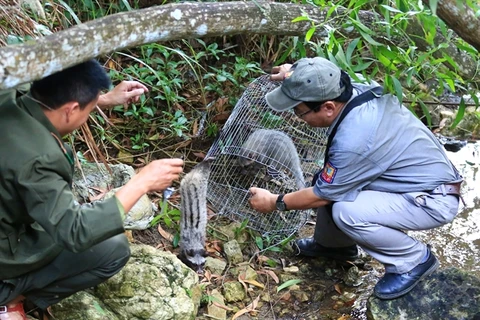
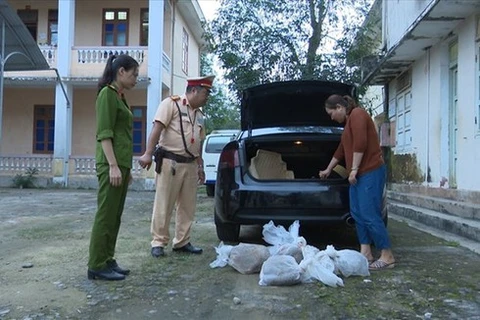
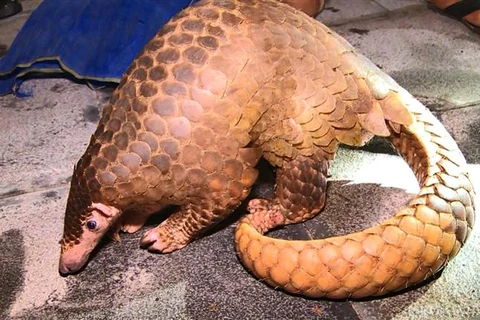
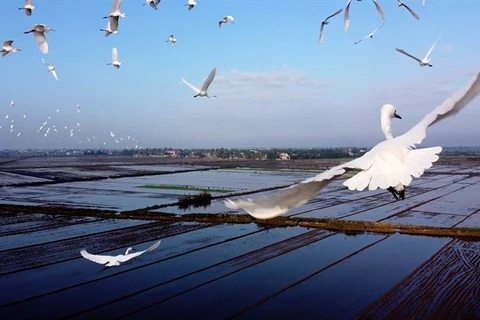
Illustrative image (Photo: ENV)
 Hanoi (VNA) – In response to the appeals for the wildlife market to be closed to curb the COVID-19 pandemic, the Ministry of Natural Resources and Environment (MoNRE) has sent a written request to other ministries, sectors and localities, urging the management and control of illegal wildlife caging, trading and consumption.
Wildlife trading still going on
According to the document signed by Deputy Minister Vo Tuan Nhan on January 22, the MoNRE already sent Document No. 379/BTNMT-TCMT to other ministries, ministry-level agencies, Government agencies, and People’s Committees of provinces and centrally-run cities, demanding stronger control of the trading and consumption of endangered wild animals and the release of invasive alien species.
Following this, many ministries, sectors and localities have issued prompt and timely directions to deal with the problem.
However, the illegal caging, trading and consumption of wild animals still continue in many localities, affecting not only biodiversity conservation but also people’s health as a number of wild species can pass diseases to humans.
Many researches in the world have warned that about 70 percent of communicable diseases transmitted from animals to humans at present come from wild species. This can be seen in global pandemics in the past like HIV, Ebola, H5N1, SARS, and smallpox, the MoNRE stressed.
[Over 1,700 wildlife violations recorded in 2019]
In particular, the acute respiratory disease caused by the novel coronavirus (COVID-19) that is spreading fast is believed to originate from wild animals.
On February 16, many Vietnamese and foreign non-profit organisations like the World Wide Fund for Nature, Wildlife Conservation Society, Fauna and Flora International, Save Vietnam’s Wildlife and Animals Asia sent an open letter to Prime Minister Nguyen Xuan Phuc to propose actions to deal with threats generated by illegal wildlife trading and consumption.
They pointed out that many pandemics over the last 20 years have connections with virus clusters in wildlife populations.
For example, the severe acute respiratory syndrome (SARS) in late 2002 and early 2003 that infected more than 8,000 people in 37 countries and killed 774 of them, came from a new beta-coronavirus strain that hails from bats and is transmitted via the masked palm civet (Paguma larvata).
 Wild birds are sold openly at Thanh Hoa Market in the southern province of Long An (Photo: VietnamPlus)
 Meanwhile, the Middle East respiratory syndrome (MERS) that broke out in 2012, spread to 2,494 people and killed 858 was caused by another coronavirus strain passed from camels to humans.
The African swine fever, which recently wreaked havoc on pig farming in China, Vietnam and nine other countries, is believed to come from wild boars in Africa, according to the organisations.
They said the ongoing COVID-19 epidemic will definitely cause considerable impact on Vietnam.
Controlling trading, strictly handling violations
To comply with the Prime Minister’s directive on proactively preventing diseases and enhancing biodiversity conservation, the MoNRE asked other ministries, ministry-level agencies, Government agencies, and provincial-level People’s Committees to boost communications to raise public awareness of illegal wildlife hunting, trading, caging and consumption, as well as risks of disease infection posed by the consumption of and contact with wild species.
[WWF-Vietnam, GreenViet work to protect endangered primates]
It also asked law enforcement bodies like forest protection, market surveillance, customs, border guard and police forces to enhance coordination in examining restaurants and businesses, prevent wildlife trading in unlicensed markets, and stringently deal with violations of relevant regulations.
Besides, ministries, sectors and localities need to instruct wildlife breeding facilities to increase phytosanitary and sterilisation measures, minimise contact with wild animals, and keep in touch with local management agencies to stay updated with disease information, according to the MoNRE./.