Nghe An cracks down on unlicensed fishing practices

The central province of Nghe An is taking steps to address problems in its fishing industry, aiming to have the "yellow card" warning by the European Commission lifted.

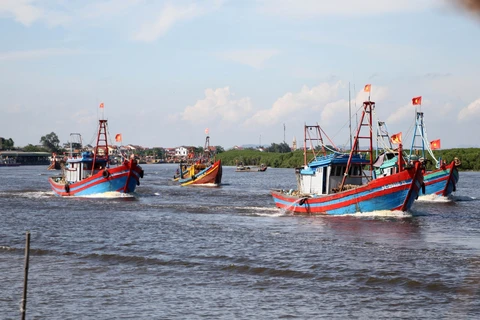
Fishing vessels in Dien Chau, Nghe An (Photo; VNA)

Nghe An (VNA) – The central province of Nghe An is taking steps to address problems in its fishing industry, aiming to have the "yellow card" warning by the European Commission lifted.

As of April 30, Nghe An successfully registered 2,318 out of its 3,462 fishing vessels, achieving 90.37%. Additionally, all of them are now included in the Vnfishbase database.

A total of 935 fishing vessels, representing 86.18% of those required to be certified, obtained valid food safety certificates. Notably, all active fishing vessels are now certified.

The province boasts a 96.95% success rate in equipping fishing vessels with voyage monitoring systems, with 1,052 out of the 1,085 vessels now compliant.

The provincial Department of Agriculture and Rural Development is working closely with the Border Guard, authorities of coastal districts and townships to educate fishermen and fishing companies on the proper use of the electronic catch documentation and traceability (eCDT) system, and intensify inspection on fishing vessels entering and exiting estuaries.

Vessels that have lost their voyage monitoring system connection since January 25, along with unregistered, unlicensed, and unauthorised vessels, will face strict fines.

Nghe An boasts a coastline of over 82km, granting it significant potential for seafood production. Its annual seafood exploitation output nears 200,000 tonnes, with nearly 17,000 workers employed in the fishing sector during peak seasons./.


VNA

See more

Automated ticketing system is used on the urban railway Cat Linh-Ha Dong line in Hanoi. (Photo: VNA)

Digital transformation powers Hanoi metro expansion

Beyond convenience, stable fares and the elimination of fuel, parking and maintenance costs have made urban rail increasingly attractive. The growing preference for metro travel is also contributing to a greener, more modern urban lifestyle.

Delegates cut the ribbon to inaugurate the operation of electric bus route No. 43. (Photo: VNA)

Hanoi accelerates shift to green buses, targets 100% by 2030

In the 2027–2030 period, the city will accelerate the transition towards the complete phase-out of fossil fuel-powered buses. The share of electric and green energy-fueled buses is projected to reach 79–89% by 2029 and 100% by 2030.

At the second session of the Ho Chi Minh City People’s Council (Photo: VNA)

Ho Chi Minh City greenlights central square, administrative centre in Thu Thiem

The new central city square and administrative centre will create a modern, centralised political-administrative complex for Ho Chi Minh City, designed to house around 8,000 officials, civil servants, and employees. It will also handle daily traffic of 1,500- 2,000 citizens and business representatives through a unified one-stop-shop administrative service system.

A working session at the job fair (Photo: VNA)

Vietnamese students flock to Seoul Job Fair 2026

The second annual Job Fair 2026 was held for Vietnamese students in the Republic of Korea. Organisers pitched it as a straight-up bridge between eager students and bosses hungry for young talent who can actually handle multicultural workplaces.

Defendants at the court (Photo: VNA)

Ho Chi Minh City court opens trial over Agribank lending scandal

The investigation revealed that multiple credit files were incomplete or riddled with inaccurate information, while some pledged assets lacked proper legal standing yet were accepted and grossly overvalued. As a result, the loans became high-risk and largely unrecoverable, leading to losses surpassing 1 trillion VND.

Hanoi introduces 53 electric buses from April 18 (Photo: VNA)

Hanoi to add 53 electric buses from April 18

According to the plan, all buses operating within Ring Road 1 will use green energy by July 1, 2026. The requirement will expand to Ring Road 2 by January 1, 2028, and to Ring Road 3 by 2030.

Illustrative image (Photo: VNA)

National, local traffic safety committees to be dissolved from June 1

Under the dicision, ministries and ministerial-level agencies will assume responsibility for tasks previously performed by the committee, in line with their mandates under the Law on Government Organisation, the Law on Road Traffic Order and Safety, the Law on Roads and other relevant legal frameworks, ensuring that traffic safety and order are maintained without disrupiton.