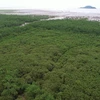
La Gian offshore wind power project will provide electricity for 7 million households. (Photo: VietnamPlus)
 Hanoi (VNA) - Offshore wind power will be fundamental to realising Vietnam’s green transition goals, stated Stuart Livesey, Country Director of Copenhagen Offshore Partners (COP) in Vietnam - the offshore wind project developer of Copenhagen Infrastructure Partners (CIP) which is implementing La Gan offshore wind power project in the south-central province of Binh Thuan.
Talking to the Vietnam News Agency on the sidelines of the release of the 2022-2023 Whitebook “Working Toward a Green Economy and Sustainable Development” by the European Chamber of Commerce in Vietnam (EuroCham) on February 16, Livesey said that Vietnam’s offshore wind resource is relatively untapped, and establishing this industry has many benefits in comparison to other renewables.
Reporter: How do you evaluate the importance of offshore wind power development to Vietnam's green energy transition?
Stuart Livesey: Offshore wind power will be a vital energy source to help Vietnam achieve the country's green transition goals. Currently, Vietnam's offshore wind resources have not been fully exploited, and establishing this industry is expected to bring more benefits compared to other renewable energy sectors.
When the development of wind projects is scaled up and supported by the right regulatory framework, they will bring more energy efficiency to Vietnam. Offshore wind power will likely be much cheaper and more sustainable than other energy sources and can utilise many of Vietnam’s existing and future labour force and supply chains.
Reporter: What do you think about the urgency of developing green energy in Vietnam?
Stuart Livesey: Vietnam committed to ambitious goals at the 26th UN Climate Change Conference (COP26) in the UK in 2021, and has demonstrated its stance to respond to climate change by actively pursuing the production of green and sustainable energy for the present and future generations.
Green and sustainable energy is very important to the future of Vietnam and its anticipated development.
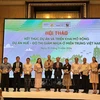
 The ceremony to release the 2022-2023 Whitebook “Working Toward a Green Economy and Sustainable Development” held by the European Chamber of Commerce in Vietnam (EuroCham) in Hanoi on February 16. (Photo: VietnamPlus)
 Countries and suppliers worldwide are currently setting targets for green supply chains and green energy. Many parties have made strong commitments to implementing these, so Vietnam must speed up the green transition to maintain its position as a key export market in Southeast Asia.
It is acknowledged that Vietnam is slightly lagging behind some countries where the green transition is progressing smoothly. This process requires support from appropriate solutions, infrastructure, and skilled workforce.
However, Vietnam still has enough time to implement the scheme if it can make the necessary reforms and timely important decisions.
Finalising legal frameworks to attract investment
Reporter: What are your opinions on policies to encourage enterprises to develop wind power in Vietnam?
Stuart Livesey: Currently, it is fundamentally impossible to deliver a commercial offshore wind farm in Vietnam due to a lack of necessary regulatory framework and of flexibility for the offtake of energy to transition to allow for these offshore mega-projects.
Both national and international developers and investors are keen to invest in offshore wind in the Vietnam market. However, the delays in key decision-making requirements and lack of ownership by aspects of the government to enable this industry could result in huge delays to green energy targets. Delays will cause billions of dollars of direct in-country investment, and potentially deter global investors from pursuing Vietnam when so many other emerging markets strive for their own offshore wind goals.
For large international developers, ESG (Environmental, Social, and Governance) is increasingly important as part of their working policy, as these companies need to meet IFC (International Finance Corporation) standards to satisfy lenders and international organisations that have high standards to meet.
 Stuart Livesey, Vietnam Country Director for Copenhagen Offshore Partners (Photo: VietnamPlus)
 CIP is one of the world's leading offshore wind developers and the largest global renewable energy development fund manager headquartered in Denmark. Meanwhile, COP, as a subsidiary of CIP, is responsible for developing and operating all CIP's offshore wind projects across the world. Therefore, we are committed to continuing to apply these criteria in Vietnam.
In my opinion, Vietnamese regulations should recognise the need to use these internationally recognised standards to establish qualified and transparent procedures on large-scale infrastructure projects
Reporter: Can you share experiences of CIP to contribute to the offshore wind and energy industry in Vietnam?
Stuart Livesey: CIP has been in the Vietnamese market for more than three years, and it has been establishing and developing the La Gan offshore wind power project with a capacity of 3.5 GW in the south-central province of Binh Thuan, which is one of the projects included in the draft National Power Development Plan for the 2021 - 2030 period with a vision to 2045 (PDP VIII).
CIP is collaborating with local partners in implementing this project, and is also exploring the development of a portfolio with a total capacity of over 10 GW for new offshore wind projects in other localities in the south (such as Ninh Thuan province).
La Gan project alone is expected to contribute approximately 10.5 billion USD in investment, with over 40% of this amount being directly transferred into the Vietnamese economy through supply chains, employment opportunities, and the use of ports.
We recognise that our global experience and expertise can contribute to the development of domestic supply chain and support Vietnam’s offshore wind industry. Therefore, we are committed to sharing knowledge and information, and working with local suppliers as this industry progresses./
Thank you for the conversation!
| The European Chamber of Commerce in Vietnam (EuroCham) held a ceremony in Hanoi on February 16 to release the 2022-2023 Whitebook “Working Toward a Green Economy and Sustainable Development” This year's edition of Eurocham's white book highlighted the importance of working toward a green economy and sustainable development for Vietnam, as well as the full implementation of the European Union–Vietnam Free Trade Agreement (EVFTA) and completing the ratification of the European Union–Vietnam Investment Protection Agreement (EVIPA). The annual edition made several recommendations in regard to a number of industries and how to better attract business investment into the Southeast Asian country. Eurocham's President Alain Cany said the chamber's white book offers an opportunity for exchanges of dialogues between businesses and policymakers and for solutions to developmental issues. |