Online exchange connects Vietnamese, Japanese youngsters

“Vietnam Festa★Online - Kanagawa is a friend of Vietnam,” an online exchange among Vietnamese and Japanese youngsters took place in Tokyo on March 12, the first of a series of events leading up to the Vietnamese Festival in Kanagawa.
Online exchange connects Vietnamese, Japanese youngsters ảnh 1Kanagawa Governor Yuji Kuroiwa, Japanese artists as well as Vietnamese and Japanese students perform the song entitled "Aoi Sora" at the event (Photo: VNA)
Tokyo (VNA) – “Vietnam Festa★Online - Kanagawa is a friend of Vietnam,” an online exchange among Vietnamese and Japanese youngsters took place in Tokyo on March 12, the first of a series of events leading up to the Vietnamese Festival in Kanagawa.

Addressing the programme, Kanagawa Governor Yuji Kuroiwa said that the event aims to reaffirm the close relationship between the Japanese prefecture with Vietnam. After two years of suspension due to COVID-19, Kanagawa is determined to organise the Vietnamese Festival this autumn, he said.

For his part, Vietnamese Ambassador to Japan Vu Hong Nam hailed the idea of organising the Vietnam Festa★Online, which contributes to strengthening connections and mutual understanding among youngsters of both countries, thus helping promote ties between Vietnam and Japan. He said he hopes the youth of Vietnam and Japan will stay united to maintain peace in the world.

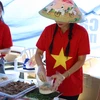
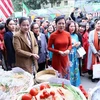
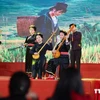
The programme, which was broadcast live on YouTube, consisted of a conference on the Kanagawa-Vietnam friendship, a contest to make “Banh xeo” (crispy Vietnamese pancake), and an art performance.

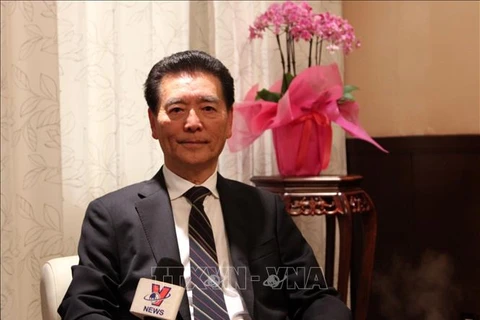
Speaking to Vietnam News Agency following the programme, Kuroiwa said that he was strongly impressed by the first Vietnam-Kanagawa Festival seven years ago, with over 400,000 participants.

The organisation of the Vietnam Festa★Online affirmed that exchange activities between the two sides continue despite the pandemic, he said, expressing hope that such activities will be further expanded.

Meanwhile, Ambassador Nam said that the programme, a joint effort of TVK company, Kanagawa authorities and the Vietnamese Embassy in Japan, showed that the linkage between Vietnamese and Japanese youngsters is developing despite COVID-19./.

VNA
See more

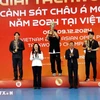
Participants in the 20th Cong hien (Devotion) Awards presentation ceremony in Hanoi on April 15 (Photo: VNA)

Devotion Awards mark two decades of honouring excellence in music, sports

Nguyen Thien Thuat, Editor-in-Chief of the The Thao & Van Hoa newspaper and Head of the organising board of the awards, said, noting that their achievements reflect the spirit of the Politburo’s Resolution No. 80, which emphasises preserving national cultural values while selectively absorbing the essence of world culture.

Artisans and students take part in cultural activities and exchanges in the Xoan singing performance space at Hung Lo ancient communal house in Phu Tho province (Photo: VNA)

Ancestral legends revived through contemporary performance

Beyond cultural value, well-organised festival programmes linked with tourism and media can contribute to the development of cultural industries and enhance Vietnam’s cultural soft power, positioning heritage-based events as distinctive national cultural brands in the international arena.

Khue Van Cac (Khue Van Pavilion) stands as a defining cultural symbol of Hanoi, closely associated with Vietnam’s long-standing tradition of valuing education and honouring knowledge. (Photo: VNA)

Greater efforts needed for heritage to shape Hanoi’s identity

As suggested by UNESCO experts, heritage should be approached as an integrated system encompassing space, people and everyday life. This perspective can inform urban planning, cultural tourism development and the creation of clear economic drivers.

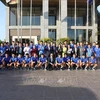
Participants at the gathering (Photo: VNA)

Lao, Cambodian students welcome traditional New Year in Ho Chi Minh City

In his speech, Vice Chairman of the municipal People’s Committee Nguyen Manh Cuong said the municipal Party organisation, authorities and people always value the close ties and solidarity among Vietnam, Laos and Cambodia. He described the three nations’ longstanding ties, forged through shared hardships, as an invaluable spiritual asset and a bedrock for sustainable development.

Vietnamese kickboxers win 32 gold medals at the Kickboxing World Cup 2026. (Photo: Vietnam Kickboxing Federation)

Vietnam finish third at Kickboxing World Cup 2026

According to Vu Duc Thinh, President of the Vietnam Kickboxing Federation, the strong results reflected careful preparation by local training centres and the determination of Vietnamese fighters. The team’s participation, funded largely through socialised and local resources, also demonstrated growing support for the development of kickboxing in Vietnam.

Politburo member, Secretary of the Party Central Committee and Head of the Party Central Committee’s Commission for Information, Education and Mass Mobilisation Trinh Van Quyet speaks at the event (Photo: VNA)

National Radio Festival opens in Quang Ninh

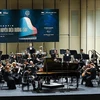
The opening night was combined with an artistic programme titled “sounds of the new era,” drawing around 50,000 spectators. The programme was structured in three chapters: Origins of Sound, Heritage Sound, and Sound of the New Era.

Vietnamese puppetry faces pressure to adapt to modern lifestyles, particularly amid growing competition from diverse entertainment forms (Photo: VNA)

Vietnamese puppetry seeks renewal amid preservation challenges

People’s Artist Nguyen Hoang Tuan, Chairman of the Hanoi Theatre Association, noted that while northern Vietnam had 27 puppetry guilds in 1986, only 14 remain today. Many traditional plays and original scripts have been lost, hurting restoration and preservation efforts.

Visitors enjoy the "Stone History Preserves Memories" exhibition, featuring a traditional format combined with digital technology solutions (Photo: VNA)

Project on digital transformation in cultural sector approved

By 2030, the project targets the establishment of shared digital platforms across 100% of cultural sectors. All digitised cultural heritage will be standardised under the national data framework and shared in accordance with regulations, while 80% of public digital heritage assets are expected to receive digital identifiers to clarify ownership and management, encouraging organisations and individuals to do the same and support market development.