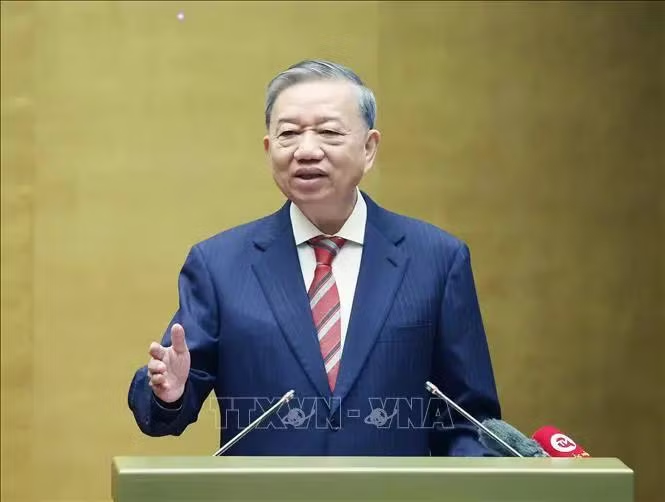
Hanoi (VNA) - The central steering committee for the review of the implementation of Resolution No. 18-NQ/TW, issued by the 12th Party Central Committee in 2017, on December 5 requested all units to complete their proposals for restructuring and streamlining the organisational apparatus in December 2024, in preparation for extraordinary meetings of the Party Central Committee and the National Assembly, scheduled to take place in February 2025.
Everything is proceeding with great urgency. Within two months, from the launch of the "revolution to streamline the state apparatus" to the completion of the restructuring plan, all must be finalised.
This is thanks to the decisive leadership of General Secretary of the Communist Party of Vietnam Central Committee To Lam, who has adopted the guiding principles of "running while queuing," "time does not wait," "acting immediately, the sooner the work is done, the better it benefits the people and the country," and "the Party Central Committee and its commissions, the National Assembly, and the government must all set examples."
Key phrases that have been prominent in the speeches of the Party chief in recent times include "revolution," "decisiveness," "urgency," "high determination," "critical importance," "strong," "act rapidly," "extraordinary effort," and "outstanding endeavour."
On October 31, 2024, at a discussion session of the legislature, the General Secretary described the streamlining of the apparatus as a "revolution" that must be implemented by the entire political system, from the central to grassroots levels, and by each party cell and member.
He emphasised that since the 12th National Party Congress, the Party Central Committee’s Resolution has recognised that the state apparatus is cumbersome, inefficient, and ineffective, and must be reorganised and streamlined. “Without streamlining the apparatus, we cannot achieve development,” he noted.
According to the leader, currently, around 70% of the budget is spent on salaries and regular expenditures to support ongoing operations. If the budget is managed in this way, there will be no funds left for development investments, national defence, security, poverty reduction, and social welfare. At least 50% of the budget should be allocated to these critical tasks. Therefore, salaries cannot be raised, as if being raised while the apparatus remains cumbersome, spending on wages will rise to 80-90% of the budget, leaving no funds for other activities, Lam stated, stressing that a cumbersome apparatus hinders development.
On November 5, Party General Secretary To Lam penned an article on building an elite, streamlined, strong, efficient, valid and effective political system.
In this article, he emphasised that with the 100th founding anniversary of the Party and the 100th founding anniversary of the nation approaching, achieving strategic goals not only requires extraordinary efforts and exceptional commitment but also does not allow any delay, slackening, lack of precision, inconsistency and loose coordination in each step. To accomplish this, it is imperative to initiate a revolution in streamlining the organisational apparatus of the political system.
It is necessary to focus on perfecting the institutions in a spirit of both "running while queuing" so as to promptly translate the Party's policies into reality. Relevant legal regulations should be reviewed for amendments, supplements or promulgations correctly by regulations, ensuring that the Party's policies are implemented as soon as they are approved by the Party Central Committee.
The Party chief also stressed the need to complete laws on the organisation and operations of agencies within the political system in association with the spirit of boosting the decentralisation and delegation of power following the motto of “localities deciding, localities implementing, and localities bearing the responsibilities”, with the Party, Government, and National Assembly strengthening the completion of the institutional framework, playing the assisting role, enhancing inspection, supervision, and maximising administrative reforms which includes reducing costs and creating the most favourable conditions for citizens and businesses.
In addition, streamlining the organisational structure should be combined with restructuring the contingent of officials to ensure they possess the necessary quality, capacity, and qualifications for their tasks, with reasonable payroll and standardised job titles, he added.
Six days later, on November 11, at a meeting with the sub-committees in charge of documents and Party rules for the upcoming 14th National Party Congress, Lam called for the swift and determined implementation of Resolution No. 18-NQ/TW on several issues regarding the reform of the political system for greater efficiency. He stressed the need for high political resolve, decisive action, and ideological consensus across the entire political system. The effort requires solidarity, courage, and self-sacrifice from every official and Party member to serve the country’s development.
On November 25, addressing the opening ceremony of the 13th Party Central Committee’s meeting, the Party chief affirmed that the continued innovation and restructuring of the political system's organisational apparatus is an urgent requirement of the current practical situation, as time does not wait.
Many tasks remain unaccomplished, and the organisational structure of the political system is still cumbersome, with multiple layers and overlapping functions, responsibilities, and authorities. Its decentralisation and delegation of power are inconsistent, and operational effectiveness and efficiency remain low, he noted.
The Politburo has reached consensus on a strong political resolve to comprehensively review Resolution No. 18-NQ/TW to report to the Party Central Committee for approval of decisive measures to continue reorganising and perfecting the organisational apparatus of the political system, starting with central agencies. It has been identified as a task that must be carried out swiftly and completed before the 14th National Party Congress.
General Secretary To Lam emphasised that following the Politburo's policy, the work has been actively implemented with the spirit of “running while queuing.” The Politburo established a steering committee to review Resolution No. 18-NQ/TW, issuing operational regulations, assigning responsibilities, and creating an implementation plan to guide ministries, sectors, and localities in conducting the review in accordance with a defined outline and specific directions.
Recently, on December 1, the Politburo and the Secretariat of the Party Central Committee convened a national conference to thoroughly popularise the review of Resolution No. 18, during which Lam said that the question now is whether this is the right time and opportunity, and where it is an urgency and an objective requirement or not for the revolution in streamlining the organisational structure of the political system to ensure effective and efficient operations.
The answer is that the nation can no longer afford any delays, as this is an urgent issue that must be addressed immediately. The sooner the work is done, the greater benefits it brings to the people and the nation.
“To ensure a healthy body, sometimes we must take bitter medicine or endure pain to surgically remove the tumor,” stressed the Party leader./.
VNA