📝 OP-ED: Mine Action Cannot Wait - Stronger partnerships key to end deadly legacy of war

In the run up to a Regional Conference on Mine Action for Sustainable Peace and Development (March 29-30, 2023), Korea International Cooperation Agency (KOICA) Country Director Cho Han-Deog and UNDP Resident Representative Ramla Khalidi offer their perspectives.

📝 OP-ED: Mine Action Cannot Wait - Stronger partnerships key to end deadly legacy of war ảnh 1
Founded in August 2018, MAT 19 is the name of the only all-female UXO clearance team among the 40 teams deployed by the Mines Advisory Group (MAG) in Quang Tri province. They perform their tasks by using specialised equiment. (Photo: VNA)

Hanoi (VNA) - In the run up to a Regional Conference on Mine Action for Sustainable Peace and Development (March 29-30, 2023), Korea International Cooperation Agency (KOICA) Country Director Cho Han-Deog and UNDP Resident Representative Ramla Khalidi offer their perspectives.

Generations of Vietnamese, Cambodians and Lao have lived in fear that their next step could be their last.

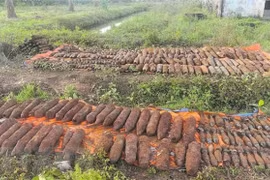
Most of the 7.5 million tonnes of ordnance dropped during the conflict in the 1960s and 70s fell on Vietnam. Half a century on from the signing of the Paris Peace Accords, a fifth of the country remains contaminated. Living next to minefields and contamination has internalised terror. “I found a mine at my backyard when I was gardening in 2009. The anxiety of landmines has always been with me,” said Y Quyet, a woman living in the central Quang Binh province.

Over the past three decades, the UNDP has worked on mine action in over 50 countries. KOICA has supported mine action in Vietnam, Laos, and Cambodia as part of the Mekong Peace Community Programme. Unexploded ordnance not only threatens lives, but contamination also curtails the opportunity to farm and make a living, to prosper in peace and security. As Oscar-winner and UNDP Goodwill Ambassador Michelle Yeoh said at a Security Council meeting on Mine Action in 2021, “Mine action is linked to the Sustainable Development Goals, and it is important to look at the issue beyond square meters cleared.”

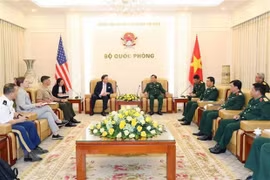
The Government of Vietnam has pledged to end further accidents due to mines and unexploded ordnance by 2025. KOICA and the UNDP are committed to supporting the government in realising this goal. This means bringing an end to losing lives and limbs to this deadly legacy of war and to release contaminated land for development and productive use. In partnership with the Ministry of National Defense, KOICA and the UNDP strengthen institutions to tackle the challenges posed by landmines, providing explosive ordnance risk education, data management, victim assistance, and undertaking clearance operations.

📝 OP-ED: Mine Action Cannot Wait - Stronger partnerships key to end deadly legacy of war ảnh 2
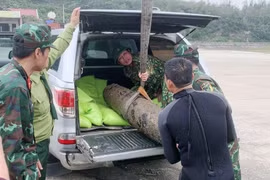
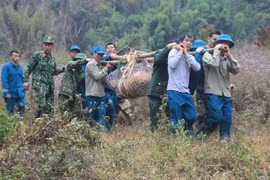
Sappers of the Defence Ministry's Corporation 319 bring an unexploded bomb to an area for UXO in Binh Dong commune of Binh Son district, Quang Ngai province. (Photo: VNA)

In three years, the project has surveyed 17,000 hectares of land, equivalent to 20,000 football fields, and cleared 10,000 contaminated hectares. Meanwhile, 450,000 local people, especially children, have received education on the risk of unexploded ordnance. KOICA and the UNDP will continue supporting Mine Action, for instance supporting 10,500 farmers to apply smart-climate and resilient agriculture and upgrading or building 50 health stations.

People like Y Quyet can only imagine a life without fear and a chance to develop the land so that their children can prosper. Every day they wait for mine action teams to undertake the painstaking progress of clearing the land acre by acre.

On April 4, we mark the International Day for Mine Awareness and Assistance in Mine Action with the message that mine action cannot wait. To accelerate progress, we must enhance regional and international cooperation to share ideas and technologies that can lead to concrete and long-lasting results on the grounds.

In Cambodia, the government has started to use drones to detect landmines. In Vietnam, an online registry and information management system for people with disabilities and unexploded ordnance survivors has been used to conduct an assessment in the country’s most contaminated provinces of Quang Binh and Binh Dinh.

Our vision is a world free from the threat of landmines and unexploded ordnance. It is important that countries collaborate to spur innovation in the region to end the deadly legacy of unexploded ordnance. There is still much work to do to reduce risk and build a better future for mine-affected communities./.
VNA

See more

Students from the VACEO art class perform at the Cultural Fusion - Narellan festival. (Photo: VNA)

Vietnamese in Australia keep heritage alive

Vietnamese dance and traditional music classes organised by the Viet-Aus Culture Exchange Organisation (VACEO) have been held every Saturday afternoon in Bankstown, Sydney.

Load testing of the 3,400-tonne main arch structure and supporting frame of the Saigon River pedestrian bridge at the factory (Photo published by VNA)

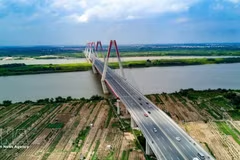
Saigon River pedestrian bridge set to be joined on October 21

The assembly comprises a main bridge structure weighing about 1,400 tonnes and a specialised steel supporting frame weighing around 2,000 tonnes. During testing, about 30 self-propelled modular transporters were used to lift the assembly 40cm off the ground for technical inspections. Sensors and monitoring equipment recorded key parameters.

Ba Vi Safari Park. (Photo: Sun Group)

Hanoi breaks ground on 299-hectare safari park

Its key features will include animal habitats modelled on natural ecosystems, veterinary and research facilities, educational exhibitions and recreational areas. Green spaces and water bodies will cover about 81.8% of the site, providing ecological corridors and suitable habitats for wildlife.

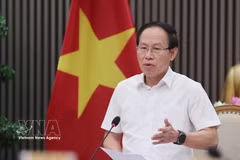
Deputy Prime Minister Le Tien Chau addresses the meeting (Photo: VNA)

Deputy PM asks for highest education quality, safety for students

Regarding the construction of inter-level boarding schools in border communes, all 108 schools under Phase 1 opened for the 2026-2027 academic year, with 40 having completed all construction items. Procedures for groundbreaking at 121 schools under Phase 2 across 17 provinces and cities have been completed, with all projects targeted for completion before August 30, 2027.

Hanoi leaders attend the inauguration and groundbreaking ceremonies for projects. (Photo: VNA)

Hanoi launches 18 key projects worth nearly 4.94 billion USD

The city announced 292 projects with a combined investment of 384.886 trillion VND (14.92 billion USD), including 18 key projects worth 127.46 trillion VND, focusing on transport, infrastructure, environmental protection and public services.

With just a smartphone, a wealth of knowledge spanning tens of thousands of books can now be accessed in an instant. (Photo: Thanh Nien Newspaper)

Vietnam’s first shared digital library platform launched

Vietnam Digital Library Joint Stock Company (ViLiB) launched its “Digital Knowledge Space – Shared Digital Library” platform in Ho Chi Minh City on October 8, enabling libraries, schools and organisations to connect and share digital resources, thereby broadening access to books and knowledge.

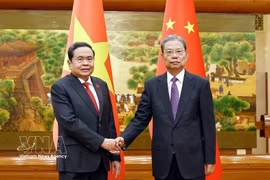
Prime Minister Le Minh Hung are welcomed by staff of the Vietnamese Embassy, representatives of Vietnamese agencies and associations, and members of the Vietnamese community in Laos on October 9, 2026. (Photo: VNA)

Vietnam–Laos special ties nurtured by the people: PM Le Minh Hung

Prime Minister Le Minh Hung urged Vietnamese people in Laos to maintain solidarity, integrate proactively, respect Lao laws and educate younger generations about their national roots and the special Vietnam–Laos relationship. Calling Laos a country undergoing dynamic transformation with emerging opportunities

Vietnamese Deputy Minister of Foreign Affairs Ngo Le Van and his Lao counterpart Anouparb Vongnorke co-chair the conference. (Photo: VNA)

Vietnam, Laos enhance legal awareness among border village leaders

The conference aimed to help officials, specialised forces and village leaders gain a better understanding of border-related policies and laws, thereby enhancing their sense of responsibility for managing and protecting the border line and markers, maintaining public order and promoting economic development in border areas.