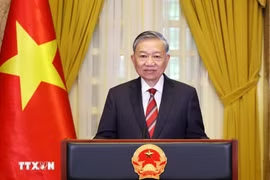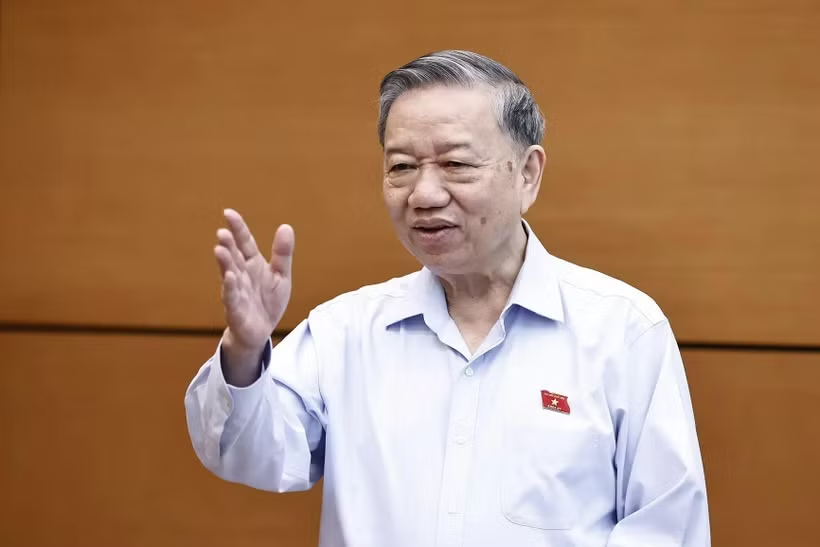
Hanoi (VNA) – Party General Secretary To Lam has freshly penned an article on building an elite, streamlined, strong, efficient, valid and effective political system.
The article published on November 5 stressed that at every revolutionary stage, the Party and State have consistently placed importance on enhancing the leadership, governance, and combat capacity of the Party, and on strengthening the efficiency, validity, and effectiveness of the political system. This is one of the pivotal elements that have enabled the Communist Party of Vietnam (CPV) to become a great helmsman and a visionary captain skillfully steering the ship of the Vietnamese revolution through challenges to achieve victory after victory, the Party leader wrote.
According to him, the strategic convergence achieved following the four decades of the national renewal process (doi moi) presents a historic opportunity for Vietnam to enter a new era of development and national rise, while posing an urgent requirement for drastic implementation of a revolutionary to build a truly elite and streamlined political system that operates efficiently and effectively and meets the requirements and tasks of this new revolutionary phase.
According to the General Secretary, with the 100th founding anniversary of the Party and the 100th anniversary of the nation’s founding approaching, achieving strategic goals not only requires extraordinary efforts and exceptional commitment but also does not allow any delay, slackening, lack of precision, inconsistency and un-coordination in each step. To accomplish this, it is imperative to initiate a revolution in streamlining the organisational apparatus of the political system, with a focus on the following key tasks:
First, building and launching a comprehensive organisational model across the entire political system that meets the requirements and tasks in the new revolutionary phase. Focusing on reviewing the 7-year implementation of Resolution No. 18 titled “Several issues on continuing to innovate and rearrange the organisational apparatus for an elite, streamlined, effective and efficient political system”, adopted by the 6th plenum of the 12th Party Central Committee, making serious and comprehensive assessment of the situation, outcomes, strong points, weaknesses, limitations, obstacles, causes, and lessons learned during the implementation. Recommendations for innovation and rearrangement of the political system’s organisational apparatus should be proposed to the Politburo and the Party Central Committee.
The review must be conducted objectively, democratically, scientifically, specifically, profoundly, openly, and accurately in accordance with real-world conditions. From this foundation, a new organisational model should be proposed and its advantages and impacts evaluated upon implementation. The work must strictly adhere to the Constitution, Political Platform, Party Statute, Party principles, and Resolutions of the Party Central Committee, ensuring comprehensiveness, consistency, interconnection. One agency should perform multiple tasks; one task is assigned to only a single agency which bears responsibility for it; overlaps in functions and tasks as well as sectoral divisions must be eradicated; intermediary organisations should be limited; and functions, tasks, and specific responsibilities must be clearly defined based on Party principles, rationality and legality.
Secondly, it is necessary to focus on perfecting the institution in a spirit of both "running and queuing" so as to promptly translate the Party's policies into reality. Relevant legal regulations should be reviewed for amendments, supplementations or promulgations correctly by regulations, ensuring that the Party's policies are implemented as soon as they are approved by the Central Committee.
The Party chief also stressed the need to complete laws on the organisation and operation of agencies within the political system in association with the spirit of boosting the decentralisation and delegation of power following the motto of “localities deciding, localities implementing, and localities bearing the responsibilities”, with the Party, Government, and National Assembly strengthening the completion of the institutional framework, playing the assisting role, enhancing inspection, supervision, and maximising administrative reforms which includes reducing costs and creating the most favourable conditions for citizens and businesses. It is crucial to clarify the duties and powers of Government agencies, organisations, and individuals, ensuring a clear-cut distinction between the level responsible for issuing policies, orientations and laws and the level responsible for their implementation.
Thirdly, streamlining the organisational structure should be combined with restructuring the contingent of officials to ensure they possess the necessary quality, capacity, and qualifications for their tasks, with reasonable payroll and standardised job titles. It is necessary to issue regulations on the framework of standards and criteria for officials at all levels, from central to local, and across different types of organisations, so that proactive reviews can be conducted to identify immediate placements.
A strong reform of recruitment, training, promotion, appointment, rotation, transfer, and assessment of officials should be implemented in a substantive manner, focused on selecting the right people based on measurable outcomes, with no “forbidden” zones and no exceptions in the evaluation of officials.
There should also be effective mechanisms for filtering out those who lack the necessary quality, competence, or credibility, while promoting individuals with outstanding abilities, Lam wrote.
The Party chief concluded that building an effective and efficient apparatus is a difficult and complex task that requires solidarity, unity, courage, and the sacrifice of each official and Party member, as well as the high determination of the entire Party and political system, especially the heads of Party committees, authorities, the Vietnam Fatherland Front, and mass organisations at all levels, towards a prosperous, powerful, fair, democratic, and civilised Vietnam, which is soon able to stand shoulder to shoulder with the great powers of the world./.
VNA