Plutonium detected in soil at Fukushima nuke plant

Plutonium has been detected in soil samples taken in five locations at Japan’s Fukushima nuclear plant No. 1, the Tokyo Electric Power company (TEPCO) said on March 28.
Plutonium has been detected in soil samples taken in five locations atJapan’s Fukushima nuclear plant No. 1, the Tokyo Electric Power company(TEPCO) said on March 28.

According to the nuclear complex’soperator TEPCO, this was the first time plutonium had been detected atthe nuke plant since the March 11earthquake and tsunami that devastatedthe plant’s reactors.

Of the samples from five locations, thereis a high possibility that at least two of them are directly linked withthe current reactor accident, TEPCO spokesman said.

Plutonium ismore noxious than other radioactive substances like iodine and cesium,but TEPCO said the level is not serious enough to harm human health.

HidehikoNishiyama, a spokesman for the Japan Nuclear and Industrial SafetyAgency, the detection of plutonium showed the damage of fuel rods. TEPCOan the Ministry of Science will keep a close watch on the environmentat the plant and its surrounding areas within a radius of 20km.

Earlierthe same day, TEPCO said, high levels of radiation exceeding 1,000millisieverts per hour have been detected in water in a trench outsidethe No. 2 reactor's building at the nuclear plant, with the contaminatedwater suspected to have come from the reactor's core, where fuel rodshave partially melted.

The radiation level in the air in the trench stood at 100 to 300 millisieverts, the company said.

Ata radiation level of 1,000 millisieverts per hour, people could suffer adecrease in the number of lymphocytes -- a type of white blood cell --in just 30 minutes, and half could die within 30 days by remaining insuch conditions for four hours./.
See more

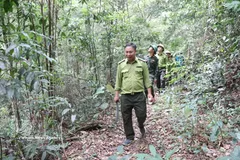
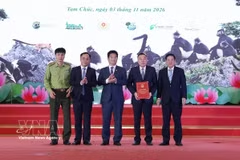
Representatives of the People’s Committee of Ninh Bình province present the decision to establish the Kim Bang Delacour's Langur Species and Habitat Conservation Area. (Photo: VNA)

Ninh Binh establishes world's largest Delacour's langur sanctuary

The establishment of the Kim Bang Delacour's Langur Species and Habitat Conservation Area in Ninh Binh province provides a solid legal and scientific foundation for completing the dossier to seek UNESCO recognition of the Van Long–Kim Bang–Tam Chuc Cultural and Ecological Landscape Complex as a World Heritage Site.

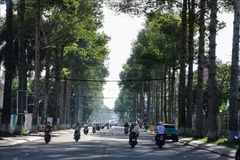
Trees planted along Vo Truong Toan street in Cao Lanh ward, Dong Thap province. Urban tree species capable of reducing fine particulate matter will be planted to reduce air pollution. (Photo: VNA)

Urban trees capable of reducing fine dust to be planted

The Forestry and Forest Protection Department (FFPD) will lead the component on identifying crop and planting structures that help reduce air pollution, while also participating in the design of urban public-space landscapes.

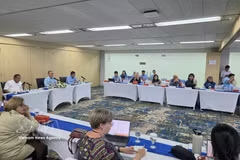
Professor Yucheng Lin, an Assistant Professor at City University of Hong Kong (CityUHK). (Photo: VNA)

Hong Kong expert offers solutions to help Vietnam tackle sea-level rise

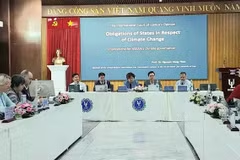
In an interview with the Vietnam News Agency’s correspondents in Hong Kong (China), Lin, an expert specialising in sea-level change and climate risk assessment, said Vietnam shared global drivers of sea-level rise with China’s coastal regions, but local conditions could lead to significant differences in the overall risks.

Typhoon Yagi caused severe losses in many provinces in Vietnam in 2024. (Photo: VNA)

Vietnam could face super typhoon like Yagi every seven years

If global average temperatures rise by two degrees Celsius, Vietnam could experience such a super typhoon once every 13 years on average. The frequency would increase to once every nine years under the three-degree warming scenario and once every seven years if temperatures rise by four degrees.

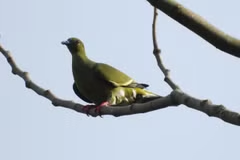
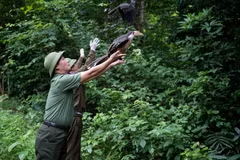
Six of the newly recorded species are of conservation significance, representing four orders and five families. (Photo published by VNA)

Dakrong Nature Reserve records 35 new bird species

Dakrong Nature Reserve in the central province of Quang Tri has recorded 35 bird species not previously documented, including several endangered and rare species listed on the International Union for Conservation of Nature (IUCN) Red List.

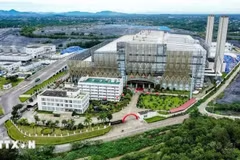
An overview of Soc Son waste-to-energy plant in the Nam Son Waste Treatment Complex, in Hanoi (Photo: VNA)

Hanoi targets collection and treatment of all industrial solid waste

Hanoi aims to ensure that all industrial solid waste from its hi-tech parks, industrial parks and industrial clusters is collected and treated in line with regulations under a new plan to strengthen waste management and tighten control on scrap collection, storage and recycling facilities across the capital.

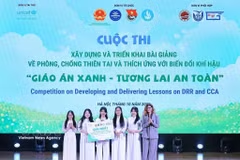
UNICEF Representative in Vietnam Silvia Danailov (first, right) honours first winners of the teaching materials competition. (Photo: VNA)

Deputy minister urges early action on disaster risks

Rapidly shifting climate conditions and increasingly overlapping hazards mean disaster risk reduction can no longer stand alone; it must sit at the heart of sustainable development, tightly integrated with climate response, water security, social welfare and economic growth.

General Secretary of the Communist Party of Vietnam Central Committee and President To Lam speaks at the groundbreaking ceremony for a project to upgrade the Bac Hung Hai irrigation system. (Photo: VNA)

Hung Yen: Project to modernise Bac Hung Hai irrigation system launched

General Secretary of the Communist Party of Vietnam Central Committee and President To Lam stressed that the development of Bac Hung Hai must be integrated into broader efforts to ensure water security, protect the environment and promote sustainable development in the Red River Delta.

Illustrative image (Source: VNA)

Northern region to experience cold spell

The cold air is forecast to reach northeastern Vietnam from the evening and night of October 4 before spreading to other parts of the north and the area from Thanh Hoa to Hue. Winds will shift to the northeast at levels 2-3 inland and levels 3-4 along coastal areas.