PM demands removing bottlenecks in real estate market for safe, healthy development
Prime Minister Pham Minh Chinh underlined the need to pay special attention to removing "bottlenecks" on the real estate market while chairing an online conference on July 14 on measures to ensure safe, healthy and sustainable development of the property market.
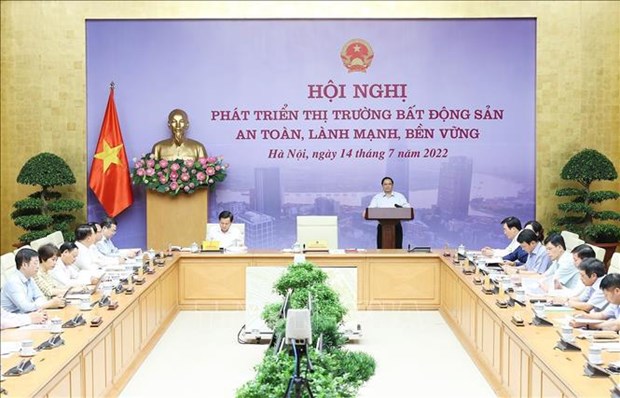 Prime Minister Pham Minh Chinh speaks at the conference (Photo: VNA)
 The conference was connected with the People's Committees of five centrally-run cities: Hanoi, Ho Chi Minh City, Da Nang, Hai Phong, and Can Tho.
In his remarks at the event, the PM emphasised the viewpoint of persistently and firmly developing a safe, healthy and sustainable real estate ecosystem without unreasonably credit tightening but strengthening inspection and supervision and State management.
Economic-civil relations will not be criminalised, but law violations will be severely punished to protect those who adhere to the law and protect and harmonise the interests of the State, businesses and people, he stated.
Pointing out shortcomings, limitations and inadequacies of the market, the PM asked ministries, sectors and localities to create a healthy environment for the property market, with priority given to the market segment serving social security. He said market rules should be respected but the State should uphold its management role to prevent manipulation of the market.
The Government leader underlined the need to promote strategic infrastructure development, thus creating new development space and motivation for the real estate market.
He assigned the Ministry of Construction to research and fine-tune the legal system related to real estate with a view to removing obstacles and facilitating the sector's stable and healthy development.
The Ministry should quickly submit to the National Assembly for consideration and approval the Housing Law (revised) and the Law on Real Estate Business (revised) to create a legal framework for real estate trading and enhancing the effectiveness of management of the property market.
The ministry was also told to report to the PM on the real estate market every quarter.
The State Bank of Vietnam (SBV) was tasked with monitoring, controlling and restructuring credit for the real estate sector to ensure proper use of capital and prevent risks to the market.
The PM required the Ministry of Natural Resources and Environment to coordinate with the Ministry of Finance and the Ministry of Justice to study, review and amend current law provisions related to the auction of land use rights in order to ensure consistency and suitability with reality.
The agencies were also requested to strengthen inspection and examination, and coordinate with localities to detect, stop and strictly handle violations in land use right auction activities.
PM Chinh assigned the Government Office to coordinate with the Ministry of Construction and related ministries and sectors to compile a Prime Minister's directive on solutions to ensure the healthy and sustainable development of the real estate market.
A report of the Ministry of Construction said the real estate market contributed 4.5 percent of the GDP both directly and indirectly. The sector fell into difficulties in 2021 due to the pandemic, but it has joined the trend of recovery from early 2022.
The ministry was of the view that the legal system related on real estate investment, building and trade has revealed some flaws that call for correction. The property prices have risen too high compared to people's incomes.
Participants focused on assessing and forecasting of Vietnam’s real estate market, proposing orientations and solutions on product structure and supply for the safe, healthy and sustainable development of the market.
Macro policy and the impact of land policy on the real estate market; the impact and influence of the capital and stock markets and policies related to the auction and valuation of land use rights on the real estate market were also put on the table./.


You should also see
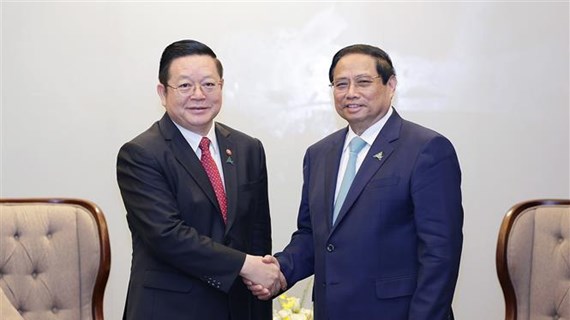
Prime Minister receives ASEAN Secretary-General
Prime Minister Pham Minh Chinh on April 23 hosted a reception for ASEAN Secretary-General Kao Kim Hourn who is paying a working trip to Vietnam and attending the ASEAN Future Forum (AFF) 2024 from April 21-24.

See more
 Business
French auction house to open office in Vietnam
France’s Millon Auction House has decided to open its representative office in Vietnam, and is preparing necessary steps for the official opening of the office in the near future.
 Business
3,400 taels of SJC-branded gold bars successfully auctioned
The State Bank of Vietnam auctioned 16,800 taels of SJC-branded gold bars in Hanoi on April 23. This is the first auction of this kind in 11 years.
 Business
HCM City seeks to draw remittances in infrastructure
A seminar aimed at channeling overseas remittances into infrastructure took place in Ho Chi Minh City on April 23, given that remittances to the city reached 9.46 billion USD in 2023, nearly three times higher than foreign direct investment (FDI), according to official statistics.
 Sci-Tech
FPT, NVIDIA ink MoU to build 200 million USD AI factory
Vietnam’s tech giant FPT plans to build a 200 million USD artificial intelligence (AI) factory using Nvidia's graphics chips and software, as announced on April 23 in a comprehensive strategic partnership with NVIDIA.
 Business
Lao Cai province calls for more Japanese investments
The advantages and potential of Vietnam’s northern border province of Lao Cai were introduced to Japanese firms at an investment and tourism promotion conference in Tokyo on April 23.
