Prompt action needed to seize opportunities, navigate challenges under RCEP
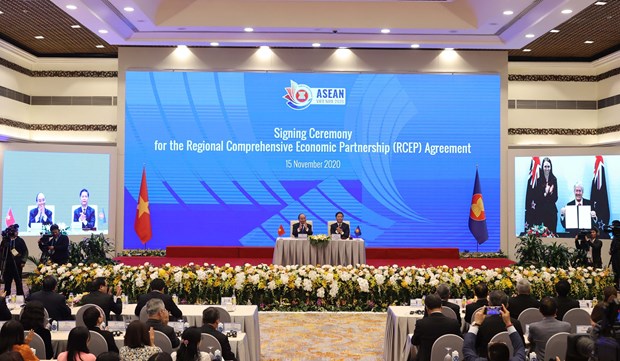 Prime Minister Nguyen Xuan Phuc, as Chair of ASEAN in 2020, witnesses the signing of the Regional Comprehensive Economic Partnership (RCEP) agreement (Photo: VNA)
Hanoi (VNA) - The recently-signed Regional Comprehensive Economic Partnership (RCEP) presents both opportunities and challenges to Vietnamese businesses, making prompt action crucial to address existing weaknesses and capitalise on deal-generated advantages.
Journalist Nguyen Ngoc Thanh, head of the Nhan dan (People) Online division, told a recent webinar held by the Nhan dan newspaper that the RCEP, which was signed on November 15 in the presence of Prime Minister Nguyen Xuan Phuc and other leaders of member countries after eight years of negotiations, opens up new opportunities as well as challenges for businesses and people.
It also marks a new step forward in Vietnam’s global economic integration, he said.
The RCEP gathers together the 10 ASEAN member states and five partners the bloc already has free trade agreements (FTAs) with: Australia, China, Japan, the Republic of Korea, and New Zealand. Once taking effect, it will create a market of 2.2 billion consumers and about 30 percent of global GDP, and become the world’s largest free trade area.
Under the deal, Vietnamese enterprises can further engage in regional value and production chains while benefiting from lower transaction costs and a friendlier business environment thanks to the harmonisation of current regulations in member countries, according to Thanh.
The agreement also poses challenges to agriculture, however, as Vietnamese produce will face greater export competition from other members.
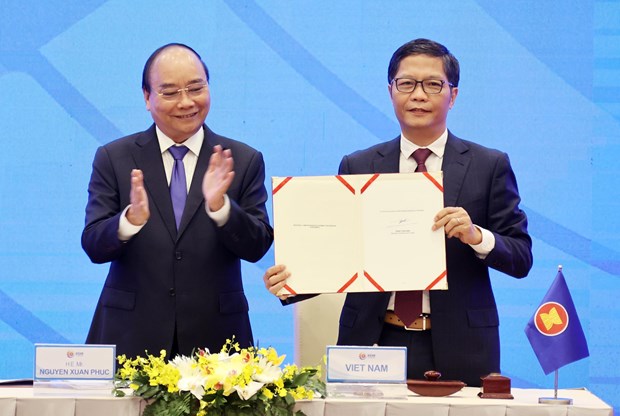 Prime Minister Nguyen Xuan Phuc (L), as Chair of ASEAN in 2020, witnesses the signing of the Regional Comprehensive Economic Partnership (RCEP) agreement (Photo: VNA)
Once the agreement comes into force, the country will become a major importer of agricultural products from RCEP countries, exposing companies to fierce competition right in the domestic market, he noted.
There is not much time left before the RCEP takes effect, he went on, so prompt and proactive measures are necessary to tap into the advantages generated and address any existing weaknesses.
Apart from the synchronous solutions taken by the Government, ministries, sectors, and localities, the proactiveness and activeness of businesses are also crucial in optimising the opportunities brought about by FTAs, Thanh added.
Luong Hoang Thai, Director of the Multilateral Trade Policy Department at the Ministry of Industry and Trade, said the RCEP has higher standards than commitments in the WTO.
Amid the COVID-19 pandemic, which has disrupted regional and global value chains, and emerging trade protectionism, the signing of the RCEP marks an important milestone in Vietnam and ASEAN’s economic integration and generates both short and long-term benefits, he noted.
It features commitments to opening up markets in the fields of goods, services, and investment; applying common rules of origin among the 15 members, instead of five sets of rules of origin under the five FTAs between ASEAN and each of its partners; and enhancing trade facilitation measures. This will create opportunities to develop new supply chains in the region that Vietnamese businesses can take part in.
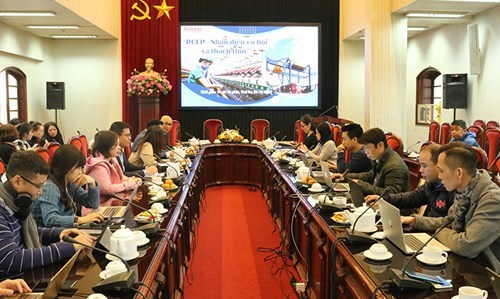 At a webinar organised by Nhan dan (People) on RCEP agreement's opportunities and challenges (Photo: VNA)
The world’s largest free trade area under the RCEP will form a stable and long-term export market for Vietnam, helping it develop export-oriented manufacturing.
Besides, Thai added, the deal will also create a legally binding framework for trade, investment, intellectual property, e-commerce, and dispute settlement policies in the region, thus contributing to a fair regional trading environment.
He recommended that, as with other FTAs, to fully capitalise on the RCEP’s benefits, the first and foremost matter is for Vietnamese businesses to thoroughly learn about the commitments contained within, especially those relating to their line of business.
At the webinar, Trinh Minh Anh, Chief of the Office of the inter-sectoral steering committee for international economic integration, called for attention on not only Vietnam’s commitments but also those of the 14 other members, adding that while Vietnamese goods will have more likelihood of entering other markets, the local market will also see an inflow of foreign products.
In the short term, enterprises should work to promote product quality and brand recognition to consolidate their foothold in the domestic market while making plans to expand export markets.
They also need to gear themselves up for any adverse impacts from the RCEP, especially stronger competition in the local market, Anh suggested./.



You should also see
Vietnam attends international security meeting in Russia

See more
 Business
Petrol prices decrease slightly on April 25
 Business
Vietnamese canned sugarcane juice favoured in US
 Business
Labels on foods exported to Singapore must be accurate: Trade counselor
 Business
April 25 gold bullion auction cancelled
 Business
