Quarantine waived for foreigners entering on short-term diplomatic, business trips
Foreigners entering Vietnam on a short-term working trip may not be subject to 14-day quarantine but there will be a number of conditions attached., according to new guidelines issued by the Ministry of Health on September 1.
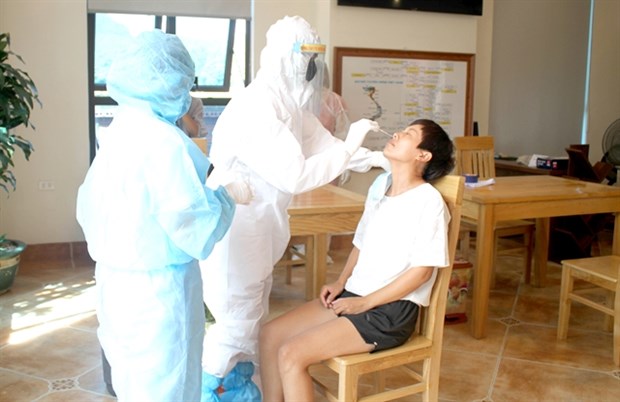 Foreign experts are tested on August 25 for SARS-CoV-2 during their quarantine period in two hotels in Ninh Binh Province. (Photo: VNA)
Hanoi (VNA) - Foreigners entering Vietnam on a short-term working trip may not be subject to 14-day quarantine but there will be a number of conditions attached, according to new guidelines issued by the Ministry of Health on September 1.
The new guidelines apply to foreign investors, experts, highly skilled workers, business managers and their families who are allowed to travel to the country since borders were closed in March.
It also includes other arrivals that are in agreement with their origin countries on a case by case basis.
Short-term trips are defined as no longer than 14 days, according to the guidelines.
Ministries, agencies, and People’s Committees of cities and provinces can consider at their discretion inviting foreign experts and guests on diplomatic missions or business trips to Vietnam without having to quarantine them but COVID-19 regulations must still be rigorously observed to prevent cross-infections and spread to the community, the guidelines read.
Those who come into contact with these foreign visitors during their entry and business in Vietnam are also amenable to the guidelines, and are expected to self-monitor their health.
Once they develop symptoms frequently associated with COVID-19 like fever, coughing, sore throat or breathing difficulties, they should immediately notify local health authorities.
The accommodation for the foreign visitors must satisfy the requirements for centralised quarantine facilities and voluntary paid quarantine facilities set out earlier in March.
Foreign visitors must possess international health coverage (or one provided by the host/inviter) and a declaration indicating they would pay for their own treatment if they contracted coronavirus.
Foreign visitors must be present in Vietnam one day earlier than their working schedule for health protocols to be conducted.
All expenses for isolation, transportation, and testing for COVID-19 are covered by the host. The fees will be waived for those entering on diplomatic missions or official purposes (except for the quarantine expenses at hotels as desired).
After 14 days from the date of entry, if experts and visitors on diplomatic or official trips would like to continue to stay in Vietnam and their coronavirus tests are negative, they could continue to work normally without being quarantined.
According to the Ministry of Health, prior to the entries of foreign experts into Vietnam, a plan needs to be developed covering their work arrangements, accommodation, transport modes, and other COVID-19 prevention measures during their contacts with other people.
For experts who would only participate in meetings, sign contracts and agreements, the host should prioritise meeting venues and accommodation in cities and provinces having or lying near border gates, to minimise the risks of having the visitors travelling through many localities into the mainland, which might complicate prevention efforts.
Foreign experts must test negative for SARS-CoV-2 with real time-PCR technique by certified labs in their countries 3-5 days prior to the date of entry to Vietnam.
Entry and exit points must be rearranged to make separate lanes for experts, avoiding contact with other people.
The experts must produce the negative tests at entry time, comply with COVID-19 measures such as health declarations, body temperature checks and screenings.
They will also be asked to install and use Bluezone, Vietnam’s contact tracing app available on both Android and iOS platforms, during their stay in the country.
Foreigners are asked to comply with Vietnamese Government’s anti-COVID-19 measures and guidelines.
They must frequently carry out personal hygiene, including washing hands with soap or hand sanitiser (especially before meetings, before and after meals), refraining from shaking hand and not sharing personal effects such as cups, bottles, or handkerchiefs.
They cannot leave their designated accommodation facility, and are asked to follow the scheduled agenda, meetings, and field trips (if any).
Those coming into contact with the foreign guests can continue to work normally, but should avoid in-person gatherings or meetings with others in the two weeks since the last contact and should monitor their own health./.




You should also see
PM urges village elders, citizens to help preserve cultural heritage
Prime Minister Pham Minh Chinh has asked village elders and chiefs, skilled artisans and reputable citizens to make greater efforts to preserve and promote tangible and intangible cultural heritage, which is the quintessence and core value of the nation.

See more
 Society
Hanoi’s virtual monthly passes help commuters travel with ease
Hanoi’s virtual monthly passes for public transport have been on offer for almost one month now, making travel more convenient for the city's commuters, reported the Hanoi Public Transport Management Centre.
 Society
Overseas Vietnamese in Russia commemorate Hung Kings
Overseas Vietnamese in Russia on April 18 held a ceremony in Moscow to mark the death anniversary of Hung Kings, the legendary nation founders.
 Society
Amended Land Law - breath of fresh air blown into real estate market: lawyer
The amended Land Law, approved by the National Assembly in January 2024, is expected to exert impacts on the business activities of overseas Vietnamese (OVs), including those in Australia., said a lawyer.
 Society
Green growth – a pillar of Vietnam-Australia comprehensive strategic partnership
The Australian Government, through agencies and partners, have launched many official development assistance (ODA) projects in Vietnam, including those on climate change adaptation and clean energy infrastructure.
 Society
Vietnamese in Thailand, Israel commemorate legendary nation founders
The overseas Vietnamese (OVs) communities in Thailand and Israel have held events to commemorate Hung Kings, the legendary founders of the nation.
