RCEP expected to be finalised by year-end: ASEAN chief
ASEAN Secretary-General Dato Lim Jock Hoi has expressed his optimism over the likelihood that the Regional Comprehensive Economic Partnership (RCEP) between 10 ASEAN member countries and six partners will be finalised by the end of the year.
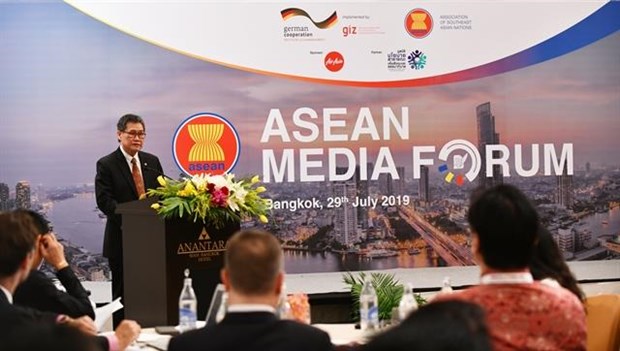 ASEAN Secretary-General Dato Lim Jock Hoi delivers a speech at the 3rd ASEAN Media Forum held in Bangkok on July 29. (Photos courtesy of ASEAN Secretariat)
Bangkok (VNS/VNA) - ASEAN Secretary-General Dato Lim Jock Hoi has expressed his optimism over the likelihood that the Regional Comprehensive Economic Partnership (RCEP) between 10 ASEAN member countries and six partners will be finalised by the end of the year.
RCEP is considered the world’s largest regional trade agreement as it covers a market of almost half of the world’s population and around one third of global gross domestic product.
There are 27 rounds of RCEP negotiations over the past seven years but “we don’t want to go beyond that, if we don’t do it this year, it will be very difficult for us to go beyond next year,” Hoi said.
According to the Secretary-General, political difficulties have already been resolved and under the situation of trade tension among economic giants, there is urgency for all ASEAN members to push the agreement to its conclusion.
“We know that challenges are still there, and we will intensify negotiations among the trade negotiators as well as at the ministerial level,” he said, affirming “the climate seems to be quite positive.”
Economic ministers are scheduled to meet in Thailand in September and “this will be a venue for the ministers to sit down and try to push [the negotiations] ahead.”
When asked about the most challenging problems that still exist, Hoi said: “Sixteen countries with different levels of economic development and different levels in trust. So it is not easy to put into one package. We need to balance the interests of each country, which is the role of ASEAN.”
“We have concluded certain chapters in telecoms, the movement in IP, the movement in financial services. But market access negotiations are still going and they will not end until we are all satisfied.”
Some countries are concerned that they would be exposed to many other imports, he said, adding that “They have to be careful and mindful with the domestic pressure.”
However, “they have taken a practical approach toward RCEP. Hopefully they will lead the way to good outcomes in the months ahead,” Hoi said.
There is also a problem with non-ASEAN members because they don’t have free trade agreements (FTAs) among themselves so they need to intensify their negotiations in market access, he added.
Speaking with Vietnam News on the sidelines of the 3rd ASEAN Media Forum early this week, Dr Suthad Setboonsarng, Board Member of the Bank of Thailand, said that RCEP is a conglomeration of five FTAs. The first one is the ASEAN-China FTA which was signed in 2003 and the toughest FTA is the one with India.
“In RCEP negotiations, one of the rules is we have to give everybody else what we give to one country,” like the Most Favoured Nations mechanism.
“What we have to give to China, we must give to India and to Japan. In 2003’s agreement, China liberalises the agriculture sector for ASEAN countries. But now for China to liberalise the agriculture sector for Japan, India and Korea, it is much more difficult,” Setboonsarng said.
However, the former first Thai Deputy General-Secretary of ASEAN was also optimistic of the future of RCEP as he saw a new mechanism being implemented in negotiating the trade deal.
In the past, there were trade negotiation working groups but heads of the groups couldnot make any immediate decision at the meeting, he said.
“The only way to get RCEP is to come out for outside talks not on the table because going to the table is very difficult.”
Currently, a small group of three countries including Thailand (current ASEAN Chair), Singapore (last year’s ASEAN Chair) and Vietnam (next year’s ASEAN Chair) are going around other countries and try to talk and see what is the problem that each country has, he said, adding that it will help facilitate the process.
“I think it has been used in political arena much more than in economic negotiations. But I saw this one, which is very important for the success of RCEP.”
Dr Hoe Ee Khor, Chief Economist of ASEAN 3 Macro Economic Research Office, said if ASEAN countries and dialogue partners can finalise the RCEP, it will be a very strong signal of commitment to rules-based multilateral trade amidst the rising trend of protectionism and nationalism.
Initiated in 2012, RCEP involves 10 ASEAN member countries, namely Indonesia, Thailand, Malaysia, Singapore, Philippines, Myanmar, Vietnam, Cambodia, Laos and Brunei; and six dialogue partners including China, Japan, Australia, New Zealand, India and the Republic of Korea.-VNS/VNA



You should also see
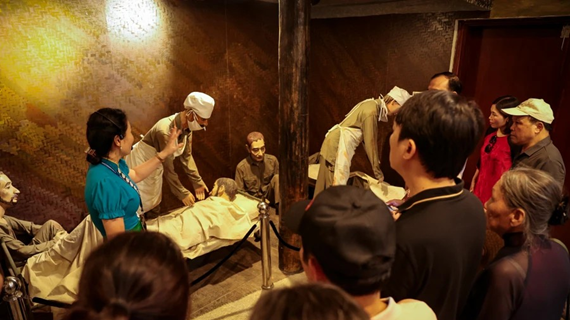
Visitors flock to memorial commemorating Dien Bien Phu victory
Numerous groups from around the country have visited the Dien Bien Phu Historical Victory Museum, a repository of artefacts and documents about Vietnam’s resounding victory that echoed around the world.
See more
 ASEAN
ASEAN
ASEAN Future Forum 2024 looks to ensure comprehensive security for community
The ASEAN Future Forum 2024 (AFF 2024) entered its second plenary session in Hanoi on the afternoon of April 23, discussing ways to ensure comprehensive security for the people-centred ASEAN Community.
 ASEAN
ASEAN
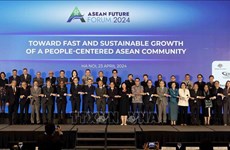
ASEAN Future Forum 2024 enters first session
The first session of the ASEAN Future Forum 2024 (AFF 2024) in Hanoi on April 23 focused on fast and sustainable growth for the Association of Southeast Asian Nations (ASEAN).
 World
World
Malaysia, Philippines warn of severe heat in upcoming summer
Malaysia and the Philippines have warned of severe heat during the upcoming summer.
 World
World
Thailand re-considers tourism tax
Thai tourism operators are urging the Thai government to seriously consider measures to tackle overtourism. One of the proposed measures is a tourism tax of 300 baht (8.11 USD).
 World
World
Ten crew members killed after two Malaysian navy helicopters collide
Ten people have died after two navy helicopters collided in mid-air during a military rehearsal for a Royal Malaysian Navy parade.
