Reviving horse racing tradition in Lao Cai’s Bac Ha

Bac Ha horse racing festival was recognised as a national intangible heritage on May 31, setting the scene for the northern mountainous province of Lao Cai to foster preservation of its distinctive north-western cultures.
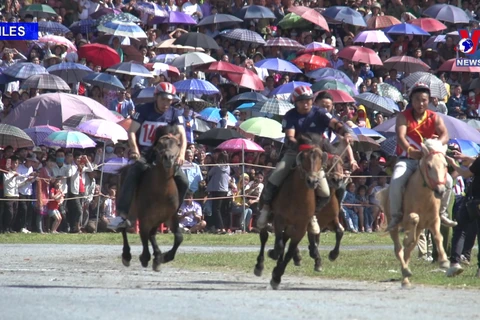
Reviving horse racing tradition in Lao Cai’s Bac Ha ảnh 1Riders compete in the opening ceremony of the Fansipan Horse Race, themed “Race Through the Clouds Fansipan,” held in June 2019. (Photo: VietnamPlus)

Hanoi (VNA) – Bac Ha horse racing festival was recognised as a national intangible heritage on May 31, setting the scene for the northern mountainous province of Lao Cai to foster preservation of its distinctive north-western cultures.

Horses are close friends of tribal villagers across Lao Cai as they have been used for transportation for generations. In the late afternoon when the sun sets behind mountains in the west, the horses patiently carry crops harvested from remote upland fields all the way through rocky bumpy mountain roads to the village.

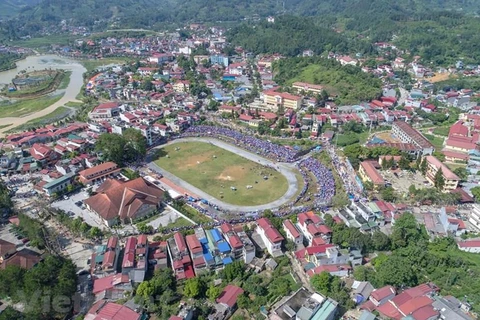
The horse racing event is held every spring at the foot of Ba Me Con Mount in the heart of Bac Ha district, which is endowed with magnificent landscapes and rich in ethnic minority culture.

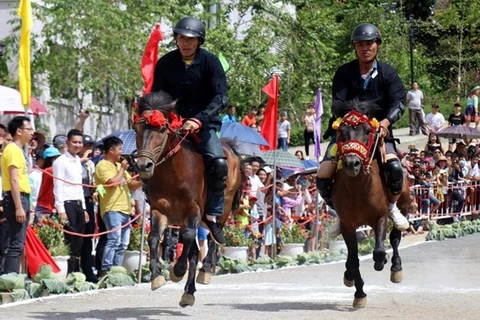
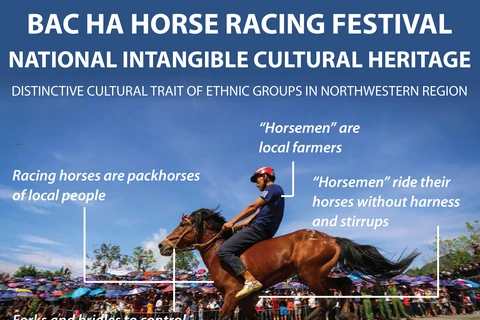
Neither a commercial nor professional race, the festival at Bac Ha features farmers and their pack horses which normally carry maize, rice and stone. Horsemen ride their horses without harness and stirrups, just a horse belt, with two iron hooks tied to ropes on either side of the horse’s mouth for control.

Bac Ha horses are dubbed as the most beautiful breed in Vietnam.

According to local residents, the horse race was revived based on stories handed down through generations since the old time when immense forests were adorned with white plum and apricot flowers and local people flocked to the edifice of the King of local Mong ethnic group, who was known as Hoang A Tuong, to see the horse race.

During the competition, the horsemen in well-fitting dress were ready to gallop when a shot signalled the start. Approaching the finish line, they jumped from their horses, fired five shots in succession, took a red ball, remounted and carried on.

The winner was the man with the fastest horse and the most points.

However, during the wars against the French and American invaders, the race was not held for many years as the horsemen were conscripted to protect national independence.

In 1975, Bac Ha residents celebrated victory in the anti-American war with a big parade of more than 200 horses.

Reviving horse racing tradition in Lao Cai’s Bac Ha ảnh 2Photo: VNA

In the spring of 1980, the horse race was once again launched by the Bac Ha Military Command, attracting more than 50 jockeys from across the district.

But it wasn't until 27 years later, in 2007, that the horse race was officially restored as part of cultural activities, and then as part of the annual tourism development co-operation programme among eight north-western provinces.

Vice Chairman of the Bac Ha People’s Committee Chu Thi Duong said making the traditional horse racing an annual tournament is among the district’s concrete efforts to honour unique cultural values of local ethnic minority people and promote the close bonds between the mountain tribes and horses in daily life and religious practices.

Vang Van Huynh, a jockey who championed the tournament in 2012 and 2013, said it is important to keep a watch on other horses while racing, to keep a safe distance and prevent them from bumping into or crossing over in front of each other, causing accidents.

“You must sit firmly on the horse’s back to control it during the race. When entering a turn, you must pull in the reins to slow it down to avoid falling and release the rein pressure and spur the horse to full speed when running on a straight track,” he said.

The festival attracts a large crowd of exciting audience every year, many of whom are visitors from other parts of the country wishing to have unforgettable memories with the Bac Ha plateau./.
VNA

See more

An Ao Dai performance at the event. (Photo: VNA)

Vietnamese cultural spirit shines through Ao Dai festival in Europe

Themed “the essence of Vietnamese Ao Dai", the event featured 19 performances and cultural activities, including ao dai showcases, musical performances, art exhibitions and interactive cultural spaces, offering audiences a vivid glimpse into Vietnamese culture in the heart of Europe.

A performance at the show (Photo: VNA)

Vietnamese water puppetry draws crowds in Laos

Following two sold-out shows in Vientiane, Vietnam’s traditional water puppetry continued to pull in strong audiences. The 700-seat auditorium of the Savannakhet provincial cultural house was filled to capacity on both floors well before the show began.

Meritorious Artisan Nguyen Thi Oanh (Photo: VNA)

Couple saves 500-year-old Dong Ho painting art from extinction

Born in Bac Ninh province’s Dong Khe residential area half a millennium ago, Dong Ho painting hit its roaring peak in the 1940s, when 17 family clans churned out vividly coloured, all-natural works for spiritual, festive and daily rituals, especially the Lunar New Year

Soldier Tran Thanh, a member of the Hoang Dieu Citadel National Salvation Youth Union, carries a lunge mine to destroy enemy tank on the streets of Hanoi on December 23, 1946, during the early days of the nationwide resistance war. (File photo: VNA)

Nghe An to host exhibition featuring President Ho Chi Minh’s call for national resistance

This is an important political and cultural event that celebrates the lasting historical significance of President Ho Chi Minh's call for national resistance, while highlighting the vision, determination, and intellectual strength of the Party and the Vietnamese people during a pivotal moment in history. The exhibition also aims to celebrate the late President’s 136th birth anniversary (May 19, 1890 - 2026).

Tthe DIFF 2026 stage has been designed around the concept of convergence, inspired by the image of converging horizons where cultures, time, and emotions meet (Source: DIFF)

DIFF 2026 set to mark breakthrough in stage scale, performance technology

The DIFF 2026 stage has been designed around the concept of convergence, inspired by the image of converging horizons where cultures, time, and emotions meet. With a width of up to 100 metres and a total area of nearly 1,200sq.m, the stage is considered the largest in the history of DIFF.

Vietnam's national U17 football team defeat United Arab Emirates national U17 football team 3-2 in the final Group C match of the AFC U17 Asian Cup 2026 in Saudi Arabia on early May 14. (Photo: VFF)

Vietnam secure berth at FIFA U17 World Cup 2026 for first time

Vietnam national U17 football team secured a place at the FIFA U17 World Cup 2026 for the first time after defeating United Arab Emirates national U17 football team 3-2 on in the final Group C match of the AFC U17 Asian Cup 2026 in Saudi Arabia on early May 14 (Vietnam time).

Vietnamese Minister of Culture, Sports and Tourism Lam Thi Phuong Thanh and Lao Minister of Culture and Tourism Suonsavan Vignaket exchange the signed culture and tourism cooperation scheme for 2026–2030. (Photo: VNA)

Vietnam, Laos ink 2026–2030 culture-tourism cooperation plan

Both sides pointed to substantive, positive outcomes in cultural and tourism cooperation from 2021-2025, citing successful cultural weeks in each country, cultural and art activities marking important occasions of the two Parties and countries, and the effective delivery of agreements reached by leaders that further fostered the special Vietnam–Laos relationship.

Students visit the photo exhibition. (Photo: VNA)

Vietnam, RoK photo exhibition highlights cultural connections

Among the displayed works, 60 photographs introduce the modern RoK with its rich cultural depth and spectacular natural landscapes, while 40 others vividly portray the beauty, cultural identity and ongoing development of Dak Lak and Vietnam’s Central Highlands region.