Robust dispute resolution framework key to Vietnam’s IFC ambitions

The development strategy for VIFC-HCMC envisions a comprehensive financial ecosystem encompassing green finance, carbon credits, financial technology (fintech), blockchain technology, digital assets, digital banking and other innovative business models. These highly internationalised sectors involve complex cross-border transactions and sophisticated legal structures.

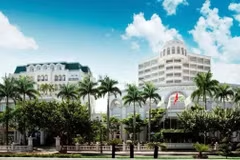
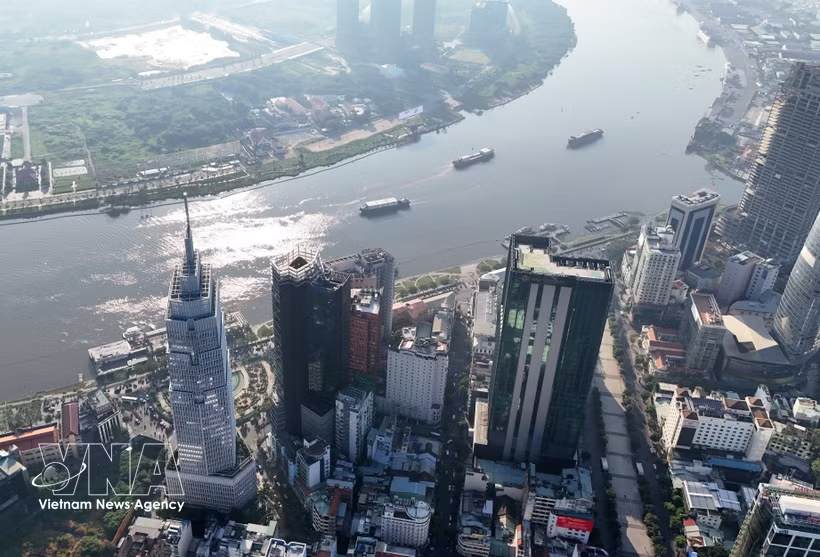
Financial buildings in downtown Ho Chi Minh City along the Saigon River. (Photo: VNA)

Hanoi (VNA) - As Vietnam develops its International Financial Centre in Ho Chi Minh City (VIFC-HCMC), establishing a modern, transparent and internationally aligned dispute resolution system is emerging as a key factor in attracting global capital, alongside financial infrastructure, technology and investment incentives.​

Hoang Huy Truong, Head of the Legal Affairs Division of the VIFC-HCMC Executive Agency, said the attractiveness and long-term sustainability of a financial centre are ultimately determined by “institutional trust”. As VIFC-HCMC aims to become a gateway connecting international capital flows with Vietnam, dispute resolution infrastructure is regarded as a critical component. Mechanisms such as specialised courts and arbitration centres could be employed to handle disputes.

The development strategy for VIFC-HCMC envisions a comprehensive financial ecosystem encompassing green finance, carbon credits, financial technology (fintech), blockchain technology, digital assets, digital banking and other innovative business models. These highly internationalised sectors involve complex cross-border transactions and sophisticated legal structures.

According to Truong, investors evaluate not only profit potential but also key legal considerations, including where disputes will be resolved, which language and legal framework will apply, and whether rulings can be effectively enforced. Experience shows that while markets can withstand volatility, uncertainty or a lack of transparency in dispute resolution mechanisms significantly increases risk costs and undermines investor confidence. As a result, dispute resolution systems are increasingly viewed as a form of strategic “soft infrastructure”.​

Vietnam’s legal framework for the IFC is gradually taking shape under the National Assembly’s Resolution No. 222/2025/QH15 on IFC in Vietnam, together with regulations governing finance, banking, labour, immigration, arbitration, land and commodity transactions.

A notable feature is the parallel development of specialised dispute resolution institutions alongside the financial centre itself. Parties will be able to choose between specialised courts within the financial centre or international arbitration institutions. They will also have the option to apply foreign laws, international practices, conduct proceedings in English and select international, foreign or Vietnamese arbitrators. These provisions are expected to bring Vietnam’s IFC closer to the operational standards of leading financial hubs in the region.

Prof. Dr. Le Hong Hanh, President of the Vietnam International Arbitration Centre (VIAC), said that building a successful international financial centre requires not only advanced financial and technological infrastructure but also a transparent legal framework aligned with international practices.

Amid intensifying global competition, a commitment to efficient, investor-friendly and predictable dispute resolution mechanisms will be a decisive factor in enhancing the competitiveness of the financial centre.

Phan Duc Trung, Chairman of the Vietnam Blockchain and Digital Assets Association, noted that without specialised mediation, arbitration and dispute resolution mechanisms in place from the outset, disputes could become increasingly complex as emerging sectors expand. The recent launch of the VIAC Panel of FinTech & Digital Economy Dispute Specialists in Ho Chi Minh City is considered an important step in developing the legal expertise needed to support the IFC’s ecosystem.

Nguyen Khanh Ngoc, President of the Vietnam Lawyers Association, stressed that the establishment of Vietnam’s IFC must go hand in hand with a clear legal framework and reliable dispute resolution mechanisms to strengthen investor confidence and ensure the sustainable development of the business environment.​

He noted that arbitration and other alternative dispute resolution methods offer significant advantages through their flexibility, confidentiality and specialised expertise, making them particularly well suited to the needs of modern financial transactions.

For Ho Chi Minh City, enhancing its international arbitration framework is about more than resolving disputes. It represents a commitment to creating a safe, transparent and internationally recognised investment environment. A modern, professional and internationally oriented arbitration system is expected to improve capital mobilisation, strengthen market attractiveness and provide a solid foundation for Vietnam’s IFC to establish its position on the global financial map./.

VNA

See more

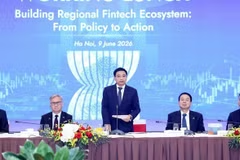
Deputy Prime Minister Nguyen Van Thang speaks at the event. (Photo: baochinhphu.vn)

Deputy PM calls for integrated ASEAN fintech ecosystem

Deputy PM Nguyen Van Thang proposed a shared vision for an ASEAN fintech ecosystem that is open, secure, transparent, inclusive, and sustainable: “Open” to foster connectivity, “Secure” to enable growth, “Transparent” to build trust, “Inclusive” to ensure that no one is left behind, and “Sustainable” to strengthen resilience and support long-term progress.

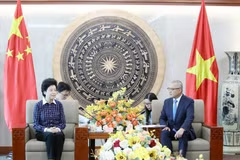
Vice Chairperson of the National Committee of the Chinese People's Political Consultative Conference (CPPCC) Xian Hui (left) meets with Secretary of Phu Tho provincial Party Commitee Pham Dai Duong on comprehensive cooperation (Photo: VNA)

Phu Tho expands cooperation with Chinese localities

A high-level delegation of the National Committee of the Chinese People's Political Consultative Conference (CPPCC), led by its Vice Chairperson Xian Hui, visited the production facility of BYD Vietnam Co., Ltd. at Phu Ha Industrial Park and held a working session with leaders of Phu Tho province on June 9.

A step in the semiconductor chip manufacturing process. (Photo: VNA)

LG to build first semiconductor substrate plant in Vietnam

LG Innotek, an affiliate of the Republic of Korea's LG Group, has announced a plan to build its first semiconductor substrate plant in Vietnam, marking a significant step in expanding its production capacity and strengthening its semiconductor packaging solutions business.

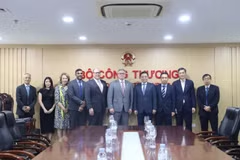
Minister of Industry and Trade Le Manh Hung, President and Chief Executive Officer of Murphy Oil Eric M. Hambly, and delegates at their meeting on June 8 in Hanoi. (Photo: moit.gov.vn)

Murphy Oil urged to expand investment in Vietnam

Murphy Oil has operated in Vietnam since 2012 and currently participates in and operates many important oil and gas contracts at projects such as Lac Da Vang and Hai Su Vang, which are expected to contribute additional oil and gas supplies, strengthen energy security and support Vietnam’s economic development.

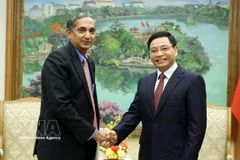
Deputy Prime Minister Nguyen Van Thang (R) receives Krishna Srinivasan, Director of the Asia and Pacific Department at the International Monetary Fund (IMF), in Hanoi on June 8. (Photo: VNA)

Deputy PM receives IMF Asia-Pacific Director

Director of the Asia and Pacific Department at the International Monetary Fund (IMF) Krisha Srinivasan affirmed that the IMF will continue to accompany and support Vietnam in the development of its financial sector, thereby helping to strengthen resilience and promote sustainable growth in the years ahead.

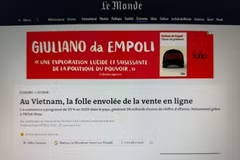
An article on Vietnam's e-commerce boom on Le Monde (Photo: VNA)

Digital economy fuels new growth momentum in Vietnam: French daily

French daily Le Monde recently reported that Vietnam’s e-commerce revenue approached 26 billion EUR (29.6 billion USD) in 2025, jumping 25% from a year earlier on the heels of a 20% gain in 2024. The sector now commands roughly 11% of total retail sales, cementing Vietnam’s status as one of Southeast Asia’s most dynamic markets.

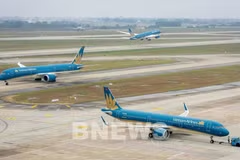
Vietnam Airlines Group offers nearly 2.2 million discounted domestic seats from now until August 16 to meet peak summer travel demand. (Photo: VNA)

Vietnam Airlines Group offers nearly 2.2 million discounted domestic seats

Vietnam Airlines Group, comprising Vietnam Airlines, Pacific Airlines and Vietnam Air Services Company (VASCO), will provide nearly 5.5 million seats on domestic routes from now until August 16 to meet peak summer travel demand, including around 2.2 million seats offered at promotional fares on various routes.

A pepper farm in Gia Lai province (Photo: VNA)

Vietnam’s pepper exports jump 21.7% in volume in five months

May shipments, however, totaled 25,180 tonnes worth 166.2 million USD, down 18.9% by volume and 13.9% by value from April, and 4.8% lower in volume from a year earlier. Major exporters reported declining shipments, underscoring a sector-wide pullback.

Representatives of Vietrade and TFO Canada discuss a new cooperation project for 2026–2030. (Photo: VNA)

Vietnam, TFO Canada move towards strategic trade partnership

Director General of Vietrade Vu Ba Phu said the success of cooperation during 2021–2024 had laid a solid foundation for elevating bilateral ties in the new phase, with Vietrade now serving as TFO Canada’s strategic partner in Vietnam.