Russian scholars propose measures to strengthen trust in addressing East Sea issue

The Russian scholars reaffirmed support for the peaceful settlement of disputes through diplomatic and legal processes, without the threat or use of force, in accordance with international law, particularly the 1982 United Nations Convention on the Law of the Sea (UNCLOS). They also emphasised the importance of maintaining peace and stability, freedom of navigation and overflight in the East Sea, and upholding the rule of law in the seas and oceans.

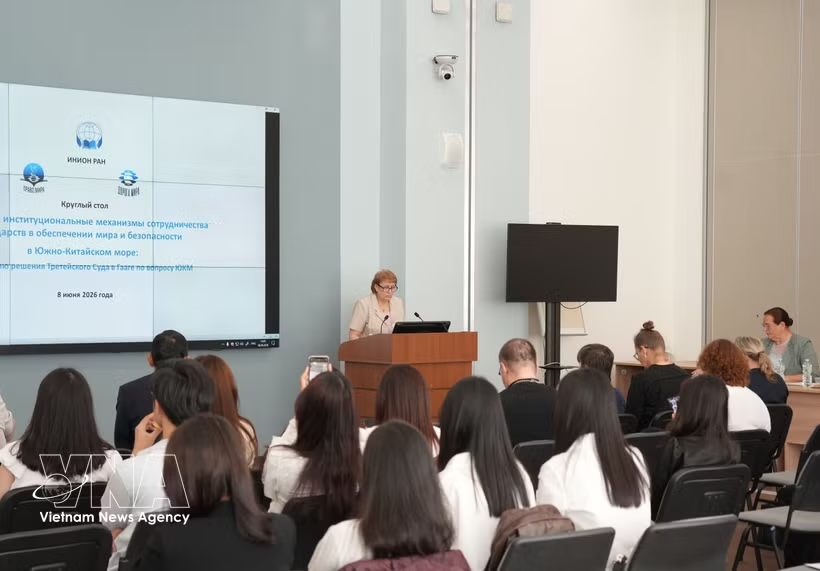
A view of the international roundtable in Russia on June 8 on legal and institutional mechanisms for governmental cooperation to ensure peace and security in the East Sea (Photo: VNA)

Moscow (VNA) - Russian scholars called for stronger trust-building measures, enhanced regional cooperation and greater reliance on international law to address disputes in the East Sea at an international roundtable in Russia on June 8.

The event, hosted by the Institute of Scientific Information on Social Sciences under the Russian Academy of Sciences (INION RAS), focused on legal and institutional mechanisms for governmental cooperation to ensure peace and security in the East Sea. It brought together leading researchers, international law experts and young researchers from Russia, Vietnam and several Southeast Asian countries. Participants presented 15 research papers providing academic perspective and comprehensive overview of developments in the East Sea over the past decade.

The presentations shared a common view that the East Sea remains a vital geostrategic area whose security, stability and freedom of navigation directly affect the global security architecture and international trade flows.

The scholars reaffirmed support for the peaceful settlement of disputes through diplomatic and legal processes, without the threat or use of force, in accordance with international law, particularly the 1982 United Nations Convention on the Law of the Sea (UNCLOS). They also emphasised the importance of maintaining peace and stability, freedom of navigation and overflight in the East Sea, and upholding the rule of law in the seas and oceans.

Addressing the role of UNCLOS 1982 in dispute settlement, the scholars noted that the Convention represents a universal, unified, and authoritative framework of international law that governs the jurisdiction, sovereign rights, and obligations of coastal states in a binding manner.

They also underscored the central role of ASEAN member states in regional affairs, noting that the bloc continues to play a key role in maintaining strategic balance, managing conflicts and promoting preventive diplomacy through sub-regional structures.

They urged relevant parties to accelerate efforts to transform the Declaration on the Conduct of Parties in the East Sea (DOC) into a meaningful, effective, and legally binding Code of Conduct in the East Sea (COC), consistent with the principles and provisions of UNCLOS 1982.

A joint recommendation adopted at the conference called on coastal states to consistently utilise the dispute-settlement mechanisms provided under UNCLOS 1982 as peaceful instruments for achieving convergence and delimiting maritime spaces.

In addition, the parties concerned should develop objective monitoring mechanisms and publicly report violations of the international legal order at sea, thereby creating effective deterrents against unilateral actions that undermine regional stability.

Delegates said that countries in the region should also promptly initiate joint governance models in areas such as the management of transboundary marine living resources, combating marine plastic pollution, maritime search and rescue (SAR), and collaborative oceanographic research, as a means of rebuilding strategic trust.

To strengthen trust-building efforts, they proposed establishing regular academic and research forums that would provide objective scientific analysis, help depoliticise existing disputes and generate practical recommendations for official diplomatic channels among countries.

Several speakers spoke highly of Vietnam’s consistent efforts to seek peaceful solutions to the East Sea issue. Professor Irina Umnova, who chaired the roundtable, said Vietnam has effectively utilised all bilateral and multilateral diplomatic channels to promote dialogue and consensus-building amid ongoing regional issues.

She also highlighted the political significance of the Vietnam–Russia Joint Statement issued during Russian President Vladimir Putin’s visit to Vietnam in June 2024, to the East Sea issue, noting that the document reaffirmed the two countries’ support for maritime security, freedom of navigation and overflight, peaceful dispute settlement in accordance with international law, including UNCLOS 1982, and restraint in the use of force.

According to Umnova, both Vietnam and Russia support the full implementation of the DOC and welcome efforts to conclude the effective and substantive COC. The two countries also share a commitment to strengthening ASEAN’s central role in the regional architecture and promoting the values and principles of the Treaty of Amity and Cooperation in Southeast Asia (TAC)./.
VNA

See more

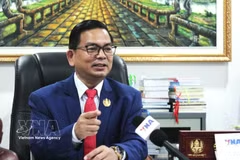
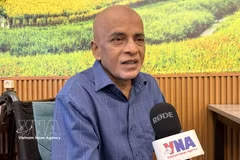
Dr. Kin Phea, Director General of the International Relations Institute of Cambodia (RAC). (Photo: VNA)

ASEAN Future Forum 2026: Important political message from Phnom Penh

Vietnam remains one of Cambodia’s most important neighbours in terms of security, economy, trade and people-to-people exchanges. Maintaining strong relations with Vietnam, therefore, serves Cambodia’s long-term national interests, said Dr. Kin Phea, Director General of the International Relations Institute of Cambodia (RAC).

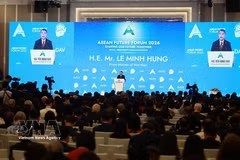
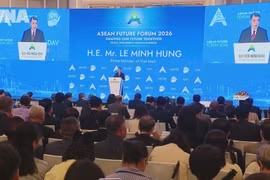
Prime Minister Le Minh Hung delivers remarks at the opening session of the third ASEAN Future Forum. (Photo: VNA)

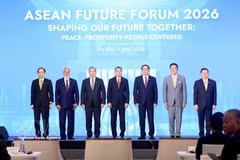
ASEAN Future Forum 2026 opens in Hanoi

In his welcoming remarks, Foreign Minister Le Hoai Trung said Vietnam established the forum with the aim of creating an open, substantive and forward-looking space for dialogue among ASEAN member states and international partners.

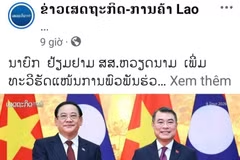
A post on the official Facebook page of the Lao Economic Daily (Photo: screenshot)

Lao media highlight deepening Vietnam–Laos cooperation

According to the reports, the Lao and Vietnamese Prime Ministers held talks on June 7, during which they briefed each other on their respective internal situations and expressed satisfaction with the socio-economic achievements recorded by the two sides. They highly valued the continued development of bilateral ties, particularly the strong political trust maintained through regular exchanges of meetings at all levels.

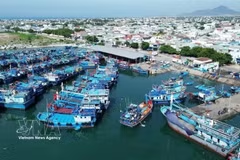
Fishing boats in Vietnam's Ninh Thuan province. (Illustrative photo: VNA)

ASEAN, Norway promote cooperation in sustainable blue economy development

The Norway–ASEAN cooperation project on blue economy development is seen as a first step toward building a regional cooperation platform to raise ASEAN member states’ awareness of the current state of aquaculture and fisheries development, identify policy gaps, and promote collaboration in the sustainable blue economy.

WB plans over 3 bln USD in financing for Philippines

WB plans over 3 bln USD in financing for Philippines

The multilateral lender is also considering structural reform initiatives as well as projects that could help the Government respond to the economic fallout from the Middle East conflict, particularly among vulnerable sectors.

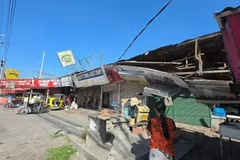
Houses are damaged after the earthquake in General Santos city, Philippines on June 8. (Photo: Xinhua/VNA)

Death toll from Philippines earthquake rises, tsunami reaches Indonesia, Japan

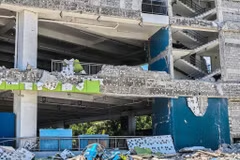
In the hard-hit port city of General Santos, disaster management officials confirmed seven deaths after several buildings collapsed and key infrastructure was damaged. The Philippine Institute of Volcanology and Seismology warned residents to exercise caution before returning to damaged buildings due to the risk of aftershocks.

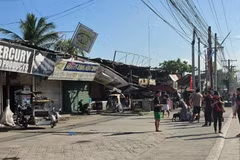
Several shops were damaged following the earthquake in General Santos City, the Philippines, on June 8, 2026. (Photo: Xinhua/VNA)

At least 12 killed, hundreds injured in Philippines earthquake

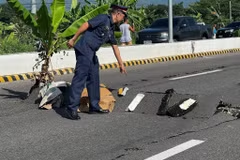
The port city of General Santos suffered the heaviest damage, with disaster management officials confirming seven fatalities and about 130 injuries after several small buildings collapsed and multiple structures, including a key bridge, sustained severe cracks. The remaining five deaths were recorded in South Cotabato, Davao Occidental and Balut Island.

Laos intensifies business environment reforms

The latest Provincial Facilitation for Investment and Trade Index report indicates that since 2018, the public sector has clearly defined timelines for document approval, reducing the time required to establish a business to just 17 days, including 10 days for the issuance of a business registration certificate, five days for seal engraving, and two days for social insurance registration.

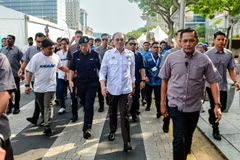
Datuk Seri Anwar Ibrahim attends the National TVET Day 2026 celebration at Dataran Putrajaya today. (Photo: Bernama)

Malaysia strengthens vocational training in technology and energy sectors

Malaysia is ramping up technical and vocational education and training (TVET) as a cornerstone of its economic transformation and talent development strategy, preparing its workforce for emerging fields such as artificial intelligence (AI), cryptocurrency technology and the global energy transition.

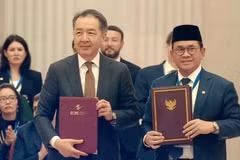
Indonesia eyes trade breakthrough with EAEU via FTA

Indonesia eyes trade breakthrough with EAEU via FTA

Indonesia seeks to develop relations with all countries and sees itself as a bridge between different regions of the world. Against a backdrop of growing geopolitical and global economic uncertainty, strengthening international cooperation and building reliable supply chains have become more important than ever.

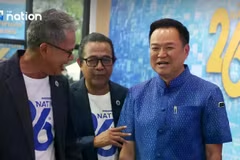
Thai Prime Minister Anutin Charnvirakul (R) at Nation TV’s 26th anniversary event on June 4, 2026. (Photo: nationthailand.com)

Thailand prioritises OECD accession

Thai Prime Minister Anutin Charnvirakul the country’s bid to join the Organisation for Economic Co-operation and Development, or OECD, is central to the government’s economic agenda.