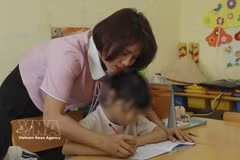
Central Highlands provinces will upgrade educational facilities toimprove school attendance rates, especially for ethnic minorities, theMinistry of Education and Training said March 2.
The Ministry will invest in more nurseries and kindergartens,particularly in ethnic minorities villages to cater for 12 percent ofunder three-year-olds and 85 percent of three to five-year-oldsrespectively by 2015.
Semi-boarding schools in ruralareas will be built with the target of 99 percent of children aged six,entering first grade and 55 percent enrollments at high schools, it wasdisclosed at conference in HCM City March 2 to review educationin the Central Highlands.
The objectives were to increase the rate of ethnic minorities at schools from nursery to university.
All districs and communes in the Central Highlands provinces will haveenough continuing education centres and 90 wards and towns havecommunity learning centres to achieve 96 percent literacy rates forpeople aged 15 and more.
Each province in theCentral Highlands will have at least one vocational college and eachdistrict have a vocational centre to increase the rate oftrained-workers to 35 percent by 2015.
Ethnic minority children will have better access to Vietnamese language learning.
Research for practical policy making is a priority to develop CentralHighlands education and attract teachers to those provinces, theconference heard.
Deputy Minister of Education TranQuang Quy said education and vocational training in the CentralHighland provinces had improved in the last five years.
The drop-out rate decreased from 1.25 percent in the 2007-08 academicyear to 0.7 percent in the 2009-10 school year, he said adding it wasthe biggest dropout reduction in the country. In the last five years,the ministry built learning centres in 70 districts and worked withlocal authorities to open 600 more community learning centres to preventilliteracy, Quy said.
Tran Duy Tao, head of theSchool Infrastructure and Equipment Department, said more than 3,500 newclassrooms and 1,936 rooms for teachers in the region were builtbetween 2008 and 2010 and 267 billion VND (12.8 million USD) was spenton teaching equipment.
One hundred communes were still in need of kindergartens and 4,700 teachers were needed at all levels, he added. /.