Seafood exports reach record 11 billion USD in 2022, challenges ahead
Despite huge challenges, the seafood sector in 2022 posted a new record in export value of 11 billion USD, up 24% year-on-year and 22% higher than the year’s target of 9 billion USD.
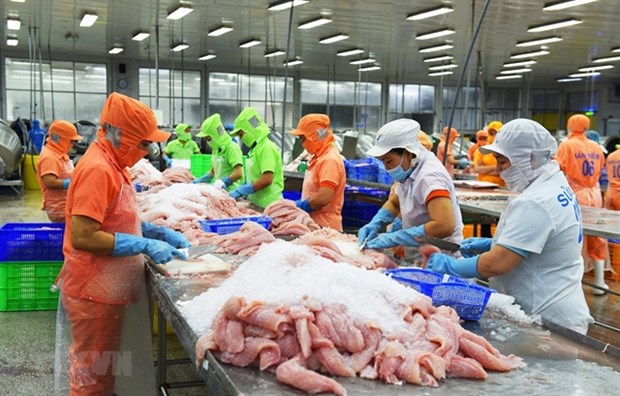 Seafood exports reached a record 11 billion USD in 2022, up 24% year-on-year and 22% higher than the year’s target of 9 billion USD. (Source: VNA)
Le Hang, communications director of the Vietnam Association of Seafood Exporters and Producers (VASEP), said that this was the highest export value in more than 20 years.
Of the amount, shrimp exports hit a record 4.3 billion USD, pangasius exports reached 2.4 billion USD, and tuna exports were 1 billion USD, she added.
Vietnam’s largest seafood export markets are the US, Japan, China and the EU.
Seafood exports to the US reached more than 2.1 billion USD last year. Meanwhile, exports to China hit a record 1.8 billion USD, up 57% year-on-year.
Exports to the EU and the Republic of Korea brought in 1.3 billion USD and 950 million USD, respectively.
Seafood exports to ASEAN countries reached 767 million USD, up 27% year-on-year.
Challenges ahead
According to Hang, inflation is forecast to greatly affect consumer sectors globally, reducing seafood exports in the first quarter of 2023.
The seafood industry will also face tough competition from competitors that offer lower costs and prices such as Ecuador and India.
Export orders have fallen sharply, and many seafood processing enterprises have not received contracts for the first quarter of 2023.
Market demand will not recover until at least the second quarter or the second half of 2023, according to the director.
Seafood businesses are also facing problems accessing loans. Many large enterprises with large capital needs can not afford to purchase aquatic products and materials for production.
Some must operate at half capacity, affecting the industry’s growth and exports. Some businesses have had to stop construction of their seafood production facilities.
Currently, 279 members of the association, which contributed more than 80% of the country’s total seafood exports, are having difficulties in accessing loans.
Hang recommended exporters search for new export markets that are less affected by inflation such as ASEAN countries, the Middle East and the Comprehensive and Progressive Agreement for Trans-Pacific Partnership (CPTPP) countries.
Exporters should focus on China, a traditionally lucrative market which is no longer following the “zero COVID” approach, and facilitate exports to this market.
Vietnam is currently the world’s third largest exporter of fish products, after China and Norway.
Seafood exports are expected to hold a 7% share of the total seafood exports in the global market, according to VASEP./.





You should also see

PM attends ceremony to start work on Him Lam resistance centre renovation project
Prime Minister Pham Minh Chinh on April 17 attended a ceremony to start work on a project to renovate Him Lam resistance centre, a part of the Dien Bien Phu complex of fortifications in the northern mountainous province of Dien Bien.



See more
 Business
Forum discusses support for women-owned firms to join supply chains
A forum on supporting women-owned businesses to join supply chains through sustainable development tools took place in Hanoi on April 17.
 Business
Satisfaction of administrative services improves
Vietnamese citizens had greater satisfaction with the administrative services provided by State agencies last year, according to the Satisfaction Index of Public Administration Services (SIPAS) 2023 announced by the Ministry of Home Affairs (MoHA) on April 17.
 Business
Petrol prices increase slightly on April 17
The retail prices of petrol were adjusted up from 3pm on April 17 by the Ministry of Industry and Trade and the Ministry of Finance.
 Business
Central Highlands provinces seek closer trade, investment ties with India
A business and investment conference was held in Dak Lak province’s Buon Ma Thuot city on April 17 with the aim of enhancing connectivity between Indian firms and Central Highlands provinces.
 Business
Foreign purchasers show interest in five product groups of Vietnam
Foreign hypermarkets, retail distributors and international buying group registering to join the Vietnam International Sourcing 2024 have shown interest in five groups of Vietnamese products, namely foodstuff, textiles and fashion accessories; shoes, backpacks, bags and accessories; sporting goods and equipment; and household appliances and furniture.
