Selling fresh fruits via live streaming forecast to boom

Selling fresh fruits and agricultural products through live streaming, a trend that has exploded in the Chinese market recently, will likely boom in Vietnam as well, trade experts have forecast.
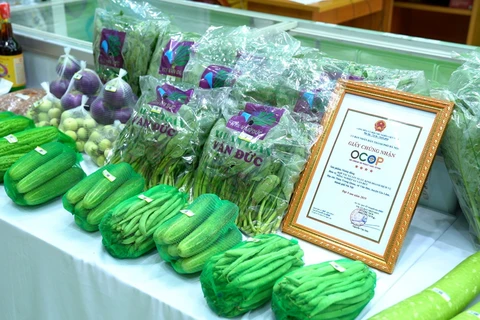
Selling fresh fruits via live streaming forecast to boom ảnh 1Illustrative image (Photo: nld.com.vn)
Hanoi (VNS/VNA) - Selling fresh fruits andagricultural products through live streaming, a trend that hasexploded in the Chinese market recently, will likely boom in Vietnam aswell, trade experts have forecast. 

Last June, farmers and businesses in the northern provinceof Bac Giang sold a large amount of lychee and many other specialitiesvia live streaming. Since 2021, farmers in this locality usedthe model to sell batches of lychee to customers nationwide. 

Amid the booming live commerce trend on social channelssuch as TikTok and Facebook, some cooperatives and lycheegrowers in Bac Giang have organised live streaming events fromtheir gardens, broadcasting the harvesting and packaging process.This has helped them connect with customers and build trust, as well assell a lot of produce, a representative from the provincial Department of Tradeand Industry has said. 

To facilitate the consumption ofagricultural and speciality products, Bac Giang has cooperated withTikTok to organise a series of activities, including the One Commune OneProduct (OCOP) events through live streaming. After only four hours,TikTok-savvy merchants sold nearly 50 tonnes of lychee and a variety oflocal OCOP products, the representative said. 

The live-selling model has also become familiar tofarmers, cooperatives and agricultural enterprises. Since the COVID-19pandemic, many farmers across the country have changed their sales methods,integrating live streaming to promote and sell their products on socialnetworks and e-commerce platforms.

Since the Lunar Newyear in 2021, several cooperativesselling dragon fruits with VietGAP and GlobalGAP certifications have beentrained in, and tested, live streaming on Facebook to sell products. 

In the southern provinces and cities, many cooperatives andhousehold businesses have also used the live streaming model toadvertise and sell southern fruits and cakes which generated massiveengagement. They said the video medium helped their sales increase comparedto selling products online like before.

Besides cooperatives and household businesses, start-upshave also been making good use of the live streaming model topromote their brands, market products and sell goods to consumers at discountprices. Several food businesses have regularly collaborated withTikTokers and KOLs (Key Opinion Leaders) to introduce everything fromraw materials, production processes and product trial experiences, Nguoi Lao Dong (The Labourers)Newspaper reported.  

To attract customers to buy goods via live streaming events,most businesses and stores reduced prices compared to direct sellingat stores or other e-commerce channels. They also allowed customers toreturn goods and get a refund if they found the goods to be of low quality,according to the newspaper. 

Logistics infrastructure needed

Do Quang Huy, an e-commerce expert, said agriculturalproducts are Vietnam's strength and promoting online salesis a trend that should attract strong investment.

Recently, TikTok Shop, the video platform's e-commerce wing,launched a new feature to sell fresh goods. Previously, sellers could only sellgoods preserved for more than 15 days. Now, TikTok Shop can handle items thatneed to be delivered within three days. This opens up great opportunitiesfor sellers to speed up agricultural product consumption, Huy toldthe Nguoi Lao Dong (The Labourers) Newspaper.  

However, fresh agricultural products require fastdelivery. Returned goods might be abandoned because of damage, Huy said,stressing the importance of developing the necessary e-commerce logisticsinfrastructure.

Luong Quang Thi, Chairman of ABA Cooltrans, a cold chainservice provider in Ho Chi Minh City, said e-commerce logistics remained problematic,especially for low-value goods that need express delivery. 

Thi cited fresh fruits as an example. Normally, consumers orderbetween 1-5 kilos of fresh fruits each time. Due to their locations, theshipping fee was sometimes higher than the cost of goods. Therefore,they often chose to buy fruits via traditional channels rather than buythem online. 

Many agricultural products had seasonal characteristics, thechairman noted. So they have to be sold immediately once harvested or their prices will decrease significantly. 

He added that it was also necessary to buildstorage warehouses right at the source./.
VNA

See more

The VinFast Evo electric motorcycle on display at the event. (Photo courtesy of VinFast)

VinFast marks new step in expansion strategy in Southeast Asia

The Evo is priced at 17.5 million IDR (about 973.90 USD) in Jakarta and is available in four colour options: black, red, white and olive green. The Feliz II is sold for 18.5 million IDR, while the Viper is priced at 22 million IDR. All prices include a battery subscription package.

Passengers check in at Hanoi's Noi Bai International Airport. (Photo: VNA)

Vietnam records 15.4% growth in international air passengers

CAAV statistics show that international passenger throughput reached 26.2 million as of June 15, 2026. Of the total, Vietnamese airlines transported 9.6 million international passengers, a slight increase of 0.2% year-on-year, accounting for 36.6% of the total international passenger market.

Vietnam, RoK expand supply chain, manufacturing cooperation

Vietnam, RoK expand supply chain, manufacturing cooperation

Beyond sourcing products, RoK companies aim to build long-term partnerships with Vietnamese firms through product showcases, business-to-business (B2B) matchmaking, investment opportunities and sustainable supply chain development.

Ho Chi Minh City, GTEL partner on technology transfer for metro network

Ho Chi Minh City, GTEL partner on technology transfer for metro network

The two sides will study and localise key technologies covering signalling, communications, power supply, electromechanical systems (E&M), SCADA, operations control centres (OCC), automatic fare collection (AFC) and platform screen doors (PSD), while advancing technology transfer, workforce development and the capabilities of domestic enterprises.

Vietnamese Ambassador to Laos Nguyen Minh Tam and Lao Deputy Minister of Industry and Commerce Phouthavanh Nanthavong visit a Vietnamese booth at VIETLAO EXPO 2026. (Photo: VNA)

Vietnam-Laos trade targets 10 billion USD

Held on the sidelines of VIETLAO EXPO 2026, the seminar aimed to help businesses explore trade and investment opportunities and foster cross-border production and supply chains.

Standing Deputy Prime Minister Pham Gia Tuc chairs a meeting with representatives of US business associations and companies operating in Vietnam on July 17, 2026. (Photo: baochinhphu.vn)

Standing Deputy PM meets with US business community

Chairing a meeting with representatives of US business associations and companies operating in Vietnam, Tuc praised the US business community for its substantive contributions to Vietnam's socio-economic development as well as the two countries’ relations.

Workers assembles electronic components on the production line at the Bao Sen Co., Ltd. in Bac Ninh province. (Photo: VNA)

Vietnam's economy needs to shift from quantity to quality: ADB experts

Shantanu Chakraborty, ADB Country Director for Vietnam, noted that while achieving strong growth in a single year is encouraging, maintaining both the pace and quality of growth over many years will be essential if Vietnam is to achieve its goal of becoming a high-income country by 2045.

The Long Son Petrochemical Complex, an investment project of Thailand's SCG Group, is located in Long Son commune, Ho Chi Minh City. (Photo: VNA)

Vietnam reshapes FDI strategy with focus on technology, innovation

Politburo Resolution No. 10-NQ/TW, issued on June 8, 2026, recognises the foreign-invested sector as an important component of the national economy, signalling a major shift in the country's investment attraction strategy. Rather than prioritising labour-intensive projects, Vietnam is now seeking high-quality investments capable of driving technological progress, innovation, sustainable development and stronger participation in global value chains.

International tourists love shopping for souvenirs at Hanoi's Old Quarter night market (Photo: VNA)

Hanoi aims to raise tourists' night-time spending to 30%

Hanoi will establish and operate flagship night-time economy zones supported by preferential policies, including heritage and cultural districts in Hoan Kiem, Cua Nam, Ba Dinh, Son Tay and Soc Son; modern entertainment hubs in Tay Ho-West Lake West, My Dinh and Dong Anh; creative economy zones linked to cultural industries such as theatres, cinemas and museums; and cultural tourism and resort destinations in suburban craft villages including Bat Trang, Ba Vi and Huong Son.