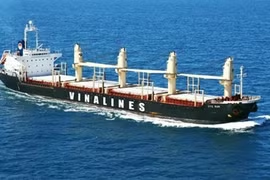
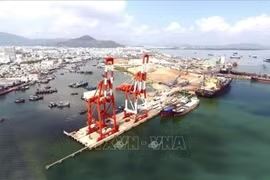
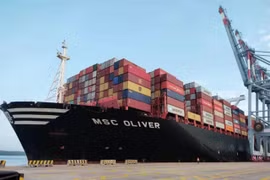
A container ship docked at Cai Mep Gemadept port-Terminal Link in Ba Ria-Vung Tau province. (Photo: VNA)
Thedevelopment of cargo ships is part of the strategy to develop Vietnam's marineeconomy by 2030.
Therefore,the ministry has proposed the Prime Minister consider and adjust financialmechanisms to support the development of the fleet, including loans withpreferential interest rates.
Investmentin a fleet of ships requires huge and long-term capital, while localenterprises are unlikely to be able to invest in high-quality fleets, accordingto Deputy Minister of Transport Nguyen Nhat.
Theshipping companies have received very little financial support from theGovernment in the past few years to carry out fleet development.
Interestrates on bank loans in Vietnam are from 8-10 percent per year, higher thaninterest rates in other countries such as Japan (1-2 percent), Singapore (3 percent)and China (4.5 percent).
Atthe same time, when registering a ship to fly the Vietnamese flag, theenterprise must carry out procedures on importing ships and have to pay taxesand fees such as registration fee, value-added tax and import tax on ships.Some ship owners have registered ships with foreign nationality to reduce taxesand fees.
Inaddition, the ministry proposed the Government reduce the corporate income taxfor shipping enterprises from 20 percent to 15 percent within 3 years andpersonal income tax for seafarers by increasing the threshold of wages that aresubject to tax.
Toencourage the shipping companies to eliminate old ships with ineffectiveoperations, the ministry has proposed exemption or reduction of taxes and fees,such as registration fees and VAT, when building or buying new and specialisedships suitable for transport needs.
Ithas also suggested that the State should have coastal fleet management policiesto meet the domestic transport demand, promote freight by sea and improveconnection among modes of transport.
Accordingto Nhat, most Vietnamese shipping companies are small sized businesses and theymainly transport cargo but do not provide logistics services, leading to lowefficiency in business activities.
Thefleet structure is not developed properly with a large number of ships withsmall tonnage and lack of ships with large tonnage that could be used oninternational routes and specialised ships such as ships transporting liquefiedgas, chemicals and bulk cement.
Vietnameseenterprises only have ships with a capacity of 1,800 twenty-foot equivalentunits (TEUs) while foreign firms have vessels of over 20,000 TEUs.
Inaddition, Vietnam's fleet of seagoing vessels is over 15 years old and many ofthem use old technology, which is not suitable for transporting import andexport goods. They cannot compete with the new generation fleet of foreignenterprises.
Anunstable source of cargo means Vietnamese shipping companies have not daredinvest in building new ships.
Nhatsaid Vietnam's fleets transport most types of cargo on the domestic sea routes,excluding liquid cargo (LPG) and bulk cement.
Forthe type of cargo that the Vietnamese fleet is not eligible for transport, theministry has licensed ships carrying foreign flags of Vietnamese enterprises torun domestic routes for a short time.
Toencourage the development of specialised ships, he said the ministry hadrequested enterprises to build or buy ships to replace foreign-nationalityvessels, because Vietnam would only license foreign-nationality ships until theend of 2023 to operate on domestic routes.
Accordingto the ministry, the percentage of import and export goods transported by localshipping companies fell by half from 10 percent in 2015 to 5 percent in 2020.That means foreign shipping companies transported 95 percent of Vietnam’simport and export goods.
Theforeign shipping companies have 10 different types of fees and surchargesbesides freight for Vietnam's import-export goods owners, including a containerimbalance surcharge, bill fee and lead clamp charge.
Inaddition, “the shipping companies have continuously increased surcharges andfreight rates during the COVID-19 pandemic, leading to higher transportationcosts. That has impacted Vietnamese enterprises,” Nhat said.
Vietnameseenterprises have delivered and received goods at Vietnamese ports, so the rightto hire vehicles is undertaken by foreign partners, Vietnamese shippers dependentirely on foreign shipping companies and are forced to pay surchargesimplemented by those shipping companies, according to Nhat.
Accordingto the Ministry of Transport, the volume of goods through Vietnam's seaportshas grown steadily over the past five years with an average growth rate at 13.8percent.
Dueto the COVID-19 pandemic, the growth of volume in 2020 was 4 percent, slowerthan the annual average. Of which, the volume of container cargo through thelocal seaports in 2020 was estimated at 22.1 million TEU, up 13 percentcompared to 2019./.
VNA