Signatories highlight RCEP’s significance to economies
Signatories of the Regional Comprehensive Economic Partnership (RCEP) Agreement affirmed its significance to each country’s economy and regional trade-investment activities following the signing of the pact on November 15.
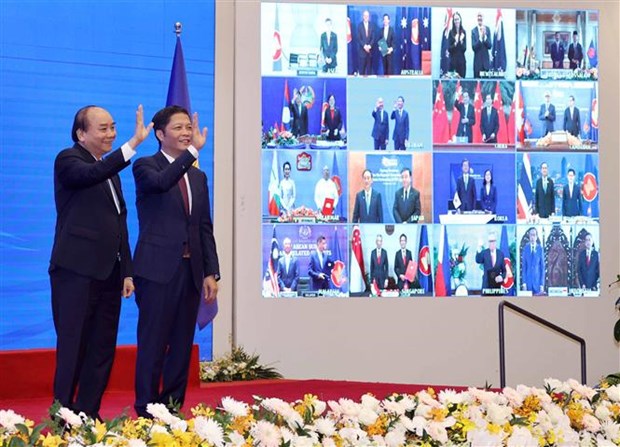 Vietnamese Prime Minister Nguyen Xuan Phuc (L) and Minister of Industry and Trade Tran Tuan Anh wave at other countries' delegates at the signing ceremony for the RCEP agreement (Photo: VNA)
Seoul (VNA) - Signatories of the Regional Comprehensive Economic Partnership (RCEP) Agreement affirmed its significance to each country’s economy and regional trade-investment activities following the signing of the pact on November 15.
The Republic of Korea (RoK)’s Cheong Wa Dae described the RCEP signing as a "core result" of President Moon Jae-in administration's New Southern Policy aimed at improving strategic ties with Southeast Asian nations and also an opportunity for the RoK to become a "pacesetting" economic power.
The same day, addressing the virtual 4th RCEP Summit hosted by Vietnam, Chinese Premier Li Keqiang said that the inking of the RCEP is not only a breakthrough achievement in East Asia cooperation, but also a victory of multilateralism and free trade.
Dr Jeffrey Wilson, a Research Director at the Perth USAsia Centre in Australia, noted that the RCEP will be the most important regional trade agreement ever signed and projected to change the region’s economic and strategic maps.
Meanwhile, Malaysian Prime Minister Muhyiddin Yassin was quoted by the Malaysian News Agency (Bernama) as saying that the RCEP will serve as an important instrument for economic recovery, and will encourage the reopening of markets while ensuring uninterrupted supply chains.
Addressing the 4th RCEP Summit, Muhyiddin said the RCEP agreement is critical for the region’s response in tackling the COVID-19 pandemic, which has not only cost lives but has also battered economies.
Coupled with the challenges to the global trading system due to regional tensions, it is imperative for ASEAN to continue to sustain competitiveness as a region, the PM stressed.
According to the Malaysian leader, Free Trade Agreements (FTAs) are the way forward to help sustain competitiveness through promotion of international trade, encouraging investments and ensuring supply of talent.
As such, the RCEP will be the main vehicle through which regional economic integration within ASEAN and its dialogue partners can be enhanced.
The PM went on to say that it is indeed significant that this partnership has been negotiated based on the different levels of economic development of the 15 participating countries, to ensure a mutually beneficial FTA for all.
He is of the view that this is the touchstone for the future growth and vibrancy of the regional economic collaboration.
Malaysia, together with ASEAN and FTA partners, would want to demonstrate to the world that even with varying levels of economic development, 15 countries can come together to create a trade pact that will be mutually beneficial, not only for the business community, but also for the people’s livelihood, the PM noted.
On another note, Muhyiddin said Malaysia recognises the difficulties India is currently facing, and wishes to express its continuous support and welcome India’s accession to the RCEP in the future.
The RCEP involves 10 members of the Association of Southeast Asian Nations (ASEAN) as well as the RoK, China, Japan, Australia and New Zealand, and their combined gross domestic product accounts for a third of the world's total./.



You should also see
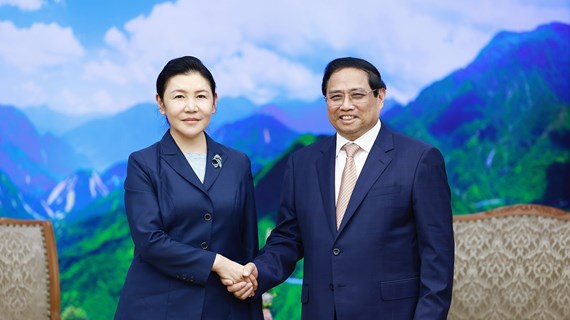
PM urges stronger cooperation between Vietnamese, Chinese Ministries of Justice
Prime Minister Pham Minh Chinh has requested the Ministries of Justice of Vietnam and China to foster cooperation and mutual support, making them to be on a par with the height of the bilateral relations.

See more
 World
World
Indonesia develops sustainable tourism
Indonesia has been working to realise its goal of building a quality, sustainable and environmentally friendly tourism industry.
 World
World
Vietnam to have many opportunities from digitalisation, green transformation: IMF
The International Monetary Fund (IMF) has forecasted that Vietnam will have many opportunities from digitalisation and green transformation, according to IMF Asia and Pacific Department Director Krishna Srinivasan.
 World
World
Thailand’s EV sales forecast to miss target
Electric vehicle (EV) sales in Thailand may fail to reach the estimate of 130,000 units this year as prices are likely to keep changing, according to Hyundai Mobility Thailand.
 World
World
Thailand, EU hope to sign FTA in mid-2025
Before the Songkran holiday, senior officials from Thailand and the European Union (EU) met in Bangkok to discuss ways to promote their relationship, including the framework of the Free Trade Agreement (FTA), green transformation, and Schengen visa waiver, Thai media has reported.
 World
World
India’s trade deficit with ASEAN widens
India's trade deficit with the Association of Southeast Asian Nations (ASEAN) has more than doubled since the implementation of the ASEAN-India Trade in Goods Agreement (AITIGA) in 2010.
