Stilt houses help cope with climate change

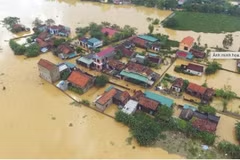
Residents are building stilt houses to adapt to rising sea levels in Ngoc Hien district, the southern most Ca Mau province.

Chairman of the district People's Committee Nguyen Truong Giang saidthe province is below sea level and its 254km coastline and 800km ofriver and canals are the most threatened by climate change in thecountry.

"In the last five years, the sea level has risenhigher and higher in this district, and only the old style houses withstilts are unaffected by the problem," Giang said.

Stilthouse suited the conditions and also the tight economics in Ngoc Hiendistrict where the rate of poor households ranked as one of the highestin the country, Giang said.

A stilt house cost 20-50million VND (1,000-2,500 USD) and stands on 1-1.5m piles made frommangrove timber. It helps people avoid the moisture of coastal saltwater, especially at high tide.

Tran Van Phung, in DatMui Village, said such houses cost less because timber from mangrovetrees is cheap and the homes do not have much furniture, such as beds,chairs and table.

The houses last about 10 years and can withstand 1m sea levels, said Phung.

In the last five years, Ngoc Hien has helped 1,200 poor householdsbuild the houses. Most offices, companies and residential houses werealso built on stilts.

However, Giang warned that stilthouses could only adapt to rises in sea level, not strong storms. Thedistrict bans people from building their houses near the sea andencourages those who have houses there to move to safer areas.

Along coastal rivers there are thousands of vulnerable households facing high tides regularly.

Along with stilt houses, Ngoc Hien district is asking for money to build sea dykes to mitigate further climate change.-VNA

See more

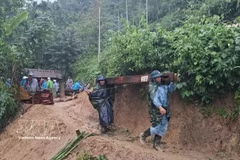
Authorities in Mang But commune, Quang Ngai province, assist residents whose homes have been affected by floods and landslides (Photo: VNA)

Heavy rain causes widespread damage across central Vietnam

According to the Vietnam Disaster and Dyke Management Authority under the Ministry of Agriculture and Environment, as of 5pm on November 11, the downpours injured two people in Hue city, and damaged or unroofed 38 houses in Quang Tri, Hue, Quang Ngai and Dak Lak.

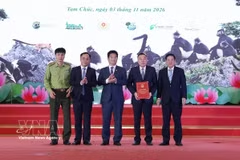
Representatives of the People’s Committee of Ninh Bình province present the decision to establish the Kim Bang Delacour's Langur Species and Habitat Conservation Area. (Photo: VNA)

Ninh Binh establishes world's largest Delacour's langur sanctuary

The establishment of the Kim Bang Delacour's Langur Species and Habitat Conservation Area in Ninh Binh province provides a solid legal and scientific foundation for completing the dossier to seek UNESCO recognition of the Van Long–Kim Bang–Tam Chuc Cultural and Ecological Landscape Complex as a World Heritage Site.

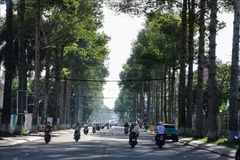
Trees planted along Vo Truong Toan street in Cao Lanh ward, Dong Thap province. Urban tree species capable of reducing fine particulate matter will be planted to reduce air pollution. (Photo: VNA)

Urban trees capable of reducing fine dust to be planted

The Forestry and Forest Protection Department (FFPD) will lead the component on identifying crop and planting structures that help reduce air pollution, while also participating in the design of urban public-space landscapes.

Professor Yucheng Lin, an Assistant Professor at City University of Hong Kong (CityUHK). (Photo: VNA)

Hong Kong expert offers solutions to help Vietnam tackle sea-level rise

In an interview with the Vietnam News Agency’s correspondents in Hong Kong (China), Lin, an expert specialising in sea-level change and climate risk assessment, said Vietnam shared global drivers of sea-level rise with China’s coastal regions, but local conditions could lead to significant differences in the overall risks.

Typhoon Yagi caused severe losses in many provinces in Vietnam in 2024. (Photo: VNA)

Vietnam could face super typhoon like Yagi every seven years

If global average temperatures rise by two degrees Celsius, Vietnam could experience such a super typhoon once every 13 years on average. The frequency would increase to once every nine years under the three-degree warming scenario and once every seven years if temperatures rise by four degrees.

Six of the newly recorded species are of conservation significance, representing four orders and five families. (Photo published by VNA)

Dakrong Nature Reserve records 35 new bird species

Dakrong Nature Reserve in the central province of Quang Tri has recorded 35 bird species not previously documented, including several endangered and rare species listed on the International Union for Conservation of Nature (IUCN) Red List.

An overview of Soc Son waste-to-energy plant in the Nam Son Waste Treatment Complex, in Hanoi (Photo: VNA)

Hanoi targets collection and treatment of all industrial solid waste

Hanoi aims to ensure that all industrial solid waste from its hi-tech parks, industrial parks and industrial clusters is collected and treated in line with regulations under a new plan to strengthen waste management and tighten control on scrap collection, storage and recycling facilities across the capital.

UNICEF Representative in Vietnam Silvia Danailov (first, right) honours first winners of the teaching materials competition. (Photo: VNA)

Deputy minister urges early action on disaster risks

Rapidly shifting climate conditions and increasingly overlapping hazards mean disaster risk reduction can no longer stand alone; it must sit at the heart of sustainable development, tightly integrated with climate response, water security, social welfare and economic growth.

General Secretary of the Communist Party of Vietnam Central Committee and President To Lam speaks at the groundbreaking ceremony for a project to upgrade the Bac Hung Hai irrigation system. (Photo: VNA)

Hung Yen: Project to modernise Bac Hung Hai irrigation system launched

General Secretary of the Communist Party of Vietnam Central Committee and President To Lam stressed that the development of Bac Hung Hai must be integrated into broader efforts to ensure water security, protect the environment and promote sustainable development in the Red River Delta.