Sustainable transformation needed for Vietnam’s strategic pangasius sector

With continued policy support, technological innovation and close coordination among authorities, businesses and farmers, Vietnam’s pangasius industry is expected to make a strong and sustainable breakthrough during the 2026–2030 period, reinforcing its position as the world’s leading exporter of the fish.

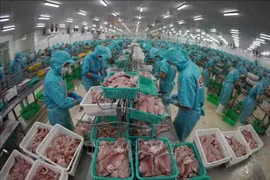
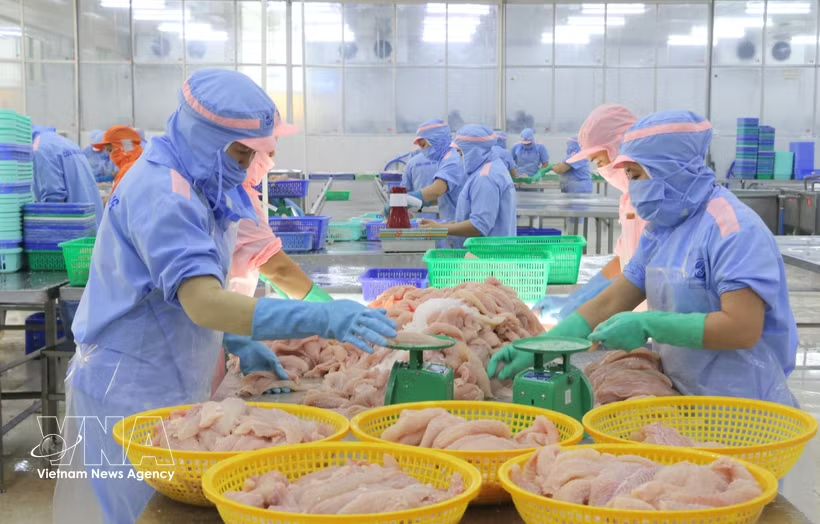
Workers process tra fish for exports. (Photo: VNA)

Hanoi (VNA) – Vietnam’s pangasius (tra fish) industry is enjoying one of its most favourable periods in recent years, with raw fish prices remaining at multi-year highs, generating substantial profits for farmers and providing fresh momentum for seafood processing and exports.

However, to secure sustainable growth amid intensifying competition and increasingly stringent technical barriers in export markets, the billion-dollar industry must address long-standing challenges related to breed quality and disease control.

Positive growth
In the current farming season, Nguyen Van Tuan, a pangasius farmer in An Huu commune of Dong Thap province, invested in a 3,000sq.m farming area. After selling more than 100 tonnes of commercial fish at 33,000 VND (1.25 USD) per kg, he has decided to reinvest in a new production cycle.

According to Tuan, this is the first time in many years that pangasius prices have remained stable at above 30,000 VND per kg for an extended period. With healthy profits after production costs, farmers are increasingly confident about staying in the business.

The strong performance is not limited to fish farming. Seafood processors and exporters have also benefited from rising demand in major markets, including China, the European Union (EU), ASEAN countries and the Middle East.

Nguyen Huu Nghia, Deputy General Director of Go Dang Joint Stock Company, said the company exported more than 15,000 tonnes of seafood products in the first four months of 2026. Pangasius fillets remained its flagship product, generating nearly 40 million USD in export revenue, up 25% year-on-year.

According to Deputy Secretary General of the Vietnam Association of Seafood Exporters and Producers (VASEP) Le Hang, pangasius exports exceeded 200 million USD in April, nearly 20% higher than the same period last year and marking another month of double-digit growth. During the first five months of 2026, total pangasius export turnover surpassed 900 million USD, reflecting strong growth momentum for one of Vietnam’s key export commodities.

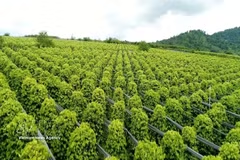
As one of the country’s strategic aquaculture products, pangasius not only contributes significantly to export earnings but also supports the livelihoods of tens of thousands of households. In 2025, the farming area expanded to more than 5,500 hectares nationwide, producing approximately 1.7 million tonnes and generating nearly 2.2 billion USD in export value.

Addressing issues of breed quality, diseases

Despite these achievements, the sector continues to face major challenges. Seed quality remains a critical issue, while disease outbreaks and climate-related risks have affected production efficiency.

Although the industry currently operates around 2,000 hectares of nursery facilities capable of supplying 4–4.5 billion fingerlings annually, localised shortages occurred during 2024–2025, pushing prices higher and disrupting production chains.

Experts attribute declining survival rates to climate change, erratic weather conditions and increasingly complex disease patterns. In some periods, survival rates of juvenile fish fell to just 5–15%, while high mortality was reported in fish younger than 30 days.

Tran Huu Phuc, Deputy Director of the Southern Freshwater Aquaculture Research Centre under the Vietnam Fisheries Science Institute, stressed the need to improve breeding through a combination of genetics, nursery technology and nutrition. He said traditional breeding methods should be integrated with gene technology to improve accuracy and maintain genetic gains, while hatchery management should be restructured with stricter environmental and biosecurity controls.

Meanwhile, Dong Thap province, which accounts for around 35% of the country’s pangasius output with some 2,500 hectares of farming ponds, is accelerating the restructuring of its industry through high technology. Local authorities are promoting improved broodstock, digital transformation, AI-assisted feeding systems and environmental management robots, while also researching salt-tolerant pangasius to expand farming areas.

With continued policy support, technological innovation and close coordination among authorities, businesses and farmers, Vietnam’s pangasius industry is expected to make a strong and sustainable breakthrough during the 2026–2030 period, reinforcing its position as the world’s leading exporter of the fish./.
VNA

See more

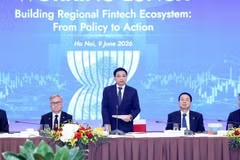
Deputy Prime Minister Nguyen Van Thang speaks at the event. (Photo: baochinhphu.vn)

Deputy PM calls for integrated ASEAN fintech ecosystem

Deputy PM Nguyen Van Thang proposed a shared vision for an ASEAN fintech ecosystem that is open, secure, transparent, inclusive, and sustainable: “Open” to foster connectivity, “Secure” to enable growth, “Transparent” to build trust, “Inclusive” to ensure that no one is left behind, and “Sustainable” to strengthen resilience and support long-term progress.

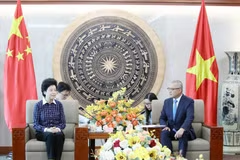
Vice Chairperson of the National Committee of the Chinese People's Political Consultative Conference (CPPCC) Xian Hui (left) meets with Secretary of Phu Tho provincial Party Commitee Pham Dai Duong on comprehensive cooperation (Photo: VNA)

Phu Tho expands cooperation with Chinese localities

A high-level delegation of the National Committee of the Chinese People's Political Consultative Conference (CPPCC), led by its Vice Chairperson Xian Hui, visited the production facility of BYD Vietnam Co., Ltd. at Phu Ha Industrial Park and held a working session with leaders of Phu Tho province on June 9.

Financial buildings in downtown Ho Chi Minh City along the Saigon River. (Photo: VNA)

Robust dispute resolution framework key to Vietnam’s IFC ambitions

The development strategy for VIFC-HCMC envisions a comprehensive financial ecosystem encompassing green finance, carbon credits, financial technology (fintech), blockchain technology, digital assets, digital banking and other innovative business models. These highly internationalised sectors involve complex cross-border transactions and sophisticated legal structures.

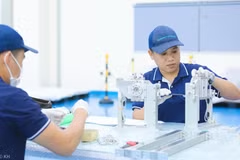
A step in the semiconductor chip manufacturing process. (Photo: VNA)

LG to build first semiconductor substrate plant in Vietnam

LG Innotek, an affiliate of the Republic of Korea's LG Group, has announced a plan to build its first semiconductor substrate plant in Vietnam, marking a significant step in expanding its production capacity and strengthening its semiconductor packaging solutions business.

Minister of Industry and Trade Le Manh Hung, President and Chief Executive Officer of Murphy Oil Eric M. Hambly, and delegates at their meeting on June 8 in Hanoi. (Photo: moit.gov.vn)

Murphy Oil urged to expand investment in Vietnam

Murphy Oil has operated in Vietnam since 2012 and currently participates in and operates many important oil and gas contracts at projects such as Lac Da Vang and Hai Su Vang, which are expected to contribute additional oil and gas supplies, strengthen energy security and support Vietnam’s economic development.

Deputy Prime Minister Nguyen Van Thang (R) receives Krishna Srinivasan, Director of the Asia and Pacific Department at the International Monetary Fund (IMF), in Hanoi on June 8. (Photo: VNA)

Deputy PM receives IMF Asia-Pacific Director

Director of the Asia and Pacific Department at the International Monetary Fund (IMF) Krisha Srinivasan affirmed that the IMF will continue to accompany and support Vietnam in the development of its financial sector, thereby helping to strengthen resilience and promote sustainable growth in the years ahead.

An article on Vietnam's e-commerce boom on Le Monde (Photo: VNA)

Digital economy fuels new growth momentum in Vietnam: French daily

French daily Le Monde recently reported that Vietnam’s e-commerce revenue approached 26 billion EUR (29.6 billion USD) in 2025, jumping 25% from a year earlier on the heels of a 20% gain in 2024. The sector now commands roughly 11% of total retail sales, cementing Vietnam’s status as one of Southeast Asia’s most dynamic markets.

Vietnam Airlines Group offers nearly 2.2 million discounted domestic seats from now until August 16 to meet peak summer travel demand. (Photo: VNA)

Vietnam Airlines Group offers nearly 2.2 million discounted domestic seats

Vietnam Airlines Group, comprising Vietnam Airlines, Pacific Airlines and Vietnam Air Services Company (VASCO), will provide nearly 5.5 million seats on domestic routes from now until August 16 to meet peak summer travel demand, including around 2.2 million seats offered at promotional fares on various routes.

A pepper farm in Gia Lai province (Photo: VNA)

Vietnam’s pepper exports jump 21.7% in volume in five months

May shipments, however, totaled 25,180 tonnes worth 166.2 million USD, down 18.9% by volume and 13.9% by value from April, and 4.8% lower in volume from a year earlier. Major exporters reported declining shipments, underscoring a sector-wide pullback.

Representatives of Vietrade and TFO Canada discuss a new cooperation project for 2026–2030. (Photo: VNA)

Vietnam, TFO Canada move towards strategic trade partnership

Director General of Vietrade Vu Ba Phu said the success of cooperation during 2021–2024 had laid a solid foundation for elevating bilateral ties in the new phase, with Vietrade now serving as TFO Canada’s strategic partner in Vietnam.