Under the agreement, HCM City and Nasdaq will cooperate in five key areas - capacity building and market governance, cross-listing, sharing experience in legal frameworks and operational mechanisms, fintech transfer, and high-quality human resource training.
The KRX system is currently in its final testing phase before full implementation. During this period, securities firms are conducting simulated trading sessions as if on a normal trading day.
The Ho Chi Minh Stock Exchange (HoSE) on January 4 announced that as of December 29, 2023, there had been 42 enterprises with capitalisation of over 1 billion USD listed on the HoSE.
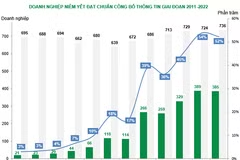
Some 385 listed companies on the Hanoi and Ho Chi Minh stock exchanges, or 52 percent, have met all information disclosure requirements, according to a survey conducted by the 2022 IR Awards programme.
The Ho Chi Minh Stock Exchange (HOSE) will mobilise all resources to implement important tasks this year, focussing on putting the trading system provided by the Korean Exchange (KRX) into operation.
Even though economic growth is expected to strongly recover this year as the pandemic has been contained, companies in many sectors have still lowered their profit targets.
The Ho Chi Minh Stock Exchange (HoSE) on March 9 joined stock exchanges around the world in a global initiative called “Ring the Bell for Gender Equality” - a partnership that highlights the economic imperative of empowering women in the workplace, marketplace, and community.
Public companies may receive a penalty of 2-3 billion VND (87,120-130,700 USD) for falsifying share listing and trading documents under a proposal from the Ministry of Finance.
The Ho Chi Minh City Securities Center (the forerunner of the Ho Chi Minh City Stock Exchange, or HoSE) held its first trading session in July 2000, marking the birth of Vietnam’s securities market. Two decades later, the market has affirmed its role as an effective capital mobilising channel for the economy, contributing significantly to the equitisation of State-owned enterprises (SOEs) and aimi
After having declined for four straight weeks, the Vietnamese market may rebound in December as analysts and securities companies expect that cheaper shares will attract hungry investors amid the world’s volatility.
Vietnamese banks are seeking to raise capital in international bond markets as they face growing pressure to hike capital to satisfy the central bank's regulations on minimum capital requirements and Basel II standards by early next year.
The liquidity on the derivatives market has shown signs of improvement and stabilising in the past two weeks, beating previous projection that the new trading fees may discourage them from derivative trading.
Prime Minister Nguyen Xuan Phuc asked accountability to be enhanced in the restructuring and divestment of State-owned enterprises (SOEs) to improve the efficiency of the process.
Vietnamese shares plummeted as investor confidence was dampened by worries over the increasing pace of the US central bank’s interest rate hike this year.
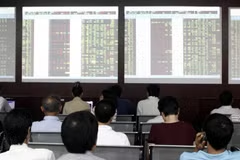
Vietnam’s benchmark VN Index has extended its growth for a fourth straight week, though recent market trading conditions suggest the benchmark index could struggle with rising selling pressures this week.
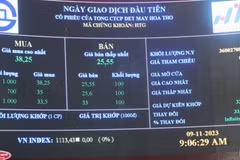
Vietnam's benchmark VN Index increased for a fourth straight session on December 27 on investor confidence in both the corporate sector and the country’s overall economy in the fourth quarter.